Удобнее читать в приложении
AI-разбор доступен после входа
Суть книги, пересказ, главный конфликт, ключевые идеи, вывод, кому полезна, главные темы, персонажи и цитаты можно получить после входа в BookRa.
auto_awesomeПолучить AI-разборО книге
Дата написания1970-01-01
Язык книгиen
Возрастное ограничение0+
Читать онлайн
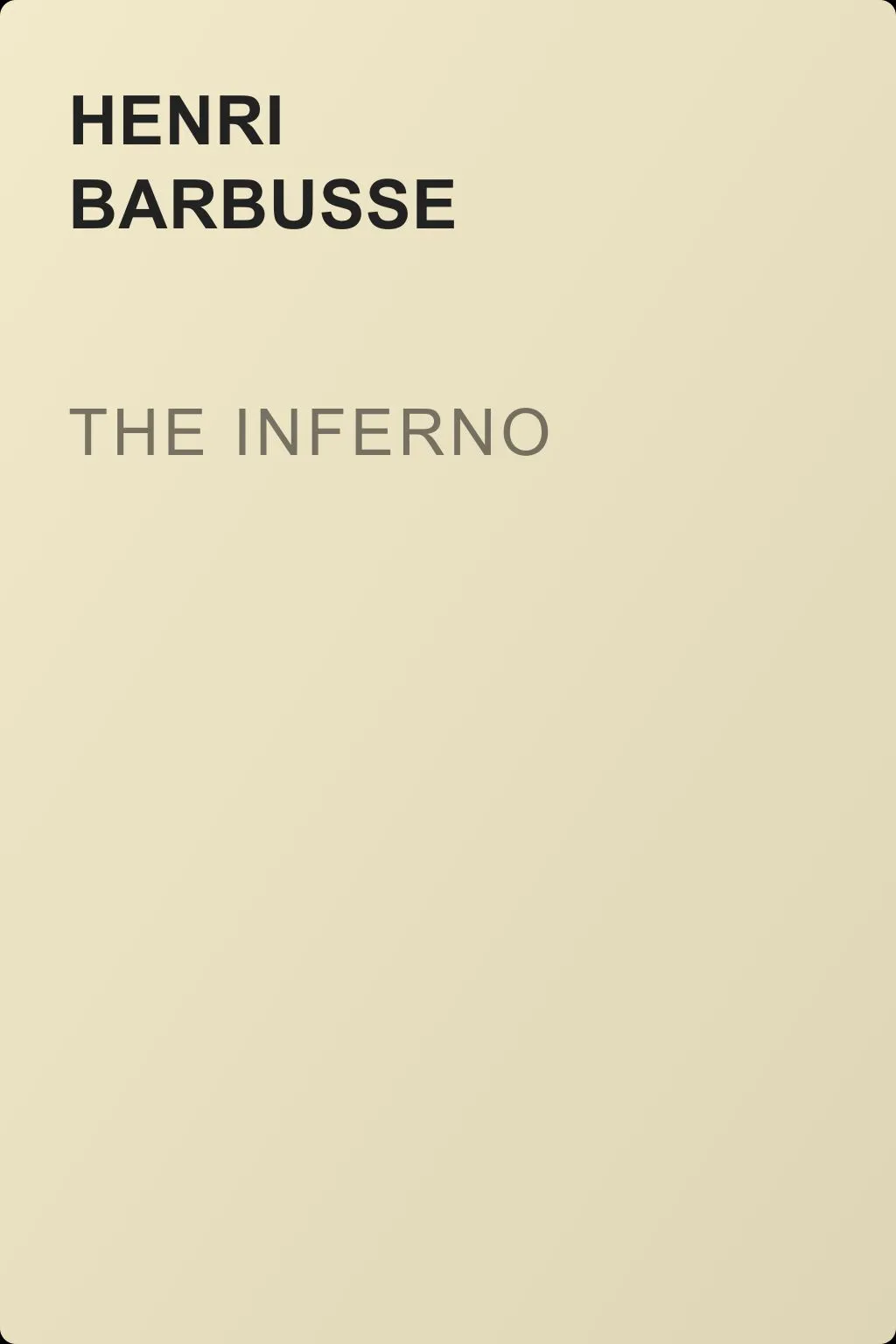
Страница 1 из 38Henri Barbusse The Inferno
INTRODUCTION
In introducing M. Barbusse's most important book to a public already familiar with "Under Fire," it seems well to point out the relation of the author's philosophy to his own time, and the kinship of his art to that of certain other contemporary French and English novelists.
"L'Enfer" has been more widely read and discussed in France than any other realistic study since the days of Zola. The French sales of the volume, in 1917 alone, exceeded a hundred thousand copies, a popularity all the more remarkable from the fact that its appeal is based as much on its philosophical substance as on the story which it tells.
Although M. Barbusse is one of the most distinguished contemporary French writers of short stories, he has found in the novel form the most fitting literary medium for the expression of his philosophy, and it is to realism rather than romanticism that he turns for the exposition of his special imaginative point of view. And yet this statement seems to need some qualification. In his introduction to "Pointed Roofs," by Dorothy Richardson, Mr. J.D. Beresford points out that a new objective literary method is becoming general in which the writer's strict detachment from his objective subject matter is united to a tendency, impersonal, to be sure, to immerse himself in the life surrounding his characters. Miss May Sinclair points out that writers are beginning to take the complete plunge for the first time, and instances as examples, not only the novels of Dorothy Richardson, but those of James Joyce.
Now it is perfectly true that Miss Richardson and Mr. Joyce have introduced this method into English fiction, and that Mr. Frank Swinnerton has carried the method a step further in another direction, but before these writers there was a precedent in France for this method, of which perhaps the two chief exemplars were Jules Romains and Henri Barbusse. Although the two writers have little else in common, both are intensely conscious of the tremendous, if imponderable, impact of elemental and universal forces upon personality, of the profound modifications which natural and social environment unconsciously impress upon the individual life, and of the continual interaction of forces by which the course of life is changed more fundamentally than by less imperceptible influences. Both M. Romains and M. Barbusse perceive, as the fundamental factor influencing human life, the contraction and expansion of physical and spiritual relationship, the inevitable ebb and flow perceived by the poet who pointed out that we cannot touch a flower without troubling of a star.
M. Romains has found his literary medium in what he calls unanimism. While M. Barbusse would not claim to belong to the same school, and in fact would appear on the surface to be at the opposite pole of life in his philosophy, we shall find that his detachment, founded, though it is, upon solitude, takes essentially the same account of outside forces as the philosophy of M. Romains.
He perceives that each man is an island of illimitable forces apart from his fellows, passionately eager to live his own life to the last degree of self-fulfilment, but continually thwarted by nature and by other men and women, until death interposes and sets the seal of oblivion upon all that he has dreamed and sought.
And he has set himself the task of disengaging, as far as possible, the purpose and hope of human life, of endeavouring to discover what promise exists for the future and how this promise can be related to the present, of marking the relationship between eternity and time, and discovering, through the tragedies of birth, love, marriage, illness and death, the ultimate possibility of human development and fulfilment.
"The Inferno" is therefore a tragic book. But I think that the attentive reader will find that the destructive criticism of M. Barbusse, in so far as it is possible for him to agree with it, only clears away the dead undergrowth which obscures the author's passionate hope and belief in the future.
Although the action of this story is spiritual as well as physical, and occupies less than a month of time, it is focussed intensely upon reality. Everything that the author permits us to see and understand is seen through a single point of life—a hole pierced in the wall between two rooms of a grey Paris boarding house. The time is most often twilight, with its romantic penumbra, darkening into the obscurity of night by imperceptible degrees.
M. Barbusse has conceived the idea of making a man perceive the whole spiritual tragedy of life through a cranny in the wall, and there is a fine symbolism in this, as if he were vouchsafing us the opportunity to perceive eternal things through the tiny crack which is all that is revealed to us of infinity, so that the gates of Horn, darkened by our human blindness, scarcely swing open before they close again.
The hero of this story has been dazzled by the flaming ramparts of the world, so that eternity is only revealed to him in fiery glimpses that shrivel him, and he is left in the dark void of time, clinging to a dream which already begins to fail him.
And the significant thing about this book is that the final revelation comes to him through the human voices of those who have suffered much, because they have loved much, after his own daring intellectual flights have failed him.
So this man who has confronted the greatest realities of life, enabled to view them with the same objective detachment with which God sees them, though without the divine knowledge which transmutes their darkness, comes to learn that we carry all heaven and hell within ourselves, and with a relentless insight, almost Lucretian in its desperate intensity, he cries: "We are divinely alone, the heavens have fallen on our heads." And he adds: "Here they will pass again, day after day, year after year, all the prisoners of rooms will pass in their kind of eternity. In the twilight when everything fades, they will sit down near the light, in the room full of haloes; they will drag themselves to the window's void. Their mouths will join and they will grow tender. They will exchange a first or a last useless glance. They will open their arms, they will caress each other. They will love life and be afraid to disappear….
"I have heard the annunciation of whatever finer things are to come. Through me has passed, without staying me in my course, the Word which does not lie, and which said over again, will satisfy."
Truly a great and pitiless book, but there is a cleansing wind running through it, which sweeps away life's illusions, and leaves a new hope for the future in our hearts.
Вам также может понравиться
{"page":{"canonicalUrl":"https://bookra.app/books/1srRozWO","pageTitle":"The Inferno (Henri Barbusse) — полный текст, краткое содержание, анализ и герои","metaDescription":"Полный текст книги «The Inferno». А также краткое содержание, главные мысли, конфликт, темы, персонажи, цитаты и ответы на вопросы.","headingTitle":"«The Inferno». Читать бесплатно онлайн","headingSubtitle":"Henri Barbusse, Edward O'Brien","structuredData":[{"@context":"https://schema.org","@type":"BreadcrumbList","@id":"https://bookra.app/books/1srRozWO#breadcrumb","itemListElement":[{"@type":"ListItem","position":1,"name":"BookRa","item":"https://bookra.app/"},{"@type":"ListItem","position":2,"name":"зарубежная классика","item":"https://bookra.app/genre/5214"},{"@type":"ListItem","position":3,"name":"The Inferno","item":"https://bookra.app/books/1srRozWO"}]},{"@context":"https://schema.org","@type":"WebPage","@id":"https://bookra.app/books/1srRozWO","url":"https://bookra.app/books/1srRozWO","name":"«The Inferno». Читать бесплатно онлайн","description":"Полный текст книги «The Inferno». А также краткое содержание, главные мысли, конфликт, темы, персонажи, цитаты и ответы на вопросы.","breadcrumb":{"@id":"https://bookra.app/books/1srRozWO#breadcrumb"},"mainEntity":{"@id":"https://bookra.app/books/1srRozWO#work"},"primaryImageOfPage":{"@type":"ImageObject","url":"https://storage.yandexcloud.net/bookra-catalog-pd-public/content/fb2c05ec-a43a-11e8-aa6b-0cc47a520474/thumbs/1200.webp"}},{"@context":"https://schema.org","@type":"Book","@id":"https://bookra.app/books/1srRozWO#work","name":"The Inferno","url":"https://bookra.app/books/1srRozWO","description":"Полный текст книги «The Inferno». А также краткое содержание, главные мысли, конфликт, темы, персонажи, цитаты и ответы на вопросы.","image":"https://storage.yandexcloud.net/bookra-catalog-pd-public/content/fb2c05ec-a43a-11e8-aa6b-0cc47a520474/thumbs/1200.webp","inLanguage":"en","genre":["зарубежная классика","зарубежная старинная литература","зарубежные любовные романы","классические любовные романы"],"sameAs":["https://litres.ru/book/raznoe-9941622/the-inferno-36365294/"],"author":[{"@type":"Person","@id":"https://bookra.app/author/ee38e763-7eb5-11e6-aa0e-0cc47a5454c6#person","name":"Henri Barbusse","url":"https://bookra.app/author/ee38e763-7eb5-11e6-aa0e-0cc47a5454c6"}],"about":[{"@type":"Thing","name":"зарубежная классика"},{"@type":"Thing","name":"зарубежная старинная литература"},{"@type":"Thing","name":"зарубежные любовные романы"},{"@type":"Thing","name":"классические любовные романы"},{"@type":"Thing","name":"чтение онлайн"},{"@type":"Thing","name":"саммари"},{"@type":"Thing","name":"AI-разбор"},{"@type":"Thing","name":"персонажи"},{"@type":"Thing","name":"цитаты"}],"workExample":{"@type":"Book","@id":"https://bookra.app/books/1srRozWO#edition","url":"https://bookra.app/books/1srRozWO","bookFormat":"https://schema.org/EBook","inLanguage":"en","sameAs":["https://litres.ru/book/raznoe-9941622/the-inferno-36365294/"],"isAccessibleForFree":true,"potentialAction":{"@type":"ReadAction","name":"Читать бесплатно онлайн «The Inferno»","target":{"@type":"EntryPoint","urlTemplate":"https://bookra.app/books/1srRozWO","actionPlatform":["https://schema.org/DesktopWebPlatform"]},"expectsAcceptanceOf":{"@type":"Offer","category":"nologinrequired"}}}}],"book":{"idCatalog":766362,"shortId":"1srRozWO","title":"The Inferno","coverUrl":"https://storage.yandexcloud.net/bookra-catalog-pd-public/content/fb2c05ec-a43a-11e8-aa6b-0cc47a520474/thumbs/1200.webp","annotationText":"","catalogType":"PUBLIC_DOMAIN","catalogTypeLabel":"Общественное достояние","authorLine":"Henri Barbusse, Edward O'Brien","authors":[{"id":"ee38e763-7eb5-11e6-aa0e-0cc47a5454c6","displayName":"Henri Barbusse","protectedUrl":"/author/ee38e763-7eb5-11e6-aa0e-0cc47a5454c6","wikipediaUrl":null,"wikidataUrl":null},{"id":"51adf78f-ea98-11e0-9959-47117d41cf4b","displayName":"Edward O'Brien","protectedUrl":"/author/51adf78f-ea98-11e0-9959-47117d41cf4b","wikipediaUrl":null,"wikidataUrl":null}],"genres":[{"id":5214,"title":"зарубежная классика","token":null,"publicUrl":"https://bookra.app/genre/5214"},{"id":5215,"title":"зарубежная старинная литература","token":null,"publicUrl":"https://bookra.app/genre/5215"},{"id":5091,"title":"зарубежные любовные романы","token":null,"publicUrl":"https://bookra.app/genre/5091"},{"id":201687,"title":"классические любовные романы","token":null,"publicUrl":"https://bookra.app/genre/201687"}],"keywords":[],"facts":[{"key":"dateWritten","label":"Дата написания","value":"1970-01-01"},{"key":"bookLanguage","label":"Язык книги","value":"en"},{"key":"adult","label":"Возрастное ограничение","value":"0+"}],"seoSections":[],"authorSummary":null,"hasArtifacts":false,"canReadInApp":true,"readUrl":"https://web.bookra.app/?startapp=r_766362","artifactsUrl":"https://web.bookra.app/?startapp=b_766362","readCtaLabel":"Читать бесплатно","artifactsCtaLabel":"AI-разбор","appReadLinks":{"tg":"https://t.me/bookra_lib_bot/BookRa?startapp=r_766362","vk":"https://vk.com/app54470698#startapp=r_766362","max":"https://max.ru/id7751370047_bot?startapp=r_766362","web":"https://web.bookra.app/?startapp=r_766362"},"appAnalysisLinks":{"tg":"https://t.me/bookra_lib_bot/BookRa?startapp=b_766362","vk":"https://vk.com/app54470698#startapp=b_766362","max":"https://max.ru/id7751370047_bot?startapp=b_766362","web":"https://web.bookra.app/?startapp=b_766362"},"guestReaderUrl":"/books/1srRozWO#reader-content","authorCtaLabel":"Все книги автора","authorProtectedUrl":"/author/ee38e763-7eb5-11e6-aa0e-0cc47a5454c6","readersCount":0,"adultLabel":"0+","yearLabel":null,"datePublished":null,"publisherLabel":null,"isbn":null,"oclc":null,"lccn":null,"partnerUrl":null,"accessNote":"Полный текст книги и AI-разбор откроются на защищенных страницах BookRa после входа."},"reader":{"page":1,"totalPages":38,"hasPrev":false,"hasNext":true,"prevPageUrl":null,"nextPageUrl":"/books/1srRozWO?page=2#reader-content","progressLabel":"Страница 1 из 38","sections":[{"id":"content0:0","kind":"heading","text":"Henri Barbusse The Inferno"},{"id":"content0:1","kind":"heading","text":"INTRODUCTION"},{"id":"content0:2","kind":"paragraph","text":"In introducing M. Barbusse's most important book to a public already familiar with \"Under Fire,\" it seems well to point out the relation of the author's philosophy to his own time, and the kinship of his art to that of certain other contemporary French and English novelists."},{"id":"content0:3","kind":"paragraph","text":"\"L'Enfer\" has been more widely read and discussed in France than any other realistic study since the days of Zola. The French sales of the volume, in 1917 alone, exceeded a hundred thousand copies, a popularity all the more remarkable from the fact that its appeal is based as much on its philosophical substance as on the story which it tells."},{"id":"content0:4","kind":"paragraph","text":"Although M. Barbusse is one of the most distinguished contemporary French writers of short stories, he has found in the novel form the most fitting literary medium for the expression of his philosophy, and it is to realism rather than romanticism that he turns for the exposition of his special imaginative point of view. And yet this statement seems to need some qualification. In his introduction to \"Pointed Roofs,\" by Dorothy Richardson, Mr. J.D. Beresford points out that a new objective literary method is becoming general in which the writer's strict detachment from his objective subject matter is united to a tendency, impersonal, to be sure, to immerse himself in the life surrounding his characters. Miss May Sinclair points out that writers are beginning to take the complete plunge for the first time, and instances as examples, not only the novels of Dorothy Richardson, but those of James Joyce."},{"id":"content0:5","kind":"paragraph","text":"Now it is perfectly true that Miss Richardson and Mr. Joyce have introduced this method into English fiction, and that Mr. Frank Swinnerton has carried the method a step further in another direction, but before these writers there was a precedent in France for this method, of which perhaps the two chief exemplars were Jules Romains and Henri Barbusse. Although the two writers have little else in common, both are intensely conscious of the tremendous, if imponderable, impact of elemental and universal forces upon personality, of the profound modifications which natural and social environment unconsciously impress upon the individual life, and of the continual interaction of forces by which the course of life is changed more fundamentally than by less imperceptible influences. Both M. Romains and M. Barbusse perceive, as the fundamental factor influencing human life, the contraction and expansion of physical and spiritual relationship, the inevitable ebb and flow perceived by the poet who pointed out that we cannot touch a flower without troubling of a star."},{"id":"content0:6","kind":"paragraph","text":"M. Romains has found his literary medium in what he calls unanimism. While M. Barbusse would not claim to belong to the same school, and in fact would appear on the surface to be at the opposite pole of life in his philosophy, we shall find that his detachment, founded, though it is, upon solitude, takes essentially the same account of outside forces as the philosophy of M. Romains."},{"id":"content0:7","kind":"paragraph","text":"He perceives that each man is an island of illimitable forces apart from his fellows, passionately eager to live his own life to the last degree of self-fulfilment, but continually thwarted by nature and by other men and women, until death interposes and sets the seal of oblivion upon all that he has dreamed and sought."},{"id":"content0:8","kind":"paragraph","text":"And he has set himself the task of disengaging, as far as possible, the purpose and hope of human life, of endeavouring to discover what promise exists for the future and how this promise can be related to the present, of marking the relationship between eternity and time, and discovering, through the tragedies of birth, love, marriage, illness and death, the ultimate possibility of human development and fulfilment."},{"id":"content0:9","kind":"paragraph","text":"\"The Inferno\" is therefore a tragic book. But I think that the attentive reader will find that the destructive criticism of M. Barbusse, in so far as it is possible for him to agree with it, only clears away the dead undergrowth which obscures the author's passionate hope and belief in the future."},{"id":"content0:10","kind":"paragraph","text":"Although the action of this story is spiritual as well as physical, and occupies less than a month of time, it is focussed intensely upon reality. Everything that the author permits us to see and understand is seen through a single point of life—a hole pierced in the wall between two rooms of a grey Paris boarding house. The time is most often twilight, with its romantic penumbra, darkening into the obscurity of night by imperceptible degrees."},{"id":"content0:11","kind":"paragraph","text":"M. Barbusse has conceived the idea of making a man perceive the whole spiritual tragedy of life through a cranny in the wall, and there is a fine symbolism in this, as if he were vouchsafing us the opportunity to perceive eternal things through the tiny crack which is all that is revealed to us of infinity, so that the gates of Horn, darkened by our human blindness, scarcely swing open before they close again."},{"id":"content0:12","kind":"paragraph","text":"The hero of this story has been dazzled by the flaming ramparts of the world, so that eternity is only revealed to him in fiery glimpses that shrivel him, and he is left in the dark void of time, clinging to a dream which already begins to fail him."},{"id":"content0:13","kind":"paragraph","text":"And the significant thing about this book is that the final revelation comes to him through the human voices of those who have suffered much, because they have loved much, after his own daring intellectual flights have failed him."},{"id":"content0:14","kind":"paragraph","text":"So this man who has confronted the greatest realities of life, enabled to view them with the same objective detachment with which God sees them, though without the divine knowledge which transmutes their darkness, comes to learn that we carry all heaven and hell within ourselves, and with a relentless insight, almost Lucretian in its desperate intensity, he cries: \"We are divinely alone, the heavens have fallen on our heads.\" And he adds: \"Here they will pass again, day after day, year after year, all the prisoners of rooms will pass in their kind of eternity. In the twilight when everything fades, they will sit down near the light, in the room full of haloes; they will drag themselves to the window's void. Their mouths will join and they will grow tender. They will exchange a first or a last useless glance. They will open their arms, they will caress each other. They will love life and be afraid to disappear…."},{"id":"content0:15","kind":"paragraph","text":"\"I have heard the annunciation of whatever finer things are to come. Through me has passed, without staying me in my course, the Word which does not lie, and which said over again, will satisfy.\""},{"id":"content0:16","kind":"paragraph","text":"Truly a great and pitiless book, but there is a cleansing wind running through it, which sweeps away life's illusions, and leaves a new hope for the future in our hearts."},{"id":"content0:17","kind":"paragraph","text":"EDWARD J. O'BRIEN."},{"id":"content0:18","kind":"paragraph","text":"BASS RIVER, MASS.,"},{"id":"content0:19","kind":"paragraph","text":"July, 10, 1918."}],"toc":[{"id":"content0:0:1","label":"Henri Barbusse The Inferno","page":1,"pageUrl":"/books/1srRozWO#reader-content"},{"id":"content0:1:1","label":"INTRODUCTION","page":1,"pageUrl":"/books/1srRozWO#reader-content"},{"id":"content0:20:2","label":"CHAPTER I","page":2,"pageUrl":"/books/1srRozWO?page=2#reader-content"},{"id":"content0:28:2","label":". . . .","page":2,"pageUrl":"/books/1srRozWO?page=2#reader-content"},{"id":"content0:56:3","label":". . . .","page":3,"pageUrl":"/books/1srRozWO?page=3#reader-content"},{"id":"content1:0:3","label":"CHAPTER II","page":3,"pageUrl":"/books/1srRozWO?page=3#reader-content"},{"id":"content1:7:4","label":". . . .","page":4,"pageUrl":"/books/1srRozWO?page=4#reader-content"},{"id":"content1:38:5","label":". . . .","page":5,"pageUrl":"/books/1srRozWO?page=5#reader-content"},{"id":"content2:0:6","label":"CHAPTER III","page":6,"pageUrl":"/books/1srRozWO?page=6#reader-content"},{"id":"content2:6:6","label":". . . .","page":6,"pageUrl":"/books/1srRozWO?page=6#reader-content"},{"id":"content2:22:7","label":"CHAPTER IV","page":7,"pageUrl":"/books/1srRozWO?page=7#reader-content"},{"id":"content2:26:7","label":". . . .","page":7,"pageUrl":"/books/1srRozWO?page=7#reader-content"},{"id":"content2:62:8","label":". . . .","page":8,"pageUrl":"/books/1srRozWO?page=8#reader-content"},{"id":"content2:108:9","label":". . . .","page":9,"pageUrl":"/books/1srRozWO?page=9#reader-content"},{"id":"content3:0:9","label":"CHAPTER V","page":9,"pageUrl":"/books/1srRozWO?page=9#reader-content"},{"id":"content3:31:10","label":". . . .","page":10,"pageUrl":"/books/1srRozWO?page=10#reader-content"},{"id":"content3:77:11","label":". . . .","page":11,"pageUrl":"/books/1srRozWO?page=11#reader-content"},{"id":"content3:109:12","label":". . . .","page":12,"pageUrl":"/books/1srRozWO?page=12#reader-content"},{"id":"content3:133:12","label":"* * * * * * * * *","page":12,"pageUrl":"/books/1srRozWO?page=12#reader-content"},{"id":"content4:0:13","label":"CHAPTER VI","page":13,"pageUrl":"/books/1srRozWO?page=13#reader-content"},{"id":"content4:14:13","label":". . . .","page":13,"pageUrl":"/books/1srRozWO?page=13#reader-content"},{"id":"content4:39:14","label":". . . .","page":14,"pageUrl":"/books/1srRozWO?page=14#reader-content"},{"id":"content5:0:15","label":"CHAPTER VII","page":15,"pageUrl":"/books/1srRozWO?page=15#reader-content"},{"id":"content5:11:15","label":". . . .","page":15,"pageUrl":"/books/1srRozWO?page=15#reader-content"},{"id":"content5:38:16","label":". . . .","page":16,"pageUrl":"/books/1srRozWO?page=16#reader-content"},{"id":"content5:42:16","label":"* * * * * * * * *","page":16,"pageUrl":"/books/1srRozWO?page=16#reader-content"},{"id":"content5:79:17","label":". . . .","page":17,"pageUrl":"/books/1srRozWO?page=17#reader-content"},{"id":"content5:109:18","label":". . . .","page":18,"pageUrl":"/books/1srRozWO?page=18#reader-content"},{"id":"content5:151:19","label":". . . .","page":19,"pageUrl":"/books/1srRozWO?page=19#reader-content"},{"id":"content6:0:19","label":"CHAPTER VIII","page":19,"pageUrl":"/books/1srRozWO?page=19#reader-content"},{"id":"content6:35:20","label":". . . .","page":20,"pageUrl":"/books/1srRozWO?page=20#reader-content"},{"id":"content6:84:21","label":". . . .","page":21,"pageUrl":"/books/1srRozWO?page=21#reader-content"},{"id":"content7:0:21","label":"CHAPTER IX","page":21,"pageUrl":"/books/1srRozWO?page=21#reader-content"},{"id":"content8:0:23","label":"CHAPTER X","page":23,"pageUrl":"/books/1srRozWO?page=23#reader-content"},{"id":"content8:23:24","label":". . . .","page":24,"pageUrl":"/books/1srRozWO?page=24#reader-content"},{"id":"content8:31:24","label":"CHAPTER XI","page":24,"pageUrl":"/books/1srRozWO?page=24#reader-content"},{"id":"content8:46:25","label":". . . .","page":25,"pageUrl":"/books/1srRozWO?page=25#reader-content"},{"id":"content8:85:26","label":". . . .","page":26,"pageUrl":"/books/1srRozWO?page=26#reader-content"},{"id":"content9:0:26","label":"CHAPTER XII","page":26,"pageUrl":"/books/1srRozWO?page=26#reader-content"},{"id":"content9:114:27","label":". . . .","page":27,"pageUrl":"/books/1srRozWO?page=27#reader-content"},{"id":"content9:116:28","label":". . . .","page":28,"pageUrl":"/books/1srRozWO?page=28#reader-content"},{"id":"content10:0:28","label":"CHAPTER XIII","page":28,"pageUrl":"/books/1srRozWO?page=28#reader-content"},{"id":"content10:54:30","label":". . . .","page":30,"pageUrl":"/books/1srRozWO?page=30#reader-content"},{"id":"content10:79:31","label":". . . .","page":31,"pageUrl":"/books/1srRozWO?page=31#reader-content"},{"id":"content11:0:31","label":"CHAPTER XIV","page":31,"pageUrl":"/books/1srRozWO?page=31#reader-content"},{"id":"content11:8:32","label":". . . .","page":32,"pageUrl":"/books/1srRozWO?page=32#reader-content"},{"id":"content11:19:32","label":"CHAPTER XV","page":32,"pageUrl":"/books/1srRozWO?page=32#reader-content"},{"id":"content11:52:33","label":"* * * * * * * * *","page":33,"pageUrl":"/books/1srRozWO?page=33#reader-content"},{"id":"content11:60:33","label":". . . .","page":33,"pageUrl":"/books/1srRozWO?page=33#reader-content"},{"id":"content12:0:34","label":"CHAPTER XVI","page":34,"pageUrl":"/books/1srRozWO?page=34#reader-content"},{"id":"content12:12:35","label":". . . .","page":35,"pageUrl":"/books/1srRozWO?page=35#reader-content"},{"id":"content12:50:36","label":". . . .","page":36,"pageUrl":"/books/1srRozWO?page=36#reader-content"},{"id":"content12:72:37","label":". . . .","page":37,"pageUrl":"/books/1srRozWO?page=37#reader-content"},{"id":"content13:0:37","label":"CHAPTER XVII","page":37,"pageUrl":"/books/1srRozWO?page=37#reader-content"},{"id":"content13:18:38","label":". . . .","page":38,"pageUrl":"/books/1srRozWO?page=38#reader-content"},{"id":"content13:23:38","label":"THE END","page":38,"pageUrl":"/books/1srRozWO?page=38#reader-content"}]},"similarBooks":[{"idCatalog":761864,"shortId":"2IaCRroM","title":"La de Bringas","authorLine":"Бенито Перес Гальдос","primaryAuthorId":"43bce3d3-d535-102a-94d5-07de47c81719","coverUrl":"https://storage.yandexcloud.net/bookra-catalog-pd-public/content/317c9f95-993d-11e8-a002-0cc47a5f3f85/thumbs/400.webp","publicUrl":"https://bookra.app/books/2IaCRroM"},{"idCatalog":760318,"shortId":"4YEBM9ds","title":"Germaine","authorLine":"Edmond About","primaryAuthorId":"d4d69f23-2b43-11e7-b6fa-00259059d1c2","coverUrl":"https://storage.yandexcloud.net/bookra-catalog-pd-public/content/04942919-a43b-11e8-aa6b-0cc47a520474/thumbs/400.webp","publicUrl":"https://bookra.app/books/4YEBM9ds"},{"idCatalog":761043,"shortId":"3uT8xYHd","title":"L\u0026apos;olmo e l\u0026apos;edera","authorLine":"Anton Barrili","primaryAuthorId":"37fead29-321d-11e7-b81c-0cc47a1952f2","coverUrl":"https://storage.yandexcloud.net/bookra-catalog-pd-public/content/2133f510-a43b-11e8-aa6b-0cc47a520474/thumbs/400.webp","publicUrl":"https://bookra.app/books/3uT8xYHd"},{"idCatalog":765505,"shortId":"3UOUdiDT","title":"El origen del pensamiento","authorLine":"Armando Palacio Valdés","primaryAuthorId":"234e2aec-661d-11e6-9614-0cc47a545a1e","coverUrl":"https://storage.yandexcloud.net/bookra-catalog-pd-public/content/caa6403c-9eea-11e8-afe9-0cc47a5453d6/thumbs/400.webp","publicUrl":"https://bookra.app/books/3UOUdiDT"},{"idCatalog":765510,"shortId":"2m4hjFUq","title":"El maestrante","authorLine":"Armando Palacio Valdés","primaryAuthorId":"234e2aec-661d-11e6-9614-0cc47a545a1e","coverUrl":"https://storage.yandexcloud.net/bookra-catalog-pd-public/content/cad0869d-9eea-11e8-afe9-0cc47a5453d6/thumbs/400.webp","publicUrl":"https://bookra.app/books/2m4hjFUq"},{"idCatalog":765840,"shortId":"2LOVWhGA","title":"L\u0026apos;hérésiarque et Cie","authorLine":"Гийом Аполлинер","primaryAuthorId":"faa39b90-a53f-102b-b8f2-843476b21e7b","coverUrl":"https://storage.yandexcloud.net/bookra-catalog-pd-public/content/dbdc92c8-a43a-11e8-aa6b-0cc47a520474/thumbs/400.webp","publicUrl":"https://bookra.app/books/2LOVWhGA"},{"idCatalog":761266,"shortId":"4EYXI5Qm","title":"The Egoist: A Comedy in Narrative","authorLine":"George Meredith","primaryAuthorId":"21b074e8-ea99-11e0-9959-47117d41cf4b","coverUrl":"https://storage.yandexcloud.net/bookra-catalog-pd-public/content/29e82393-993d-11e8-a002-0cc47a5f3f85/thumbs/400.webp","publicUrl":"https://bookra.app/books/4EYXI5Qm"},{"idCatalog":761414,"shortId":"0ZGtFJg0","title":"Evelina, Or, the History of a Young Lady\u0026apos;s Entrance into the World","authorLine":"Fanny Burney","primaryAuthorId":"e9828ec7-a178-11e1-aac2-5924aae99221","coverUrl":"https://storage.yandexcloud.net/bookra-catalog-pd-public/content/2bbec9ae-993d-11e8-a002-0cc47a5f3f85/thumbs/400.webp","publicUrl":"https://bookra.app/books/0ZGtFJg0"},{"idCatalog":761576,"shortId":"2GqqMBwM","title":"The Czar\u0026apos;s Spy","authorLine":"William Le Queux","primaryAuthorId":"665cdb48-ff55-11e6-9c73-0cc47a1952f2","coverUrl":"https://storage.yandexcloud.net/bookra-catalog-pd-public/content/2e25d11f-993d-11e8-a002-0cc47a5f3f85/thumbs/400.webp","publicUrl":"https://bookra.app/books/2GqqMBwM"},{"idCatalog":761862,"shortId":"18QUKXy8","title":"La Fontana de Oro","authorLine":"Бенито Перес Гальдос","primaryAuthorId":"43bce3d3-d535-102a-94d5-07de47c81719","coverUrl":"https://storage.yandexcloud.net/bookra-catalog-pd-public/content/3174f471-993d-11e8-a002-0cc47a5f3f85/thumbs/400.webp","publicUrl":"https://bookra.app/books/18QUKXy8"},{"idCatalog":764351,"shortId":"1BOwpM8f","title":"Los cuatro jinetes del apocalipsis","authorLine":"Висенте Бласко-Ибаньес","primaryAuthorId":"92bdba0e-9f41-11e1-aac2-5924aae99221","coverUrl":"https://storage.yandexcloud.net/bookra-catalog-pd-public/content/af1b390d-a43a-11e8-aa6b-0cc47a520474/thumbs/400.webp","publicUrl":"https://bookra.app/books/1BOwpM8f"},{"idCatalog":765302,"shortId":"00g2rZHw","title":"The Choice of Life","authorLine":"Alexander Teixeira de Mattos, Georgette Leblanc","primaryAuthorId":"c91350d6-24e9-11e5-a6ec-0025905a06ea","coverUrl":"https://storage.yandexcloud.net/bookra-catalog-pd-public/content/c6c5a4b6-9eea-11e8-afe9-0cc47a5453d6/thumbs/400.webp","publicUrl":"https://bookra.app/books/00g2rZHw"}],"similarBooksPagination":{"page":1,"pageSize":12,"totalItems":52,"totalPages":5,"hasPrev":false,"hasNext":true}},"notFound":false}