Удобнее читать в приложении
Дата написания1970-01-01
Язык книгиen
Возрастное ограничение12+
Темыамериканская литератураамериканская классика
Описание
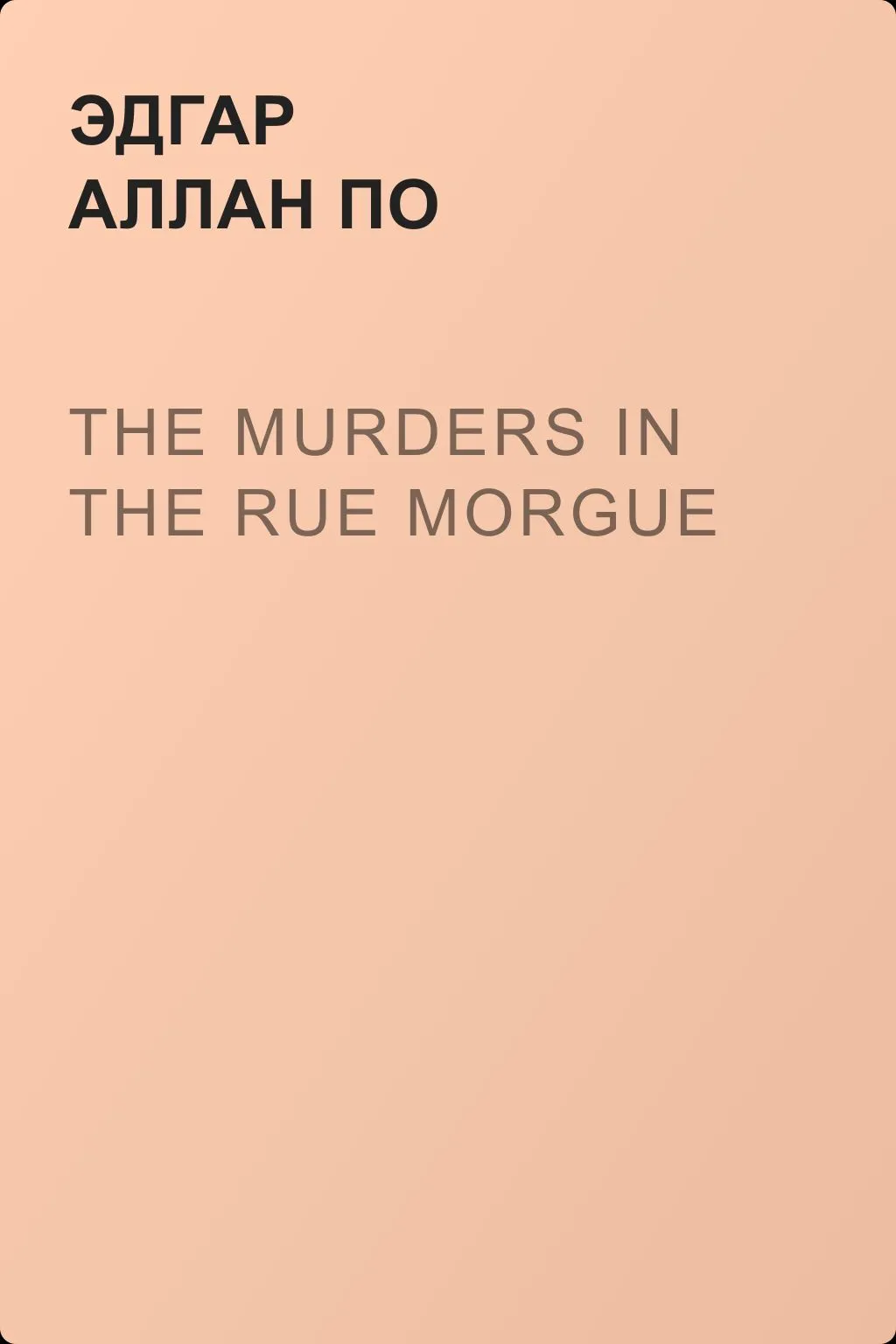
Нарратор, прибывший во Францию, знакомится с бедным, но умным М. К. Дупином. Вместе они расследуют загадочные убийства в доме на улице Морг, где обнаружены тела матери и дочери Madame L'Espanaye. Дупин, применяя наблюдение и дедукцию, приходит к выводу, что убийства совершила обезьяна, и раскрывает преступление, подтверждая свои выводы встречей с владельцем животного.
Главный конфликт / проблема
Раскрытие загадочных убийств на улице Морг и определение виновника
Ключевые идеи
- Аналитический подход к расследованию: наблюдение, логика, дедукция.
- Важность детализации: окна, двери, камин, следы.
- Мотивы и отсутствие мотивов: деньги, но убийство без причины.
- Невероятные обстоятельства: обезьяна как убийца.
Вывод
Книга демонстрирует, что тщательное наблюдение и логический анализ способны раскрыть даже самые странные преступления.
Кому полезна
- Любители детективов
- Студенты логики и криминологии
Главные темы
- Детективное расследование
- Наблюдение и логика
Персонажи
- Дупин — Бедный, но умный француз, применяющий наблюдение и дедукцию для раскрытия преступления.
- Нарратор — Британский путешественник, любящий книги, который становится свидетелем расследования.
- Madame L'Espanaye — Старушка, убитая в своем доме.
- Mademoiselle L'Espanaye — Дочь Madame L'Espanaye, убитая в камине.
- Моряк — Мальтийский моряка, который объясняет, как обезьяна убила людей.
Цитаты
- «Всё, что я сделал, было лишь наблюдением, а не интуицией».
- «Убийца, как я понял, не человек, а обезьяна, которая использовала нож и камин».
Сводка по автору из Wikidata
1809–1849. Edgar Allan Poe. американский писатель, поэт, литературный критик и редактор (1809—1849)
Читать онлайн
Страница 1 из 12Edger Allen Poe THE MURDERS IN THE RUE MORGUE
What song the Syrens sang, or what name Achilles assumed when he hid himself among women, although puzzling questions, are not beyond all conjecture.
The mental features discoursed of as the analytical, are, in themselves, but little susceptible of analysis. We appreciate them only in their effects. We know of them, among other things, that they are always to their possessor, when inordinately possessed, a source of the liveliest enjoyment. As the strong man exults in his physical ability, delighting in such exercises as call his muscles into action, so glories the analyst in that moral activity which disentangles. He derives pleasure from even the most trivial occupations bringing his talent into play. He is fond of enigmas, of conundrums, of hieroglyphics; exhibiting in his solutions of each a degree of acumen which appears to the ordinary apprehension pr? ternatural. His results, brought about by the very soul and essence of method, have, in truth, the whole air of intuition.
The faculty of re-solution is possibly much invigorated by mathematical study, and especially by that highest branch of it which, unjustly, and merely on account of its retrograde operations, has been called, as if _par excellence_, analysis. Yet to calculate is not in itself to analyse. A chess-player, for example, does the one without effort at the other. It follows that the game of chess, in its effects upon mental character, is greatly misunderstood. I am not now writing a treatise, but simply prefacing a somewhat peculiar narrative by observations very much at random; I will, therefore, take occasion to assert that the higher powers of the reflective intellect are more decidedly and more usefully tasked by the unostentatious game of draughts than by a the elaborate frivolity of chess. In this latter, where the pieces have different and _bizarre_ motions, with various and variable values, what is only complex is mistaken (a not unusual error) for what is profound. The _attention_ is here called powerfully into play. If it flag for an instant, an oversight is committed resulting in injury or defeat. The possible moves being not only manifold but involute, the chances of such oversights are multiplied; and in nine cases out of ten it is the more concentrative rather than the more acute player who conquers. In draughts, on the contrary, where the moves are _unique_ and have but little variation, the probabilities of inadvertence are diminished, and the mere attention being left comparatively unemployed, what advantages are obtained by either party are obtained by superior _acumen_. To be less abstract - Let us suppose a game of draughts where the pieces are reduced to four kings, and where, of course, no oversight is to be expected. It is obvious that here the victory can be decided (the players being at all equal) only by some _recherche_ movement, the result of some strong exertion of the intellect.
Deprived of ordinary resources, the analyst throws himself into the spirit of his opponent, identifies himself therewith, and not unfrequently sees thus, at a glance, the sole methods (sometime indeed absurdly simple ones) by which he may seduce into error or hurry into miscalculation.
Whist has long been noted for its influence upon what is termed the calculating power; and men of the highest order of intellect have been known to take an apparently unaccountable delight in it, while eschewing chess as frivolous. Beyond doubt there is nothing of a similar nature so greatly tasking the faculty of analysis. The best chess-player in Christendom may be little more than the best player of chess; but proficiency in whist implies capacity for success in all those more important undertakings where mind struggles with mind.
When I say proficiency, I mean that perfection in the game which includes a comprehension of all the sources whence legitimate advantage may be derived. These are not only manifold but multiform, and lie frequently among recesses of thought altogether inaccessible to the ordinary understanding. To observe attentively is to remember distinctly; and, so far, the concentrative chess-player will do very well at whist; while the rules of Hoyle (themselves based upon the mere mechanism of the game) are sufficiently and generally comprehensible. Thus to have a retentive memory, and to proceed by "the book," are points commonly regarded as the sum total of good playing. But it is in matters beyond the limits of mere rule that the skill of the analyst is evinced. He makes, in silence, a host of observations and inferences. So, perhaps, do his companions; and the difference in the extent of the information obtained, lies not so much in the validity of the inference as in the quality of the observation. The necessary knowledge is that of what to observe.
Our player confines himself not at all; nor, because the game is the object, does he reject deductions from things external to the game.
He examines the countenance of his partner, comparing it carefully with that of each of his opponents. He considers the mode of assorting the cards in each hand; often counting trump by trump, and honor by honor, through the glances bestowed by their holders upon each. He notes every variation of face as the play progresses, gathering a fund of thought from the differences in the expression of certainty, of surprise, of triumph, or of chagrin. From the manner of gathering up a trick he judges whether the person taking it can make another in the suit. He recognises what is played through feint, by the air with which it is thrown upon the table. A casual or inadvertent word; the accidental dropping or turning of a card, with the accompanying anxiety or carelessness in regard to its concealment; the counting of the tricks, with the order of their arrangement; embarrassment, hesitation, eagerness or trepidation - all afford, to his apparently intuitive perception, indications of the true state of affairs. The first two or three rounds having been played, he is in full possession of the contents of each hand, and thenceforward puts down his cards with as absolute a precision of purpose as if the rest of the party had turned outward the faces of their own.
The analytical power should not be confounded with ample ingenuity; for while the analyst is necessarily ingenious, the ingenious man is often remarkably incapable of analysis. The constructive or combining power, by which ingenuity is usually manifested, and to which the phrenologists (I believe erroneously) have assigned a separate organ, supposing it a primitive faculty, has been so frequently seen in those whose intellect bordered otherwise upon idiocy, as to have attracted general observation among writers on morals. Between ingenuity and the analytic ability there exists a difference far greater, indeed, than that between the fancy and the imagination, but of a character very strictly analogous. It will be found, in fact, that the ingenious are always fanciful, and the truly imaginative never otherwise than analytic.
Вам также может понравиться
{"page":{"canonicalUrl":"https://bookra.app/books/2Od0WNpS","pageTitle":"The Murders in the Rue Morgue (Эдгар Аллан По) — полный текст, краткое содержание, анализ и герои","metaDescription":"Полный текст книги «The Murders in the Rue Morgue». А также краткое содержание, главные мысли, конфликт, темы, персонажи, цитаты и ответы на вопросы.","headingTitle":"«The Murders in the Rue Morgue». Читать бесплатно онлайн","headingSubtitle":"Эдгар Аллан По","structuredData":[{"@context":"https://schema.org","@type":"BreadcrumbList","@id":"https://bookra.app/books/2Od0WNpS#breadcrumb","itemListElement":[{"@type":"ListItem","position":1,"name":"BookRa","item":"https://bookra.app/"},{"@type":"ListItem","position":2,"name":"классические детективы","item":"https://bookra.app/genre/5261"},{"@type":"ListItem","position":3,"name":"The Murders in the Rue Morgue","item":"https://bookra.app/books/2Od0WNpS"}]},{"@context":"https://schema.org","@type":"WebPage","@id":"https://bookra.app/books/2Od0WNpS","url":"https://bookra.app/books/2Od0WNpS","name":"«The Murders in the Rue Morgue». Читать бесплатно онлайн","description":"Полный текст книги «The Murders in the Rue Morgue». А также краткое содержание, главные мысли, конфликт, темы, персонажи, цитаты и ответы на вопросы.","breadcrumb":{"@id":"https://bookra.app/books/2Od0WNpS#breadcrumb"},"mainEntity":{"@id":"https://bookra.app/books/2Od0WNpS#work"},"primaryImageOfPage":{"@type":"ImageObject","url":"https://storage.yandexcloud.net/bookra-catalog-pd-public/content/2DB2D595-3048-4CAF-8BA5-2D30D7A79818/thumbs/1200.webp"}},{"@context":"https://schema.org","@type":"Book","@id":"https://bookra.app/books/2Od0WNpS#work","name":"The Murders in the Rue Morgue","url":"https://bookra.app/books/2Od0WNpS","description":"Нарратор, прибывший во Францию, знакомится с бедным, но умным М. К. Дупином. Вместе они расследуют загадочные убийства в доме на улице Морг, где обнаружены тела матери и дочери Madame L'Espanaye. Дупин, применяя наблюдение и дедукцию, приходит к выводу, что убийства совершила обезьяна, и раскрывает преступление, подтверждая свои выводы встречей с владельцем животного.","image":"https://storage.yandexcloud.net/bookra-catalog-pd-public/content/2DB2D595-3048-4CAF-8BA5-2D30D7A79818/thumbs/1200.webp","inLanguage":"en","genre":["классические детективы"],"keywords":"американская литература, американская классика","author":[{"@type":"Person","@id":"https://bookra.app/author/86dc7633-2a81-102a-9ae1-2dfe723fe7c7#person","name":"Эдгар Аллан По","url":"https://bookra.app/author/86dc7633-2a81-102a-9ae1-2dfe723fe7c7","sameAs":["https://ru.wikipedia.org/wiki/%D0%9F%D0%BE%2C_%D0%AD%D0%B4%D0%B3%D0%B0%D1%80_%D0%90%D0%BB%D0%BB%D0%B0%D0%BD","https://www.wikidata.org/wiki/Q16867"]}],"about":[{"@type":"Thing","name":"классические детективы"},{"@type":"Thing","name":"американская литература"},{"@type":"Thing","name":"американская классика"},{"@type":"Thing","name":"чтение онлайн"},{"@type":"Thing","name":"саммари"},{"@type":"Thing","name":"AI-разбор"},{"@type":"Thing","name":"персонажи"},{"@type":"Thing","name":"цитаты"}],"workExample":{"@type":"Book","@id":"https://bookra.app/books/2Od0WNpS#edition","url":"https://bookra.app/books/2Od0WNpS","bookFormat":"https://schema.org/EBook","inLanguage":"en","isAccessibleForFree":true,"potentialAction":{"@type":"ReadAction","name":"Читать бесплатно онлайн «The Murders in the Rue Morgue»","target":{"@type":"EntryPoint","urlTemplate":"https://bookra.app/books/2Od0WNpS","actionPlatform":["https://schema.org/DesktopWebPlatform"]},"expectsAcceptanceOf":{"@type":"Offer","category":"nologinrequired"}}}}],"book":{"idCatalog":793976,"shortId":"2Od0WNpS","title":"The Murders in the Rue Morgue","coverUrl":"https://storage.yandexcloud.net/bookra-catalog-pd-public/content/2DB2D595-3048-4CAF-8BA5-2D30D7A79818/thumbs/1200.webp","annotationText":"\"The Murders in the Rue Morgue\" is a short story by Edgar Allan Poe published in Graham's Magazine in 1841. It has been claimed as the first detective story; Poe referred to it as one of his «tales of ratiocination».","catalogType":"PUBLIC_DOMAIN","catalogTypeLabel":"Общественное достояние","authorLine":"Эдгар Аллан По","authors":[{"id":"86dc7633-2a81-102a-9ae1-2dfe723fe7c7","displayName":"Эдгар Аллан По","protectedUrl":"/author/86dc7633-2a81-102a-9ae1-2dfe723fe7c7","wikipediaUrl":"https://ru.wikipedia.org/wiki/%D0%9F%D0%BE%2C_%D0%AD%D0%B4%D0%B3%D0%B0%D1%80_%D0%90%D0%BB%D0%BB%D0%B0%D0%BD","wikidataUrl":"https://www.wikidata.org/wiki/Q16867"}],"genres":[{"id":5261,"title":"классические детективы","token":null,"publicUrl":"https://bookra.app/genre/5261"}],"keywords":["американская литература","американская классика"],"facts":[{"key":"dateWritten","label":"Дата написания","value":"1970-01-01"},{"key":"bookLanguage","label":"Язык книги","value":"en"},{"key":"adult","label":"Возрастное ограничение","value":"12+"}],"seoSections":[{"key":"summaryShort","title":"Описание","body":"Нарратор, прибывший во Францию, знакомится с бедным, но умным М. К. Дупином. Вместе они расследуют загадочные убийства в доме на улице Морг, где обнаружены тела матери и дочери Madame L'Espanaye. Дупин, применяя наблюдение и дедукцию, приходит к выводу, что убийства совершила обезьяна, и раскрывает преступление, подтверждая свои выводы встречей с владельцем животного."},{"key":"conflict","title":"Главный конфликт / проблема","body":"Раскрытие загадочных убийств на улице Морг и определение виновника"},{"key":"keyIdeas","title":"Ключевые идеи","body":["Аналитический подход к расследованию: наблюдение, логика, дедукция.","Важность детализации: окна, двери, камин, следы.","Мотивы и отсутствие мотивов: деньги, но убийство без причины.","Невероятные обстоятельства: обезьяна как убийца."]},{"key":"conclusion","title":"Вывод","body":"Книга демонстрирует, что тщательное наблюдение и логический анализ способны раскрыть даже самые странные преступления."},{"key":"audience","title":"Кому полезна","body":["Любители детективов","Студенты логики и криминологии"]},{"key":"topics","title":"Главные темы","body":["Детективное расследование","Наблюдение и логика"]},{"key":"characters","title":"Персонажи","body":["Дупин — Бедный, но умный француз, применяющий наблюдение и дедукцию для раскрытия преступления.","Нарратор — Британский путешественник, любящий книги, который становится свидетелем расследования.","Madame L'Espanaye — Старушка, убитая в своем доме.","Mademoiselle L'Espanaye — Дочь Madame L'Espanaye, убитая в камине.","Моряк — Мальтийский моряка, который объясняет, как обезьяна убила людей."]},{"key":"quotes","title":"Цитаты","body":["«Всё, что я сделал, было лишь наблюдением, а не интуицией».","«Убийца, как я понял, не человек, а обезьяна, которая использовала нож и камин»."]}],"authorSummary":{"key":"authorSummary","title":"Сводка по автору из Wikidata","body":"1809–1849. Edgar Allan Poe. американский писатель, поэт, литературный критик и редактор (1809—1849)"},"hasArtifacts":true,"canReadInApp":true,"readUrl":"https://web.bookra.app/?startapp=r_793976","artifactsUrl":"https://web.bookra.app/?startapp=b_793976","readCtaLabel":"Читать бесплатно","artifactsCtaLabel":"AI-разбор","appReadLinks":{"tg":"https://t.me/bookra_lib_bot/BookRa?startapp=r_793976","vk":"https://vk.com/app54470698#startapp=r_793976","max":"https://max.ru/id7751370047_bot?startapp=r_793976","web":"https://web.bookra.app/?startapp=r_793976"},"appAnalysisLinks":{"tg":"https://t.me/bookra_lib_bot/BookRa?startapp=b_793976","vk":"https://vk.com/app54470698#startapp=b_793976","max":"https://max.ru/id7751370047_bot?startapp=b_793976","web":"https://web.bookra.app/?startapp=b_793976"},"guestReaderUrl":"/books/2Od0WNpS#reader-content","authorCtaLabel":"Все книги автора","authorProtectedUrl":"/author/86dc7633-2a81-102a-9ae1-2dfe723fe7c7","readersCount":0,"adultLabel":"12+","yearLabel":null,"datePublished":null,"publisherLabel":null,"isbn":null,"oclc":null,"lccn":null,"partnerUrl":null,"accessNote":"Полный текст книги и AI-разбор откроются на защищенных страницах BookRa после входа."},"reader":{"page":1,"totalPages":12,"hasPrev":false,"hasNext":true,"prevPageUrl":null,"nextPageUrl":"/books/2Od0WNpS?page=2#reader-content","progressLabel":"Страница 1 из 12","sections":[{"id":"id11:0","kind":"heading","text":"Edger Allen Poe THE MURDERS IN THE RUE MORGUE"},{"id":"id11:1","kind":"paragraph","text":"What song the Syrens sang, or what name Achilles assumed when he hid himself among women, although puzzling questions, are not beyond all conjecture."},{"id":"id11:2","kind":"paragraph","text":"Sir Thomas Browne"},{"id":"id11:3","kind":"paragraph","text":"The mental features discoursed of as the analytical, are, in themselves, but little susceptible of analysis. We appreciate them only in their effects. We know of them, among other things, that they are always to their possessor, when inordinately possessed, a source of the liveliest enjoyment. As the strong man exults in his physical ability, delighting in such exercises as call his muscles into action, so glories the analyst in that moral activity which disentangles. He derives pleasure from even the most trivial occupations bringing his talent into play. He is fond of enigmas, of conundrums, of hieroglyphics; exhibiting in his solutions of each a degree of acumen which appears to the ordinary apprehension pr? ternatural. His results, brought about by the very soul and essence of method, have, in truth, the whole air of intuition."},{"id":"id11:4","kind":"paragraph","text":"The faculty of re-solution is possibly much invigorated by mathematical study, and especially by that highest branch of it which, unjustly, and merely on account of its retrograde operations, has been called, as if _par excellence_, analysis. Yet to calculate is not in itself to analyse. A chess-player, for example, does the one without effort at the other. It follows that the game of chess, in its effects upon mental character, is greatly misunderstood. I am not now writing a treatise, but simply prefacing a somewhat peculiar narrative by observations very much at random; I will, therefore, take occasion to assert that the higher powers of the reflective intellect are more decidedly and more usefully tasked by the unostentatious game of draughts than by a the elaborate frivolity of chess. In this latter, where the pieces have different and _bizarre_ motions, with various and variable values, what is only complex is mistaken (a not unusual error) for what is profound. The _attention_ is here called powerfully into play. If it flag for an instant, an oversight is committed resulting in injury or defeat. The possible moves being not only manifold but involute, the chances of such oversights are multiplied; and in nine cases out of ten it is the more concentrative rather than the more acute player who conquers. In draughts, on the contrary, where the moves are _unique_ and have but little variation, the probabilities of inadvertence are diminished, and the mere attention being left comparatively unemployed, what advantages are obtained by either party are obtained by superior _acumen_. To be less abstract - Let us suppose a game of draughts where the pieces are reduced to four kings, and where, of course, no oversight is to be expected. It is obvious that here the victory can be decided (the players being at all equal) only by some _recherche_ movement, the result of some strong exertion of the intellect."},{"id":"id11:5","kind":"paragraph","text":"Deprived of ordinary resources, the analyst throws himself into the spirit of his opponent, identifies himself therewith, and not unfrequently sees thus, at a glance, the sole methods (sometime indeed absurdly simple ones) by which he may seduce into error or hurry into miscalculation."},{"id":"id11:6","kind":"paragraph","text":"Whist has long been noted for its influence upon what is termed the calculating power; and men of the highest order of intellect have been known to take an apparently unaccountable delight in it, while eschewing chess as frivolous. Beyond doubt there is nothing of a similar nature so greatly tasking the faculty of analysis. The best chess-player in Christendom may be little more than the best player of chess; but proficiency in whist implies capacity for success in all those more important undertakings where mind struggles with mind."},{"id":"id11:7","kind":"paragraph","text":"When I say proficiency, I mean that perfection in the game which includes a comprehension of all the sources whence legitimate advantage may be derived. These are not only manifold but multiform, and lie frequently among recesses of thought altogether inaccessible to the ordinary understanding. To observe attentively is to remember distinctly; and, so far, the concentrative chess-player will do very well at whist; while the rules of Hoyle (themselves based upon the mere mechanism of the game) are sufficiently and generally comprehensible. Thus to have a retentive memory, and to proceed by \"the book,\" are points commonly regarded as the sum total of good playing. But it is in matters beyond the limits of mere rule that the skill of the analyst is evinced. He makes, in silence, a host of observations and inferences. So, perhaps, do his companions; and the difference in the extent of the information obtained, lies not so much in the validity of the inference as in the quality of the observation. The necessary knowledge is that of what to observe."},{"id":"id11:8","kind":"paragraph","text":"Our player confines himself not at all; nor, because the game is the object, does he reject deductions from things external to the game."},{"id":"id11:9","kind":"paragraph","text":"He examines the countenance of his partner, comparing it carefully with that of each of his opponents. He considers the mode of assorting the cards in each hand; often counting trump by trump, and honor by honor, through the glances bestowed by their holders upon each. He notes every variation of face as the play progresses, gathering a fund of thought from the differences in the expression of certainty, of surprise, of triumph, or of chagrin. From the manner of gathering up a trick he judges whether the person taking it can make another in the suit. He recognises what is played through feint, by the air with which it is thrown upon the table. A casual or inadvertent word; the accidental dropping or turning of a card, with the accompanying anxiety or carelessness in regard to its concealment; the counting of the tricks, with the order of their arrangement; embarrassment, hesitation, eagerness or trepidation - all afford, to his apparently intuitive perception, indications of the true state of affairs. The first two or three rounds having been played, he is in full possession of the contents of each hand, and thenceforward puts down his cards with as absolute a precision of purpose as if the rest of the party had turned outward the faces of their own."},{"id":"id11:10","kind":"paragraph","text":"The analytical power should not be confounded with ample ingenuity; for while the analyst is necessarily ingenious, the ingenious man is often remarkably incapable of analysis. The constructive or combining power, by which ingenuity is usually manifested, and to which the phrenologists (I believe erroneously) have assigned a separate organ, supposing it a primitive faculty, has been so frequently seen in those whose intellect bordered otherwise upon idiocy, as to have attracted general observation among writers on morals. Between ingenuity and the analytic ability there exists a difference far greater, indeed, than that between the fancy and the imagination, but of a character very strictly analogous. It will be found, in fact, that the ingenious are always fanciful, and the truly imaginative never otherwise than analytic."}],"toc":[{"id":"id11:0:1","label":"Edger Allen Poe THE MURDERS IN THE RUE MORGUE","page":1,"pageUrl":"/books/2Od0WNpS#reader-content"},{"id":"id11:178:12","label":"This file was created","page":12,"pageUrl":"/books/2Od0WNpS?page=12#reader-content"},{"id":"id11:179:12","label":"with BookDesigner program","page":12,"pageUrl":"/books/2Od0WNpS?page=12#reader-content"},{"id":"id11:180:12","label":"bookdesigner@the-ebook.org","page":12,"pageUrl":"/books/2Od0WNpS?page=12#reader-content"},{"id":"id11:181:12","label":"28/03/10","page":12,"pageUrl":"/books/2Od0WNpS?page=12#reader-content"}]},"similarBooks":[{"idCatalog":162586,"shortId":"0AqOAHkO","title":"Весь Шерлок Холмс","authorLine":"Артур Конан Дойл, Николай Корнеевич Чуковский, Марина Николаевна Чуковская, Адриан Конан Дойл, Юлия Ивановна Жукова, Мария Дмитриевна Литвинова, Марина Казимировна Баранович, Нина Львовна Емельянникова, А. Поливанова, Виктор Анатольевич Вебер, Дебора Григорьевна Лившиц, Виктор Абрамович Ашкенази, Наталия Вениаминовна Рейн, Игорь Леонидович Моничев, Александра Ильинична Ильф, Надежда Давыдовна Вольпин, Наталья Альбертовна Волжина, Елена Игоревна Филиппова, Нина Александровна Дехтерева, Ирина Яковлевна Доронина, Татьяна Владимировна Голубева, Нинель Яковлевна Гвоздарева, Галина Олеговна Веснина, Дмитрий Владимирович Вознякевич, Надежда Савельевна Войтинская, Джон Диксон Карр, Вадим Константинович Штенгель, Эстер Айзиковна Бер","primaryAuthorId":"90f52029-2a81-102a-9ae1-2dfe723fe7c7","coverUrl":"https://storage.yandexcloud.net/bookra-catalog-litres-public/content/c2d4b00f-137b-11e7-aec0-0cc47a5453d6/thumbs/400.webp","publicUrl":"https://bookra.app/books/0AqOAHkO"},{"idCatalog":545,"shortId":"25LNkE3f","title":"Коллекционер","authorLine":"Джон Роберт Фаулз, Ирина Михайловна Бессмертная","primaryAuthorId":"e11d950c-2a80-102a-9ae1-2dfe723fe7c7","coverUrl":"https://storage.yandexcloud.net/bookra-catalog-litres-public/content/bb3a986a-29cc-4a84-a7ce-f4103242c270/thumbs/400.webp","publicUrl":"https://bookra.app/books/25LNkE3f"},{"idCatalog":546962,"shortId":"3UnWxJgy","title":"Убийства во Флит-хаусе","authorLine":"Люсинда Райли, INSPIRIA, Татьяна Борисова, Инна Михайловна Клигман","primaryAuthorId":"796ad7ea-c5b6-11e2-ac71-002590591ea6","coverUrl":"https://storage.yandexcloud.net/bookra-catalog-litres-public/content/6edea73f-9830-11ee-8496-0cc47af30fe4/thumbs/400.webp","publicUrl":"https://bookra.app/books/3UnWxJgy"},{"idCatalog":15002,"shortId":"0Uei0Dbg","title":"Моя кузина Рейчел","authorLine":"Дафна дю Морье, Николай Николаевич Тихонов","primaryAuthorId":"799a736d-2a93-102a-9ac3-800cba805322","coverUrl":"https://storage.yandexcloud.net/bookra-catalog-litres-public/content/6e39e063-7a8d-4407-bbd1-35de23ade50d/thumbs/400.webp","publicUrl":"https://bookra.app/books/0Uei0Dbg"},{"idCatalog":765205,"shortId":"0QmHoY3z","title":"Собака Баскервилей","authorLine":"Артур Конан Дойл, Елена Николаевна Ломиковская","primaryAuthorId":"90f52029-2a81-102a-9ae1-2dfe723fe7c7","coverUrl":"https://storage.yandexcloud.net/bookra-catalog-pd-public/content/c595229e-63a0-11e4-a2cd-002590591dd6/thumbs/400.webp","publicUrl":"https://bookra.app/books/0QmHoY3z"},{"idCatalog":605587,"shortId":"4d7uSa1B","title":"Разочарованные","authorLine":"Валерия А. Фридман, Дом Историй, Мари Варей","primaryAuthorId":"0c8af44c-a166-11ee-8496-0cc47af30fe4","coverUrl":"https://storage.yandexcloud.net/bookra-catalog-litres-public/content/eda6a243-89f1-11ef-8ce3-0cc47af30fe4/thumbs/400.webp","publicUrl":"https://bookra.app/books/4d7uSa1B"},{"idCatalog":38921,"shortId":"0gsogwxr","title":"Темная сторона души","authorLine":"Елена Ивановна Михалкова","primaryAuthorId":"87f30524-473c-102b-8580-badb19e949b1","coverUrl":"https://storage.yandexcloud.net/bookra-catalog-litres-public/content/64b8fcc3-c993-102b-946f-f03f69515cd7/thumbs/400.webp","publicUrl":"https://bookra.app/books/0gsogwxr"},{"idCatalog":129074,"shortId":"3R0hJV88","title":"Приключения Шерлока Холмса","authorLine":"Артур Конан Дойл, Вадим Константинович Штенгель","primaryAuthorId":"90f52029-2a81-102a-9ae1-2dfe723fe7c7","coverUrl":"https://storage.yandexcloud.net/bookra-catalog-litres-public/content/cc95bfbc-1ec2-11e6-99d6-0cc47a52085c/thumbs/400.webp","publicUrl":"https://bookra.app/books/3R0hJV88"},{"idCatalog":420343,"shortId":"4Ejlg0YP","title":"Сороки-убийцы","authorLine":"Энтони Горовиц, Александр Леонидович Яковлев","primaryAuthorId":"9b114b72-38ed-11e2-a193-002590591ea6","coverUrl":"https://storage.yandexcloud.net/bookra-catalog-litres-public/content/0f72c172-23ba-11ec-a246-441ea152441c/thumbs/400.webp","publicUrl":"https://bookra.app/books/4Ejlg0YP"},{"idCatalog":191311,"shortId":"0PrWHolF","title":"Токийский Зодиак","authorLine":"Содзи Симада, Сергей И. Логачев","primaryAuthorId":"844490d5-6c85-4a57-bf60-4eb076b0f53b","coverUrl":"https://storage.yandexcloud.net/bookra-catalog-litres-public/content/24272864-cd2d-11e7-b9d3-0cc47a5453d6/thumbs/400.webp","publicUrl":"https://bookra.app/books/0PrWHolF"},{"idCatalog":163346,"shortId":"3bWHjxIu","title":"Холод туманного замка","authorLine":"Елена Александровна Обухова, Наталья Тимошенко","primaryAuthorId":"2aa8cade-cee7-52f7-9b60-578ec3abeec8","coverUrl":"https://storage.yandexcloud.net/bookra-catalog-litres-public/content/27944f67-1607-11e7-9b47-0cc47a5203ba/thumbs/400.webp","publicUrl":"https://bookra.app/books/3bWHjxIu"},{"idCatalog":442286,"shortId":"1ne173vQ","title":"Лунный камень","authorLine":"Уильям Уилки Коллинз, Сергей Рюмин","primaryAuthorId":"9dc1b987-2a83-102a-9ae1-2dfe723fe7c7","coverUrl":"https://storage.yandexcloud.net/bookra-catalog-litres-public/content/72bd178a-93bd-11ec-a192-0cc47af30dde/thumbs/400.webp","publicUrl":"https://bookra.app/books/1ne173vQ"}],"similarBooksPagination":{"page":1,"pageSize":12,"totalItems":638,"totalPages":54,"hasPrev":false,"hasNext":true}},"notFound":false}