Читать бесплатно онлайн
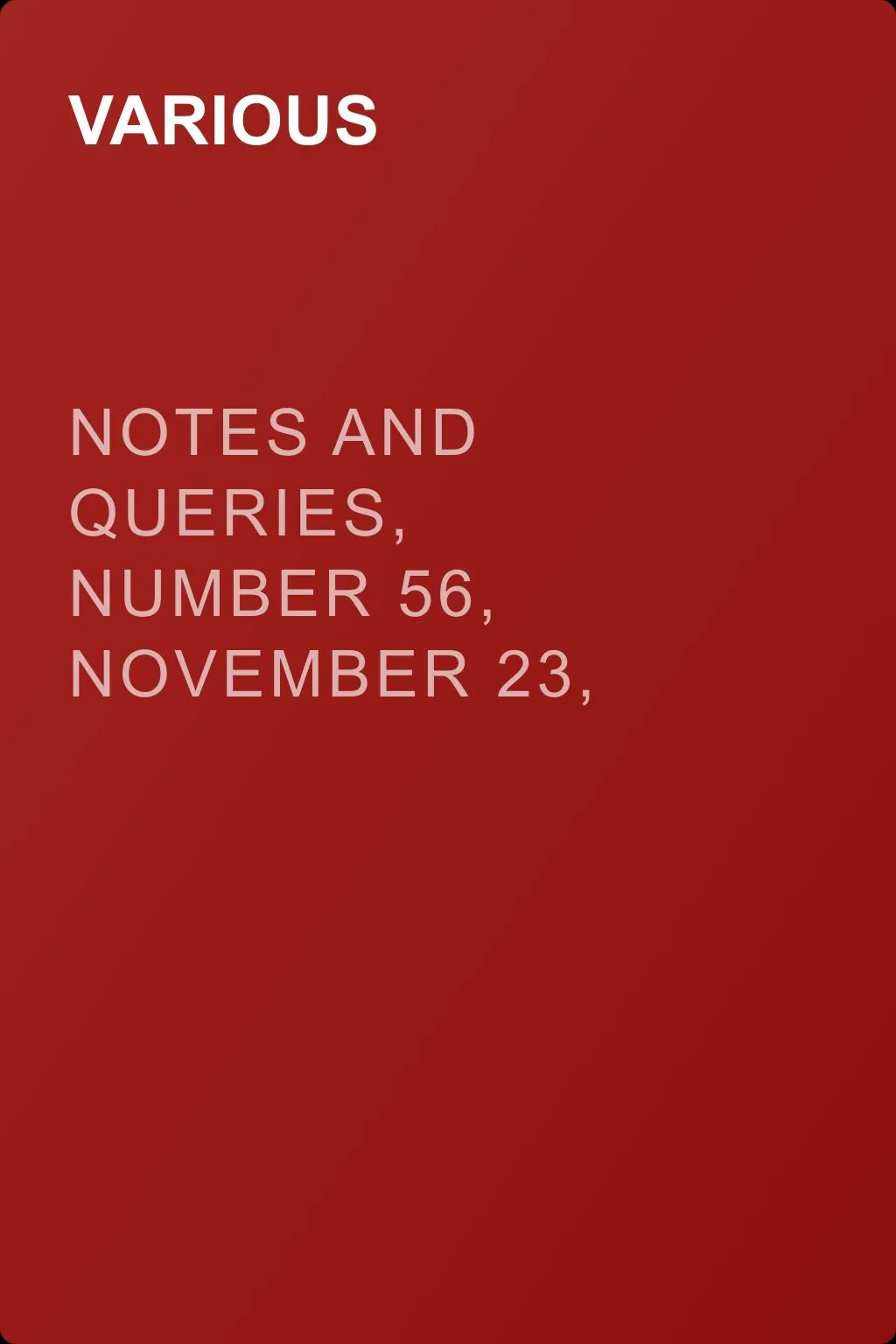
Notes and Queries, Number 56, November 23, 1850
Автор Various0+
Удобнее читать в приложении
AI-разбор доступен после входа
Суть книги, пересказ, главный конфликт, ключевые идеи, вывод, кому полезна, главные темы, персонажи и цитаты можно получить после входа в BookRa.
auto_awesomeПолучить AI-разборО книге
Дата написания1970-01-01
Язык книгиen
Возрастное ограничение0+
Читать онлайн
Страница 2 из 12GREEK PARTICLES ILLUSTRATED BY THE EASTERN LANGUAGES
The affinity which exists between such of the vernacular languages of India as are offshoots of the Sanscrit, as the Hindostanee, Mahratta, Guzeratee, &c., and the Greek, Latin, German, and English languages, is now well known to European scholars, more especially since the publication of the researches of Vans Kennedy, Professor Bopp of Berlin, &c. Indeed, scarcely a day passes in which the European resident in India may not recognise, in his intercourse with the natives, many familiar words in all those languages, clothed in an oriental dress. I am inclined also to think that new light may be thrown upon some of the impracticable Greek particles by a reference to the languages of the East; and without wishing to be understood as laying down anything dogmatically in the present communication, I hope, through the medium of your valuable publication, to attract attention to this subject, and invite discussion on it. Taking, as an illustration, the 233d line of the first book of the Iliad, where the hero of the poem is violently abusing Agamemnon for depriving him of his prize, the fair maid Briseis, he says,
"Αλλ' εκ τοι ερεω, και επι μεγαν ‛ορκον ‛ομουμαι."
What is the meaning of εκ in the above line? It is commonly construed with ερεω, and translated, "I plainly tell thee—I declare to thee;" εξερεω, "I speak out—proclaim." But may it not be identical with the Sanscrit ek, "one," a word, as most of your readers are doubtless aware, in universal use throughout India, Persia, &c; the rendering literally running thus:
"But one thing I tell thee," &c.
That this is the original sense of the line appears probable by comparing it with line 297. of the same book, where in the second speech of Achilles, that impiger, iracundus, inexorabilis, acer, chieftain again scolds "the king of men,"—
"Αλλο δε τοι ερεω, συ δ' ενε φρεσι βαλλεο σησι." "And another thing I tell thee."
This rendering receives additional confirmation by a comparison with the following:
Il. iii. 177., and Od. vii. 243.
Od. iv. 410., and x. 289.
In the last three lines Αλλο, Τουτο, and Παντα stand precisely in the same relation to ερεω that εκ does in the first, Αλλ' merely taking the place of δε, for the sake of versification.
"But one thing I tell thee. And another thing I tell thee. But this thing I tell thee. And all things I tell thee."
It is not impossible that εξερεω may be a compound of εκ, "one," and ερεω, "I speak." There is in the Hindostanee an analogous form of expression, Ek bat bolo, "one word speak." This is constantly used to denote, speaking plainly; to speak decidedly; one word only; no display of unnecessary verbiage to conceal thought; no humbug; I tell thee plainly; I speak solemnly—once for all; which is precisely the meaning of εξερεω in all the passages where it occurs in Homer: e.g. Il. i. 212. (where it is employed by Minerva in her solemn address to Achilles); Il. viii. 286., Od. ix. 365. (where it is very characteristically used), &c.
The word ace (ace of spades, &c.) I suppose you will have no difficulty in identifying with the Sanscrit ek and the Greek εις, the c sometimes pronounced hard and sometimes soft. The Sanscrit das, the Greek δεκ-α, and the Latin dec-em, all signifying ten, on the same principle, have been long identified.
SAMUEL ROWLANDS, AND HIS CLAIM TO THE AUTHORSHIP OF "THE CHOISE OF CHANGE."
Mr. T. Jones in "NOTES AND QUERIES" (Vol. i., p. 39.), describing a copy of The Choise of Change in the Chetham Library, unhesitatingly ascribes its authorship to the well-known satirist, Samuel Rowlands, whom he says, "appears to have been a Welshman from his love of Triads." Mr. JONES'S dictum, that the letters "S.R.," on the title-page "are the well-known initials of Samuel Rowlands," may well, I think, be questioned. Great caution should be used in these matters. Bibliographers and catalogue-makers are constantly making confusion by assigning works, which bear the initials only, to wrong authors.
The Choise of Change may with much more probability be given to a very different author. I have a copy of the edition of 1598 now before me, in which the name is filled up, in a cotemporary hand, S[imon], R[obson]. And I find in Lowndes' Bibliographer's Manual, that the work in question is entered under the latter name. The compiler adds,—"This piece is by some attributed to Dr. Simon Robson, Dean of Bristol in 1598; by others, most probably erroneously, to Samuel Rowland." An examination of the biography of Dr. Robson, who died in 1617, might tend to elucidate some particulars concerning his claim to the authorship of this and several other works of similar character.
Samuel Rowland's earliest publication is supposed to have been The Betraying of Christ, &c., printed in 1598. If it can be proved that he has any claim to The Choise of Change (first printed in 1585), we make him an author thirteen years earlier. In the title-page of the latter, the writer, whoever he was, is styled "Gent and Student in the Universitie of Cambridge." This is a fact of some importance towards the elucidation of authorship and has, I believe, escaped the notice of those writers who have touched upon Samuel Rowland's scanty biography. But I can hardly conceive that either of the publications above alluded to came from the same pen as Humours Ordinarie, Martin Mark-all, The Four Knaves, and many others of the same class, which are known to have been the productions of Samuel Rowlands.
Respecting Samuel Rowlands it may be regarded as extraordinary that no account has been discovered; and though his pamphlets almost rival in number those of Greene, Taylor, and Prynne, their prefaces—those fruitful sources of information—throw no light upon the life or circumstances of their author. The late Mr. Octavius Gilchrist considered that "Rowlands was an ecclesiastic [?] by profession;" and, inferring his zeal in the pulpit from his labours through the press, adds, "it should seem that he was an active servant of the church." (See Fry's Bibliographical Memoranda, p. 257.) Sir Walter Scott (Preface to his reprint of The Letting of Humours Blood in the Head Vaine) gives us a very different idea of the nature of his calling. His words are:
"Excepting that he lived and wrote, none of those industrious antiquaries have pointed out any particulars respecting Rowland[s]. It has been remarked that his muse is seldom found in the best company; and to have become so well acquainted with the bullies, drunkards, gamesters, and cheats, whom he describes, he must have frequented the haunts of dissipation in which such characters are to be found. But the humorous descriptions of low-life exhibited in his satires are more precious to antiquaries than more grave works, and those who make the manners of Shakspeare's age the subject their study may better spare a better author than Samuel Rowlands."
Вам также может понравиться
{"page":{"canonicalUrl":"https://bookra.app/books/2E9pUtkI","pageTitle":"Notes and Queries, Number 56, November 23, 1850 (Various) — полный текст, краткое содержание, анализ и герои","metaDescription":"Полный текст книги «Notes and Queries, Number 56, November 23, 1850». А также краткое содержание, главные мысли, конфликт, темы, персонажи, цитаты и ответы на вопросы.","headingTitle":"«Notes and Queries, Number 56, November 23, 1850». Читать бесплатно онлайн","headingSubtitle":"Various","structuredData":[{"@context":"https://schema.org","@type":"BreadcrumbList","@id":"https://bookra.app/books/2E9pUtkI#breadcrumb","itemListElement":[{"@type":"ListItem","position":1,"name":"BookRa","item":"https://bookra.app/"},{"@type":"ListItem","position":2,"name":"зарубежная образовательная литература","item":"https://bookra.app/genre/5217"},{"@type":"ListItem","position":3,"name":"Notes and Queries, Number 56, November 23, 1850","item":"https://bookra.app/books/2E9pUtkI"}]},{"@context":"https://schema.org","@type":"WebPage","@id":"https://bookra.app/books/2E9pUtkI","url":"https://bookra.app/books/2E9pUtkI","name":"«Notes and Queries, Number 56, November 23, 1850». Читать бесплатно онлайн","description":"Полный текст книги «Notes and Queries, Number 56, November 23, 1850». А также краткое содержание, главные мысли, конфликт, темы, персонажи, цитаты и ответы на вопросы.","breadcrumb":{"@id":"https://bookra.app/books/2E9pUtkI#breadcrumb"},"mainEntity":{"@id":"https://bookra.app/books/2E9pUtkI#work"},"primaryImageOfPage":{"@type":"ImageObject","url":"https://storage.yandexcloud.net/bookra-catalog-pd-public/content/24f60200-867b-11e8-aa6b-0cc47a520474/thumbs/1200.webp"}},{"@context":"https://schema.org","@type":"Book","@id":"https://bookra.app/books/2E9pUtkI#work","name":"Notes and Queries, Number 56, November 23, 1850","url":"https://bookra.app/books/2E9pUtkI","description":"Полный текст книги «Notes and Queries, Number 56, November 23, 1850». А также краткое содержание, главные мысли, конфликт, темы, персонажи, цитаты и ответы на вопросы.","image":"https://storage.yandexcloud.net/bookra-catalog-pd-public/content/24f60200-867b-11e8-aa6b-0cc47a520474/thumbs/1200.webp","inLanguage":"en","genre":["зарубежная образовательная литература","зарубежная старинная литература"],"sameAs":["https://litres.ru/book/various-10848091/notes-and-queries-number-56-november-23-1850-35494055/"],"author":[{"@type":"Person","@id":"https://bookra.app/author/6bc78809-ff55-11e6-9c73-0cc47a1952f2#person","name":"Various","url":"https://bookra.app/author/6bc78809-ff55-11e6-9c73-0cc47a1952f2"}],"about":[{"@type":"Thing","name":"зарубежная образовательная литература"},{"@type":"Thing","name":"зарубежная старинная литература"},{"@type":"Thing","name":"чтение онлайн"},{"@type":"Thing","name":"саммари"},{"@type":"Thing","name":"AI-разбор"},{"@type":"Thing","name":"персонажи"},{"@type":"Thing","name":"цитаты"}],"workExample":{"@type":"Book","@id":"https://bookra.app/books/2E9pUtkI#edition","url":"https://bookra.app/books/2E9pUtkI","bookFormat":"https://schema.org/EBook","inLanguage":"en","sameAs":["https://litres.ru/book/various-10848091/notes-and-queries-number-56-november-23-1850-35494055/"],"isAccessibleForFree":true,"potentialAction":{"@type":"ReadAction","name":"Читать бесплатно онлайн «Notes and Queries, Number 56, November 23, 1850»","target":{"@type":"EntryPoint","urlTemplate":"https://bookra.app/books/2E9pUtkI","actionPlatform":["https://schema.org/DesktopWebPlatform"]},"expectsAcceptanceOf":{"@type":"Offer","category":"nologinrequired"}}}}],"book":{"idCatalog":761144,"shortId":"2E9pUtkI","title":"Notes and Queries, Number 56, November 23, 1850","coverUrl":"https://storage.yandexcloud.net/bookra-catalog-pd-public/content/24f60200-867b-11e8-aa6b-0cc47a520474/thumbs/1200.webp","annotationText":"","catalogType":"PUBLIC_DOMAIN","catalogTypeLabel":"Общественное достояние","authorLine":"Various","authors":[{"id":"6bc78809-ff55-11e6-9c73-0cc47a1952f2","displayName":"Various","protectedUrl":"/author/6bc78809-ff55-11e6-9c73-0cc47a1952f2","wikipediaUrl":null,"wikidataUrl":null}],"genres":[{"id":5217,"title":"зарубежная образовательная литература","token":null,"publicUrl":"https://bookra.app/genre/5217"},{"id":5215,"title":"зарубежная старинная литература","token":null,"publicUrl":"https://bookra.app/genre/5215"}],"keywords":[],"facts":[{"key":"dateWritten","label":"Дата написания","value":"1970-01-01"},{"key":"bookLanguage","label":"Язык книги","value":"en"},{"key":"adult","label":"Возрастное ограничение","value":"0+"}],"seoSections":[],"authorSummary":null,"hasArtifacts":false,"canReadInApp":true,"readUrl":"https://web.bookra.app/?startapp=r_761144","artifactsUrl":"https://web.bookra.app/?startapp=b_761144","readCtaLabel":"Читать бесплатно","artifactsCtaLabel":"AI-разбор","appReadLinks":{"tg":"https://t.me/bookra_lib_bot/BookRa?startapp=r_761144","vk":"https://vk.com/app54470698#startapp=r_761144","max":"https://max.ru/id7751370047_bot?startapp=r_761144","web":"https://web.bookra.app/?startapp=r_761144"},"appAnalysisLinks":{"tg":"https://t.me/bookra_lib_bot/BookRa?startapp=b_761144","vk":"https://vk.com/app54470698#startapp=b_761144","max":"https://max.ru/id7751370047_bot?startapp=b_761144","web":"https://web.bookra.app/?startapp=b_761144"},"guestReaderUrl":"/books/2E9pUtkI?page=2#reader-content","authorCtaLabel":"Все книги автора","authorProtectedUrl":"/author/6bc78809-ff55-11e6-9c73-0cc47a1952f2","readersCount":0,"adultLabel":"0+","yearLabel":null,"datePublished":null,"publisherLabel":null,"isbn":null,"oclc":null,"lccn":null,"partnerUrl":null,"accessNote":"Полный текст книги и AI-разбор откроются на защищенных страницах BookRa после входа."},"reader":{"page":2,"totalPages":12,"hasPrev":true,"hasNext":true,"prevPageUrl":"/books/2E9pUtkI#reader-content","nextPageUrl":"/books/2E9pUtkI?page=3#reader-content","progressLabel":"Страница 2 из 12","sections":[{"id":"content0:14","kind":"heading","text":"GREEK PARTICLES ILLUSTRATED BY THE EASTERN LANGUAGES"},{"id":"content0:15","kind":"paragraph","text":"The affinity which exists between such of the vernacular languages of India as are offshoots of the Sanscrit, as the Hindostanee, Mahratta, Guzeratee, \u0026c., and the Greek, Latin, German, and English languages, is now well known to European scholars, more especially since the publication of the researches of Vans Kennedy, Professor Bopp of Berlin, \u0026c. Indeed, scarcely a day passes in which the European resident in India may not recognise, in his intercourse with the natives, many familiar words in all those languages, clothed in an oriental dress. I am inclined also to think that new light may be thrown upon some of the impracticable Greek particles by a reference to the languages of the East; and without wishing to be understood as laying down anything dogmatically in the present communication, I hope, through the medium of your valuable publication, to attract attention to this subject, and invite discussion on it. Taking, as an illustration, the 233d line of the first book of the Iliad, where the hero of the poem is violently abusing Agamemnon for depriving him of his prize, the fair maid Briseis, he says,"},{"id":"content0:16","kind":"paragraph","text":"\"Αλλ' εκ τοι ερεω, και επι μεγαν ‛ορκον ‛ομουμαι.\""},{"id":"content0:17","kind":"paragraph","text":"What is the meaning of εκ in the above line? It is commonly construed with ερεω, and translated, \"I plainly tell thee—I declare to thee;\" εξερεω, \"I speak out—proclaim.\" But may it not be identical with the Sanscrit ek, \"one,\" a word, as most of your readers are doubtless aware, in universal use throughout India, Persia, \u0026c; the rendering literally running thus:"},{"id":"content0:18","kind":"paragraph","text":"\"But one thing I tell thee,\" \u0026c."},{"id":"content0:19","kind":"paragraph","text":"That this is the original sense of the line appears probable by comparing it with line 297. of the same book, where in the second speech of Achilles, that impiger, iracundus, inexorabilis, acer, chieftain again scolds \"the king of men,\"—"},{"id":"content0:20","kind":"paragraph","text":"\"Αλλο δε τοι ερεω, συ δ' ενε φρεσι βαλλεο σησι.\" \"And another thing I tell thee.\""},{"id":"content0:21","kind":"paragraph","text":"This rendering receives additional confirmation by a comparison with the following:"},{"id":"content0:22","kind":"paragraph","text":"\"Τουτο δε τοι ερεω.\""},{"id":"content0:23","kind":"paragraph","text":"Il. iii. 177., and Od. vii. 243."},{"id":"content0:24","kind":"paragraph","text":"\"Παντα δε τοι ερεω.\""},{"id":"content0:25","kind":"paragraph","text":"Od. iv. 410., and x. 289."},{"id":"content0:26","kind":"paragraph","text":"In the last three lines Αλλο, Τουτο, and Παντα stand precisely in the same relation to ερεω that εκ does in the first, Αλλ' merely taking the place of δε, for the sake of versification."},{"id":"content0:27","kind":"paragraph","text":"\"But one thing I tell thee. And another thing I tell thee. But this thing I tell thee. And all things I tell thee.\""},{"id":"content0:28","kind":"paragraph","text":"It is not impossible that εξερεω may be a compound of εκ, \"one,\" and ερεω, \"I speak.\" There is in the Hindostanee an analogous form of expression, Ek bat bolo, \"one word speak.\" This is constantly used to denote, speaking plainly; to speak decidedly; one word only; no display of unnecessary verbiage to conceal thought; no humbug; I tell thee plainly; I speak solemnly—once for all; which is precisely the meaning of εξερεω in all the passages where it occurs in Homer: e.g. Il. i. 212. (where it is employed by Minerva in her solemn address to Achilles); Il. viii. 286., Od. ix. 365. (where it is very characteristically used), \u0026c."},{"id":"content0:29","kind":"paragraph","text":"The word ace (ace of spades, \u0026c.) I suppose you will have no difficulty in identifying with the Sanscrit ek and the Greek εις, the c sometimes pronounced hard and sometimes soft. The Sanscrit das, the Greek δεκ-α, and the Latin dec-em, all signifying ten, on the same principle, have been long identified."},{"id":"content0:30","kind":"paragraph","text":"J. SH."},{"id":"content0:31","kind":"paragraph","text":"Bombay."},{"id":"content1:0","kind":"heading","text":"SAMUEL ROWLANDS, AND HIS CLAIM TO THE AUTHORSHIP OF \"THE CHOISE OF CHANGE.\""},{"id":"content1:1","kind":"paragraph","text":"Mr. T. Jones in \"NOTES AND QUERIES\" (Vol. i., p. 39.), describing a copy of The Choise of Change in the Chetham Library, unhesitatingly ascribes its authorship to the well-known satirist, Samuel Rowlands, whom he says, \"appears to have been a Welshman from his love of Triads.\" Mr. JONES'S dictum, that the letters \"S.R.,\" on the title-page \"are the well-known initials of Samuel Rowlands,\" may well, I think, be questioned. Great caution should be used in these matters. Bibliographers and catalogue-makers are constantly making confusion by assigning works, which bear the initials only, to wrong authors."},{"id":"content1:2","kind":"paragraph","text":"The Choise of Change may with much more probability be given to a very different author. I have a copy of the edition of 1598 now before me, in which the name is filled up, in a cotemporary hand, S[imon], R[obson]. And I find in Lowndes' Bibliographer's Manual, that the work in question is entered under the latter name. The compiler adds,—\"This piece is by some attributed to Dr. Simon Robson, Dean of Bristol in 1598; by others, most probably erroneously, to Samuel Rowland.\" An examination of the biography of Dr. Robson, who died in 1617, might tend to elucidate some particulars concerning his claim to the authorship of this and several other works of similar character."},{"id":"content1:3","kind":"paragraph","text":"Samuel Rowland's earliest publication is supposed to have been The Betraying of Christ, \u0026c., printed in 1598. If it can be proved that he has any claim to The Choise of Change (first printed in 1585), we make him an author thirteen years earlier. In the title-page of the latter, the writer, whoever he was, is styled \"Gent and Student in the Universitie of Cambridge.\" This is a fact of some importance towards the elucidation of authorship and has, I believe, escaped the notice of those writers who have touched upon Samuel Rowland's scanty biography. But I can hardly conceive that either of the publications above alluded to came from the same pen as Humours Ordinarie, Martin Mark-all, The Four Knaves, and many others of the same class, which are known to have been the productions of Samuel Rowlands."},{"id":"content1:4","kind":"paragraph","text":"Respecting Samuel Rowlands it may be regarded as extraordinary that no account has been discovered; and though his pamphlets almost rival in number those of Greene, Taylor, and Prynne, their prefaces—those fruitful sources of information—throw no light upon the life or circumstances of their author. The late Mr. Octavius Gilchrist considered that \"Rowlands was an ecclesiastic [?] by profession;\" and, inferring his zeal in the pulpit from his labours through the press, adds, \"it should seem that he was an active servant of the church.\" (See Fry's Bibliographical Memoranda, p. 257.) Sir Walter Scott (Preface to his reprint of The Letting of Humours Blood in the Head Vaine) gives us a very different idea of the nature of his calling. His words are:"},{"id":"content1:5","kind":"paragraph","text":"\"Excepting that he lived and wrote, none of those industrious antiquaries have pointed out any particulars respecting Rowland[s]. It has been remarked that his muse is seldom found in the best company; and to have become so well acquainted with the bullies, drunkards, gamesters, and cheats, whom he describes, he must have frequented the haunts of dissipation in which such characters are to be found. But the humorous descriptions of low-life exhibited in his satires are more precious to antiquaries than more grave works, and those who make the manners of Shakspeare's age the subject their study may better spare a better author than Samuel Rowlands.\""}],"toc":[{"id":"content0:0:1","label":"Various Notes and Queries, Number 56, November 23, 1850","page":1,"pageUrl":"/books/2E9pUtkI#reader-content"},{"id":"content0:1:1","label":"NOTES","page":1,"pageUrl":"/books/2E9pUtkI#reader-content"},{"id":"content0:2:1","label":"THE OLDENBURG HORN","page":1,"pageUrl":"/books/2E9pUtkI#reader-content"},{"id":"content0:14:2","label":"GREEK PARTICLES ILLUSTRATED BY THE EASTERN LANGUAGES","page":2,"pageUrl":"/books/2E9pUtkI?page=2#reader-content"},{"id":"content1:0:2","label":"SAMUEL ROWLANDS, AND HIS CLAIM TO THE AUTHORSHIP OF \"THE CHOISE OF CHANGE.\"","page":2,"pageUrl":"/books/2E9pUtkI?page=2#reader-content"},{"id":"content1:8:3","label":"\"APRICOT,\" \"PEACH,\" AND \"NECTARINE,\" ETYMOLOGY OF","page":3,"pageUrl":"/books/2E9pUtkI?page=3#reader-content"},{"id":"content1:27:3","label":"MINOR NOTES","page":3,"pageUrl":"/books/2E9pUtkI?page=3#reader-content"},{"id":"content2:0:4","label":"QUERIES","page":4,"pageUrl":"/books/2E9pUtkI?page=4#reader-content"},{"id":"content2:1:4","label":"BIBLIOGRAPHICAL QUERIES","page":4,"pageUrl":"/books/2E9pUtkI?page=4#reader-content"},{"id":"content2:2:4","label":"(Continued from page 325.)","page":4,"pageUrl":"/books/2E9pUtkI?page=4#reader-content"},{"id":"content2:22:5","label":"MINOR QUERIES","page":5,"pageUrl":"/books/2E9pUtkI?page=5#reader-content"},{"id":"content3:0:7","label":"REPLIES","page":7,"pageUrl":"/books/2E9pUtkI?page=7#reader-content"},{"id":"content3:1:7","label":"LICENSING OF BOOKS","page":7,"pageUrl":"/books/2E9pUtkI?page=7#reader-content"},{"id":"content3:2:7","label":"(Vol. ii., p.359.)","page":7,"pageUrl":"/books/2E9pUtkI?page=7#reader-content"},{"id":"content4:0:8","label":"REMAINS OF JAMES II","page":8,"pageUrl":"/books/2E9pUtkI?page=8#reader-content"},{"id":"content4:1:8","label":"(Vol. ii., pp. 243. 281.)","page":8,"pageUrl":"/books/2E9pUtkI?page=8#reader-content"},{"id":"content4:13:8","label":"JUDGE CRADOCK","page":8,"pageUrl":"/books/2E9pUtkI?page=8#reader-content"},{"id":"content5:0:9","label":"REPLIES TO MINOR QUERIES","page":9,"pageUrl":"/books/2E9pUtkI?page=9#reader-content"},{"id":"content5:1:9","label":"REPLIES BY GEORGE STEPHENS","page":9,"pageUrl":"/books/2E9pUtkI?page=9#reader-content"},{"id":"content5:42:10","label":"MISCELLANEOUS","page":10,"pageUrl":"/books/2E9pUtkI?page=10#reader-content"},{"id":"content5:43:10","label":"NOTES ON BOOKS, SALES, CATALOGUES, ETC","page":10,"pageUrl":"/books/2E9pUtkI?page=10#reader-content"},{"id":"content6:0:10","label":"BOOKS AND ODD VOLUMES WANTED TO PURCHASE","page":10,"pageUrl":"/books/2E9pUtkI?page=10#reader-content"},{"id":"content6:4:10","label":"Notices to Correspondents","page":10,"pageUrl":"/books/2E9pUtkI?page=10#reader-content"}]},"similarBooks":[{"idCatalog":792538,"shortId":"3mVN2TRg","title":"Государь","authorLine":"Никколо Макиавелли","primaryAuthorId":"7fcb44f8-2a81-102a-9ae1-2dfe723fe7c7","coverUrl":"https://storage.yandexcloud.net/bookra-catalog-pd-public/content/de5c6783-ed65-538d-be5c-e8a41100356b/thumbs/400.webp","publicUrl":"https://bookra.app/books/3mVN2TRg"},{"idCatalog":803360,"shortId":"20EgCd5y","title":"Диалоги","authorLine":"Платон","primaryAuthorId":"bfbcc84f-2a93-102a-9ac3-800cba805322","coverUrl":"https://storage.yandexcloud.net/bookra-catalog-pd-public/content/d0a029c9-5474-11e9-aa86-0cc47a5453d6/thumbs/400.webp","publicUrl":"https://bookra.app/books/20EgCd5y"},{"idCatalog":16956,"shortId":"3eahNTLe","title":"История","authorLine":"Геродот, Георгий Андреевич Стратановский","primaryAuthorId":"bf200f87-2a93-102a-9ac3-800cba805322","coverUrl":"https://storage.yandexcloud.net/bookra-catalog-litres-public/content/0179c752-4be8-11e5-87ef-0025905a06ea/thumbs/400.webp","publicUrl":"https://bookra.app/books/3eahNTLe"},{"idCatalog":163478,"shortId":"1T5NB3Ce","title":"Трактат о военном искусстве","authorLine":"Сунь-цзы, Николай Иосифович Конрад","primaryAuthorId":"af833b18-2a93-102a-9ac3-800cba805322","coverUrl":"https://storage.yandexcloud.net/bookra-catalog-litres-public/content/66c147fd-191c-11e7-9b47-0cc47a5203ba/thumbs/400.webp","publicUrl":"https://bookra.app/books/1T5NB3Ce"},{"idCatalog":794304,"shortId":"2Gcx9zNO","title":"МЕТАФИЗИКА","authorLine":"Аристотель","primaryAuthorId":"76572bf3-2a93-102a-9ac3-800cba805322","coverUrl":"https://storage.yandexcloud.net/bookra-catalog-pd-public/content/67e57a46-33ce-52fa-9b09-72ebec56a682/thumbs/400.webp","publicUrl":"https://bookra.app/books/2Gcx9zNO"},{"idCatalog":803361,"shortId":"3ZYkMgZn","title":"Апология Сократа","authorLine":"Платон, Михаил Сергеевич Соловьев","primaryAuthorId":"bfbcc84f-2a93-102a-9ac3-800cba805322","coverUrl":"https://storage.yandexcloud.net/bookra-catalog-pd-public/content/e9085dd7-2175-11e8-9a05-0cc47a52085c/thumbs/400.webp","publicUrl":"https://bookra.app/books/3ZYkMgZn"},{"idCatalog":229496,"shortId":"4VRUv1qU","title":"Бусидо","authorLine":"Юдзан Дайдодзи, Цунэтомо Ямамото, А. А. Петрова, Р. В. Котенко, А. А. Мищенко","primaryAuthorId":"298e0100-5115-11e2-b3a9-002590591dd6","coverUrl":"https://storage.yandexcloud.net/bookra-catalog-litres-public/content/30b8b29f-c19e-11e8-bb1b-0cc47a5203ba/thumbs/400.webp","publicUrl":"https://bookra.app/books/4VRUv1qU"},{"idCatalog":803364,"shortId":"4BU69zeg","title":"Пир","authorLine":"Платон, Василий Николаевич Карпов","primaryAuthorId":"bfbcc84f-2a93-102a-9ac3-800cba805322","coverUrl":"https://storage.yandexcloud.net/bookra-catalog-pd-public/content/1af9e6cd-217a-11e8-9a05-0cc47a52085c/thumbs/400.webp","publicUrl":"https://bookra.app/books/4BU69zeg"},{"idCatalog":78865,"shortId":"4D2jf48p","title":"О природе вещей","authorLine":"И. Рачинский, Тит Лукреций Кар","primaryAuthorId":"825f947f-7c07-11e2-8493-002590591ed2","coverUrl":"https://storage.yandexcloud.net/bookra-catalog-litres-public/content/ed0916f3-7c07-11e2-8493-002590591ed2/thumbs/400.webp","publicUrl":"https://bookra.app/books/4D2jf48p"},{"idCatalog":794536,"shortId":"4Ca43bP4","title":"Риторика","authorLine":"Аристотель, Надежда Николаевна Платонова","primaryAuthorId":"76572bf3-2a93-102a-9ac3-800cba805322","coverUrl":"https://storage.yandexcloud.net/bookra-catalog-pd-public/content/99d87ece-3c8c-11e7-b2fb-0cc47a52085c/thumbs/400.webp","publicUrl":"https://bookra.app/books/4Ca43bP4"},{"idCatalog":66597,"shortId":"2dyvti99","title":"История Рима от основания Города","authorLine":"Тит Ливий, П. Андрианов","primaryAuthorId":"bfab7b16-2a93-102a-9ac3-800cba805322","coverUrl":"https://storage.yandexcloud.net/bookra-catalog-litres-public/content/8ef6df4c-1f78-11e1-aac2-5924aae99221/thumbs/400.webp","publicUrl":"https://bookra.app/books/2dyvti99"},{"idCatalog":60340,"shortId":"2bXVBb6o","title":"Мифы и легенды Греции и Рима","authorLine":"Эдит Гамильтон, Л. А. Игоревский","primaryAuthorId":"75b1416f-7dab-11e0-9959-47117d41cf4b","coverUrl":"https://storage.yandexcloud.net/bookra-catalog-litres-public/content/89fd37ea-7dab-11e0-9959-47117d41cf4b/thumbs/400.webp","publicUrl":"https://bookra.app/books/2bXVBb6o"}],"similarBooksPagination":{"page":1,"pageSize":12,"totalItems":803,"totalPages":67,"hasPrev":false,"hasNext":true}},"notFound":false}