Читать бесплатно онлайн
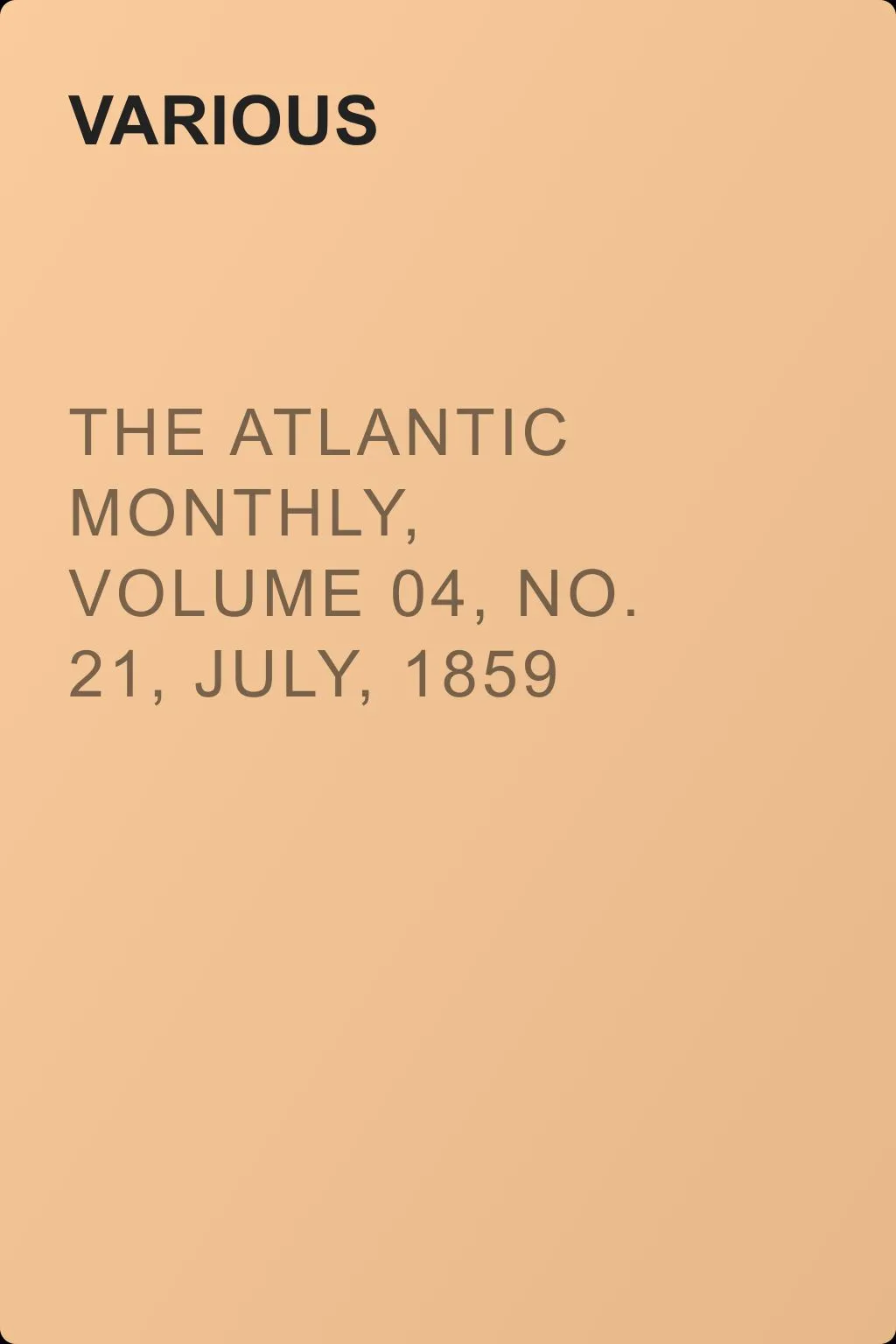
The Atlantic Monthly, Volume 04, No. 21, July, 1859
Автор Various12+
Удобнее читать в приложении
AI-разбор доступен после входа
Суть книги, пересказ, главный конфликт, ключевые идеи, вывод, кому полезна, главные темы, персонажи и цитаты можно получить после входа в BookRa.
auto_awesomeПолучить AI-разборО книге
Дата написания1970-01-01
Язык книгиen
Возрастное ограничение12+
Читать онлайн
Страница 2 из 74But the real issue between the two parties, which underlay all their proposed measures and professed principles, was the old struggle of classes, modified of course by the time and the place. The Democrats contended for perfect equality, political and social, and as little power as possible in the central government so long as their party was not in command. The Federalists, who held the reins, were for a strong conservative administration, and a wholesome distinction of classes. The two parties were not long in waiting for flags to rally around, and fresh fields on which to fight. The French Revolution furnished both. In its early stages it had excited a general sympathy in America; and, indeed, so has every foreign insurrection, rebellion, or riot since, no matter where or why it occurred, provided good use has been made of the sacred words Revolution and Liberty. This cry has never been echoed in this country without exciting a large body of men to mass-meetings, dinners, and other public demonstrations, who do not stop to consider what it means, or whether, in the immediate instance, it has any meaning at all. John Adams said in his "Defence of American Constitutions," "Our countrymen will never run delirious after a word or a name." Mr. Adams was much mistaken. If, according to the Latin proverb, a word is sufficient for a wise man, so, in another sense, it is all that is needful for fools. But as the Revolution advanced in France towards republicanism, the Federalists, who thought the English system, less the king and the hereditary lords, the best scheme of government, began to grow lukewarm. When it became evident that the New Era was to end in bloodshed, instead of universal peace and good-will towards men,—that the Rights of Man included murder, confiscation, and atheism,—that the Sovereignty of the People meant the rule of King Mob, who seemed determined to carry out to the letter Diderot's famous couplet,—
"Et des boyaux du dernier prêtre Serrez le cou du dernier des rois,"—
then the adjective French became in Federal mouths an epithet of abhorrence and abuse; up went the flag of dear Old England, the defender of the faith and of social order. The opposition party, on the contrary, saw in the success of the French people, in their overthrow of kings and nobles, a cheerful encouragement to their own struggle against the aristocratic Federalists, and would allow no sanguinary irregularities to divert their sympathy from the great Democratic triumph abroad. The gay folds of the tricolor which floated over them seemed to shed upon their heads a mild influence of that Gallic madness that led them into absurdities we could not now believe, were they not on record. The fashions, sartorial and social, of the French were affected; amiable Yankees called each other citizen, invented the feminine citess, and proposed changing our old calendar for the Ventose and Fructidor arrangement of the one and indivisible republic. (We wish they had adopted their admirable system of weights and measures.) Divines are said to have offered up thanks to the Supreme Being for the success of the good Sans-culottes. At all events, their victories were celebrated by civic festivals and the discharge of cannon; the English flag was burned as a sacrifice to the Goddess of Liberty; a French frigate took a prize off the Capes of the Delaware, and sent her in to Philadelphia; thousands of the populace crowded the wharves, and, when the British colors were seen reversed, and the French flying over them, burst into exulting hurras. When a report came that the Duke of York was a prisoner and shown in a cage in Paris, all the bells of Philadelphia rang peals of joy for the downfall of tyrants. Here is the story of a civic fête given at Reading, in Massachusetts, which we extract from a newspaper of the time as a specimen of the Gallo-Yankee absurdities perpetrated by our grandfathers:—
"The day was ushered in by the ringing of the bells, and a salute of fifteen discharges from a field-piece. The American flag waved in the wind, and the flag of France over the British in inverted order. At noon a large number of respectable citizens assembled at Citizen Raynor's, and partook of an elegant entertainment. After dinner, Captain Emerson's military company in uniform assembled and escorted the citizens to the meeting-house, where an address pertinent to the occasion was delivered by the Rev. Citizen Prentiss, and united prayers and praises were offered to God, and several hymns and anthems were well sung; after which they returned in procession to Citizen Raynor's, where three farmers, with their frocks and utensils, and with a tree on their shoulders, were escorted by the military company formed in a hollow square to the Common, where the tree was planted in form, as an emblem of freedom, and the Marseillaise Hymn was sung by a choir within a circle round the tree. Major Boardman, by request, superintended the business of the day, and directed the manoeuvres."
In the Gallic jargon then fashionable, England was "an insular Bastille of slaves," and New England "the Vendée of America." On the other side, the Federalists returned cheer for cheer,—looked with true British contempt on the warlike struggles of the restless Frenchman,—chuckled over the disasters which befell "his little popgun fleets,"—and damned the Democrats for a pack of poor, dirty, blasphemous cutthroats. Hate one another was the order of the day. The religious element, which always exasperates dissension, was present. French Democrats had set up the Goddess of Reason (in private life Mme. Momoro) as an object of worship; American Democrats were accused of making Tom Paine's "Age of Reason" their Bible; "Atheist" and "Infidel" were added to the epithets which the Federalists discharged at their foes. So fierce and so general was the quarrel on this European ground, that a distinguished foreigner, then travelling in this country, said that he saw many French and English, but scarcely ever met with an American. Weld, a more humble tourist, put into his book, that in Norfolk, Virginia, he found half the town ready to fight the other half on the French question. Meanwhile, both French and English treated us with ill-disguised contempt, and inflicted open outrages upon our commerce. But it made little difference. One faction was willing to be kicked by England; and the other took a pleasure in being souffleté by France. The rival flags were kept flying until the close of the war of 1812.
Вам также может понравиться
{"page":{"canonicalUrl":"https://bookra.app/books/2GUIMdSU","pageTitle":"The Atlantic Monthly, Volume 04, No. 21, July, 1859 (Various) — полный текст, краткое содержание, анализ и герои","metaDescription":"Полный текст книги «The Atlantic Monthly, Volume 04, No. 21, July, 1859». А также краткое содержание, главные мысли, конфликт, темы, персонажи, цитаты и ответы на вопросы.","headingTitle":"«The Atlantic Monthly, Volume 04, No. 21, July, 1859». Читать бесплатно онлайн","headingSubtitle":"Various","structuredData":[{"@context":"https://schema.org","@type":"BreadcrumbList","@id":"https://bookra.app/books/2GUIMdSU#breadcrumb","itemListElement":[{"@type":"ListItem","position":1,"name":"BookRa","item":"https://bookra.app/"},{"@type":"ListItem","position":2,"name":"зарубежная образовательная литература","item":"https://bookra.app/genre/5217"},{"@type":"ListItem","position":3,"name":"The Atlantic Monthly, Volume 04, No. 21, July, 1859","item":"https://bookra.app/books/2GUIMdSU"}]},{"@context":"https://schema.org","@type":"WebPage","@id":"https://bookra.app/books/2GUIMdSU","url":"https://bookra.app/books/2GUIMdSU","name":"«The Atlantic Monthly, Volume 04, No. 21, July, 1859». Читать бесплатно онлайн","description":"Полный текст книги «The Atlantic Monthly, Volume 04, No. 21, July, 1859». А также краткое содержание, главные мысли, конфликт, темы, персонажи, цитаты и ответы на вопросы.","breadcrumb":{"@id":"https://bookra.app/books/2GUIMdSU#breadcrumb"},"mainEntity":{"@id":"https://bookra.app/books/2GUIMdSU#work"},"primaryImageOfPage":{"@type":"ImageObject","url":"https://storage.yandexcloud.net/bookra-catalog-pd-public/content/ba8b07ff-871a-11e8-bef6-0cc47a5f3f85/thumbs/1200.webp"}},{"@context":"https://schema.org","@type":"Book","@id":"https://bookra.app/books/2GUIMdSU#work","name":"The Atlantic Monthly, Volume 04, No. 21, July, 1859","url":"https://bookra.app/books/2GUIMdSU","description":"Полный текст книги «The Atlantic Monthly, Volume 04, No. 21, July, 1859». А также краткое содержание, главные мысли, конфликт, темы, персонажи, цитаты и ответы на вопросы.","image":"https://storage.yandexcloud.net/bookra-catalog-pd-public/content/ba8b07ff-871a-11e8-bef6-0cc47a5f3f85/thumbs/1200.webp","inLanguage":"en","genre":["зарубежная образовательная литература","зарубежная старинная литература"],"sameAs":["https://litres.ru/book/various-10848091/the-atlantic-monthly-volume-04-no-21-july-1859-35501619/"],"author":[{"@type":"Person","@id":"https://bookra.app/author/6bc78809-ff55-11e6-9c73-0cc47a1952f2#person","name":"Various","url":"https://bookra.app/author/6bc78809-ff55-11e6-9c73-0cc47a1952f2"}],"about":[{"@type":"Thing","name":"зарубежная образовательная литература"},{"@type":"Thing","name":"зарубежная старинная литература"},{"@type":"Thing","name":"чтение онлайн"},{"@type":"Thing","name":"саммари"},{"@type":"Thing","name":"AI-разбор"},{"@type":"Thing","name":"персонажи"},{"@type":"Thing","name":"цитаты"}],"workExample":{"@type":"Book","@id":"https://bookra.app/books/2GUIMdSU#edition","url":"https://bookra.app/books/2GUIMdSU","bookFormat":"https://schema.org/EBook","inLanguage":"en","sameAs":["https://litres.ru/book/various-10848091/the-atlantic-monthly-volume-04-no-21-july-1859-35501619/"],"isAccessibleForFree":true,"potentialAction":{"@type":"ReadAction","name":"Читать бесплатно онлайн «The Atlantic Monthly, Volume 04, No. 21, July, 1859»","target":{"@type":"EntryPoint","urlTemplate":"https://bookra.app/books/2GUIMdSU","actionPlatform":["https://schema.org/DesktopWebPlatform"]},"expectsAcceptanceOf":{"@type":"Offer","category":"nologinrequired"}}}}],"book":{"idCatalog":764660,"shortId":"2GUIMdSU","title":"The Atlantic Monthly, Volume 04, No. 21, July, 1859","coverUrl":"https://storage.yandexcloud.net/bookra-catalog-pd-public/content/ba8b07ff-871a-11e8-bef6-0cc47a5f3f85/thumbs/1200.webp","annotationText":"","catalogType":"PUBLIC_DOMAIN","catalogTypeLabel":"Общественное достояние","authorLine":"Various","authors":[{"id":"6bc78809-ff55-11e6-9c73-0cc47a1952f2","displayName":"Various","protectedUrl":"/author/6bc78809-ff55-11e6-9c73-0cc47a1952f2","wikipediaUrl":null,"wikidataUrl":null}],"genres":[{"id":5217,"title":"зарубежная образовательная литература","token":null,"publicUrl":"https://bookra.app/genre/5217"},{"id":5215,"title":"зарубежная старинная литература","token":null,"publicUrl":"https://bookra.app/genre/5215"}],"keywords":[],"facts":[{"key":"dateWritten","label":"Дата написания","value":"1970-01-01"},{"key":"bookLanguage","label":"Язык книги","value":"en"},{"key":"adult","label":"Возрастное ограничение","value":"12+"}],"seoSections":[],"authorSummary":null,"hasArtifacts":false,"canReadInApp":true,"readUrl":"https://web.bookra.app/?startapp=r_764660","artifactsUrl":"https://web.bookra.app/?startapp=b_764660","readCtaLabel":"Читать бесплатно","artifactsCtaLabel":"AI-разбор","appReadLinks":{"tg":"https://t.me/bookra_lib_bot/BookRa?startapp=r_764660","vk":"https://vk.com/app54470698#startapp=r_764660","max":"https://max.ru/id7751370047_bot?startapp=r_764660","web":"https://web.bookra.app/?startapp=r_764660"},"appAnalysisLinks":{"tg":"https://t.me/bookra_lib_bot/BookRa?startapp=b_764660","vk":"https://vk.com/app54470698#startapp=b_764660","max":"https://max.ru/id7751370047_bot?startapp=b_764660","web":"https://web.bookra.app/?startapp=b_764660"},"guestReaderUrl":"/books/2GUIMdSU?page=2#reader-content","authorCtaLabel":"Все книги автора","authorProtectedUrl":"/author/6bc78809-ff55-11e6-9c73-0cc47a1952f2","readersCount":0,"adultLabel":"12+","yearLabel":null,"datePublished":null,"publisherLabel":null,"isbn":null,"oclc":null,"lccn":null,"partnerUrl":null,"accessNote":"Полный текст книги и AI-разбор откроются на защищенных страницах BookRa после входа."},"reader":{"page":2,"totalPages":74,"hasPrev":true,"hasNext":true,"prevPageUrl":"/books/2GUIMdSU#reader-content","nextPageUrl":"/books/2GUIMdSU?page=3#reader-content","progressLabel":"Страница 2 из 74","sections":[{"id":"content0:9","kind":"paragraph","text":"But the real issue between the two parties, which underlay all their proposed measures and professed principles, was the old struggle of classes, modified of course by the time and the place. The Democrats contended for perfect equality, political and social, and as little power as possible in the central government so long as their party was not in command. The Federalists, who held the reins, were for a strong conservative administration, and a wholesome distinction of classes. The two parties were not long in waiting for flags to rally around, and fresh fields on which to fight. The French Revolution furnished both. In its early stages it had excited a general sympathy in America; and, indeed, so has every foreign insurrection, rebellion, or riot since, no matter where or why it occurred, provided good use has been made of the sacred words Revolution and Liberty. This cry has never been echoed in this country without exciting a large body of men to mass-meetings, dinners, and other public demonstrations, who do not stop to consider what it means, or whether, in the immediate instance, it has any meaning at all. John Adams said in his \"Defence of American Constitutions,\" \"Our countrymen will never run delirious after a word or a name.\" Mr. Adams was much mistaken. If, according to the Latin proverb, a word is sufficient for a wise man, so, in another sense, it is all that is needful for fools. But as the Revolution advanced in France towards republicanism, the Federalists, who thought the English system, less the king and the hereditary lords, the best scheme of government, began to grow lukewarm. When it became evident that the New Era was to end in bloodshed, instead of universal peace and good-will towards men,—that the Rights of Man included murder, confiscation, and atheism,—that the Sovereignty of the People meant the rule of King Mob, who seemed determined to carry out to the letter Diderot's famous couplet,—"},{"id":"content0:10","kind":"paragraph","text":"\"Et des boyaux du dernier prêtre Serrez le cou du dernier des rois,\"—"},{"id":"content0:11","kind":"paragraph","text":"then the adjective French became in Federal mouths an epithet of abhorrence and abuse; up went the flag of dear Old England, the defender of the faith and of social order. The opposition party, on the contrary, saw in the success of the French people, in their overthrow of kings and nobles, a cheerful encouragement to their own struggle against the aristocratic Federalists, and would allow no sanguinary irregularities to divert their sympathy from the great Democratic triumph abroad. The gay folds of the tricolor which floated over them seemed to shed upon their heads a mild influence of that Gallic madness that led them into absurdities we could not now believe, were they not on record. The fashions, sartorial and social, of the French were affected; amiable Yankees called each other citizen, invented the feminine citess, and proposed changing our old calendar for the Ventose and Fructidor arrangement of the one and indivisible republic. (We wish they had adopted their admirable system of weights and measures.) Divines are said to have offered up thanks to the Supreme Being for the success of the good Sans-culottes. At all events, their victories were celebrated by civic festivals and the discharge of cannon; the English flag was burned as a sacrifice to the Goddess of Liberty; a French frigate took a prize off the Capes of the Delaware, and sent her in to Philadelphia; thousands of the populace crowded the wharves, and, when the British colors were seen reversed, and the French flying over them, burst into exulting hurras. When a report came that the Duke of York was a prisoner and shown in a cage in Paris, all the bells of Philadelphia rang peals of joy for the downfall of tyrants. Here is the story of a civic fête given at Reading, in Massachusetts, which we extract from a newspaper of the time as a specimen of the Gallo-Yankee absurdities perpetrated by our grandfathers:—"},{"id":"content0:12","kind":"paragraph","text":"\"The day was ushered in by the ringing of the bells, and a salute of fifteen discharges from a field-piece. The American flag waved in the wind, and the flag of France over the British in inverted order. At noon a large number of respectable citizens assembled at Citizen Raynor's, and partook of an elegant entertainment. After dinner, Captain Emerson's military company in uniform assembled and escorted the citizens to the meeting-house, where an address pertinent to the occasion was delivered by the Rev. Citizen Prentiss, and united prayers and praises were offered to God, and several hymns and anthems were well sung; after which they returned in procession to Citizen Raynor's, where three farmers, with their frocks and utensils, and with a tree on their shoulders, were escorted by the military company formed in a hollow square to the Common, where the tree was planted in form, as an emblem of freedom, and the Marseillaise Hymn was sung by a choir within a circle round the tree. Major Boardman, by request, superintended the business of the day, and directed the manoeuvres.\""},{"id":"content0:13","kind":"paragraph","text":"In the Gallic jargon then fashionable, England was \"an insular Bastille of slaves,\" and New England \"the Vendée of America.\" On the other side, the Federalists returned cheer for cheer,—looked with true British contempt on the warlike struggles of the restless Frenchman,—chuckled over the disasters which befell \"his little popgun fleets,\"—and damned the Democrats for a pack of poor, dirty, blasphemous cutthroats. Hate one another was the order of the day. The religious element, which always exasperates dissension, was present. French Democrats had set up the Goddess of Reason (in private life Mme. Momoro) as an object of worship; American Democrats were accused of making Tom Paine's \"Age of Reason\" their Bible; \"Atheist\" and \"Infidel\" were added to the epithets which the Federalists discharged at their foes. So fierce and so general was the quarrel on this European ground, that a distinguished foreigner, then travelling in this country, said that he saw many French and English, but scarcely ever met with an American. Weld, a more humble tourist, put into his book, that in Norfolk, Virginia, he found half the town ready to fight the other half on the French question. Meanwhile, both French and English treated us with ill-disguised contempt, and inflicted open outrages upon our commerce. But it made little difference. One faction was willing to be kicked by England; and the other took a pleasure in being souffleté by France. The rival flags were kept flying until the close of the war of 1812."}],"toc":[{"id":"content0:0:1","label":"Various The Atlantic Monthly, Volume 04, No. 21, July, 1859 / A Magazine of Literature, Art, and Politics","page":1,"pageUrl":"/books/2GUIMdSU#reader-content"},{"id":"content0:1:1","label":"THOMAS PAINE'S","page":1,"pageUrl":"/books/2GUIMdSU#reader-content"},{"id":"content0:2:1","label":"SECOND APPEARANCE IN THE UNITED STATES","page":1,"pageUrl":"/books/2GUIMdSU#reader-content"},{"id":"content1:0:10","label":"OF BOOKS AND THE READING THEREOF","page":10,"pageUrl":"/books/2GUIMdSU?page=10#reader-content"},{"id":"content2:0:15","label":"AFTER THE BALL","page":15,"pageUrl":"/books/2GUIMdSU?page=15#reader-content"},{"id":"content2:2:15","label":"ROCK, TREE, AND MAN","page":15,"pageUrl":"/books/2GUIMdSU?page=15#reader-content"},{"id":"content2:43:22","label":"CHIP DARTMOUTH","page":22,"pageUrl":"/books/2GUIMdSU?page=22#reader-content"},{"id":"content2:226:31","label":"SEEN AND UNSEEN","page":31,"pageUrl":"/books/2GUIMdSU?page=31#reader-content"},{"id":"content3:0:31","label":"PERCIVAL","page":31,"pageUrl":"/books/2GUIMdSU?page=31#reader-content"},{"id":"content3:70:39","label":"ZELMA'S VOW","page":39,"pageUrl":"/books/2GUIMdSU?page=39#reader-content"},{"id":"content3:71:39","label":"IN TWO PARTS","page":39,"pageUrl":"/books/2GUIMdSU?page=39#reader-content"},{"id":"content3:72:39","label":"PART FIRST. HOW IT WAS MADE","page":39,"pageUrl":"/books/2GUIMdSU?page=39#reader-content"},{"id":"content3:162:45","label":"WILLIAM SHAKESPEARE,","page":45,"pageUrl":"/books/2GUIMdSU?page=45#reader-content"},{"id":"content3:163:45","label":"ATTORNEY AT LAW AND SOLICITOR IN CHANCERY","page":45,"pageUrl":"/books/2GUIMdSU?page=45#reader-content"},{"id":"content3:168:46","label":"CHAPTER I","page":46,"pageUrl":"/books/2GUIMdSU?page=46#reader-content"},{"id":"content3:169:46","label":"THE FUGITIVE","page":46,"pageUrl":"/books/2GUIMdSU?page=46#reader-content"},{"id":"content4:0:57","label":"THE MINISTER'S WOOING","page":57,"pageUrl":"/books/2GUIMdSU?page=57#reader-content"},{"id":"content4:2:57","label":"CHAPTER XVI","page":57,"pageUrl":"/books/2GUIMdSU?page=57#reader-content"},{"id":"content4:92:62","label":"CHAPTER XVII","page":62,"pageUrl":"/books/2GUIMdSU?page=62#reader-content"},{"id":"content4:132:64","label":"THE PROFESSOR AT THE BREAKFAST-TABLE","page":64,"pageUrl":"/books/2GUIMdSU?page=64#reader-content"},{"id":"content4:133:64","label":"WHAT HE SAID, WHAT HE HEARD, AND WHAT HE SAW","page":64,"pageUrl":"/books/2GUIMdSU?page=64#reader-content"},{"id":"content4:201:69","label":"ROBINSON OF LEYDEN","page":69,"pageUrl":"/books/2GUIMdSU?page=69#reader-content"},{"id":"content4:204:70","label":"ART","page":70,"pageUrl":"/books/2GUIMdSU?page=70#reader-content"},{"id":"content4:205:70","label":"THE HEART OF THE ANDES","page":70,"pageUrl":"/books/2GUIMdSU?page=70#reader-content"},{"id":"content4:213:70","label":"REVIEWS AND LITERARY NOTICES","page":70,"pageUrl":"/books/2GUIMdSU?page=70#reader-content"},{"id":"contentnotes0:0:73","label":"1","page":73,"pageUrl":"/books/2GUIMdSU?page=73#reader-content"},{"id":"contentnotes0:3:74","label":"2","page":74,"pageUrl":"/books/2GUIMdSU?page=74#reader-content"},{"id":"contentnotes0:6:74","label":"3","page":74,"pageUrl":"/books/2GUIMdSU?page=74#reader-content"},{"id":"contentnotes0:9:74","label":"4","page":74,"pageUrl":"/books/2GUIMdSU?page=74#reader-content"},{"id":"contentnotes0:12:74","label":"5","page":74,"pageUrl":"/books/2GUIMdSU?page=74#reader-content"},{"id":"contentnotes0:15:74","label":"6","page":74,"pageUrl":"/books/2GUIMdSU?page=74#reader-content"},{"id":"contentnotes0:18:74","label":"7","page":74,"pageUrl":"/books/2GUIMdSU?page=74#reader-content"},{"id":"contentnotes0:21:74","label":"8","page":74,"pageUrl":"/books/2GUIMdSU?page=74#reader-content"}]},"similarBooks":[{"idCatalog":792538,"shortId":"3mVN2TRg","title":"Государь","authorLine":"Никколо Макиавелли","primaryAuthorId":"7fcb44f8-2a81-102a-9ae1-2dfe723fe7c7","coverUrl":"https://storage.yandexcloud.net/bookra-catalog-pd-public/content/de5c6783-ed65-538d-be5c-e8a41100356b/thumbs/400.webp","publicUrl":"https://bookra.app/books/3mVN2TRg"},{"idCatalog":803360,"shortId":"20EgCd5y","title":"Диалоги","authorLine":"Платон","primaryAuthorId":"bfbcc84f-2a93-102a-9ac3-800cba805322","coverUrl":"https://storage.yandexcloud.net/bookra-catalog-pd-public/content/d0a029c9-5474-11e9-aa86-0cc47a5453d6/thumbs/400.webp","publicUrl":"https://bookra.app/books/20EgCd5y"},{"idCatalog":16956,"shortId":"3eahNTLe","title":"История","authorLine":"Геродот, Георгий Андреевич Стратановский","primaryAuthorId":"bf200f87-2a93-102a-9ac3-800cba805322","coverUrl":"https://storage.yandexcloud.net/bookra-catalog-litres-public/content/0179c752-4be8-11e5-87ef-0025905a06ea/thumbs/400.webp","publicUrl":"https://bookra.app/books/3eahNTLe"},{"idCatalog":163478,"shortId":"1T5NB3Ce","title":"Трактат о военном искусстве","authorLine":"Сунь-цзы, Николай Иосифович Конрад","primaryAuthorId":"af833b18-2a93-102a-9ac3-800cba805322","coverUrl":"https://storage.yandexcloud.net/bookra-catalog-litres-public/content/66c147fd-191c-11e7-9b47-0cc47a5203ba/thumbs/400.webp","publicUrl":"https://bookra.app/books/1T5NB3Ce"},{"idCatalog":794304,"shortId":"2Gcx9zNO","title":"МЕТАФИЗИКА","authorLine":"Аристотель","primaryAuthorId":"76572bf3-2a93-102a-9ac3-800cba805322","coverUrl":"https://storage.yandexcloud.net/bookra-catalog-pd-public/content/67e57a46-33ce-52fa-9b09-72ebec56a682/thumbs/400.webp","publicUrl":"https://bookra.app/books/2Gcx9zNO"},{"idCatalog":803361,"shortId":"3ZYkMgZn","title":"Апология Сократа","authorLine":"Платон, Михаил Сергеевич Соловьев","primaryAuthorId":"bfbcc84f-2a93-102a-9ac3-800cba805322","coverUrl":"https://storage.yandexcloud.net/bookra-catalog-pd-public/content/e9085dd7-2175-11e8-9a05-0cc47a52085c/thumbs/400.webp","publicUrl":"https://bookra.app/books/3ZYkMgZn"},{"idCatalog":229496,"shortId":"4VRUv1qU","title":"Бусидо","authorLine":"Юдзан Дайдодзи, Цунэтомо Ямамото, А. А. Петрова, Р. В. Котенко, А. А. Мищенко","primaryAuthorId":"298e0100-5115-11e2-b3a9-002590591dd6","coverUrl":"https://storage.yandexcloud.net/bookra-catalog-litres-public/content/30b8b29f-c19e-11e8-bb1b-0cc47a5203ba/thumbs/400.webp","publicUrl":"https://bookra.app/books/4VRUv1qU"},{"idCatalog":803364,"shortId":"4BU69zeg","title":"Пир","authorLine":"Платон, Василий Николаевич Карпов","primaryAuthorId":"bfbcc84f-2a93-102a-9ac3-800cba805322","coverUrl":"https://storage.yandexcloud.net/bookra-catalog-pd-public/content/1af9e6cd-217a-11e8-9a05-0cc47a52085c/thumbs/400.webp","publicUrl":"https://bookra.app/books/4BU69zeg"},{"idCatalog":78865,"shortId":"4D2jf48p","title":"О природе вещей","authorLine":"И. Рачинский, Тит Лукреций Кар","primaryAuthorId":"825f947f-7c07-11e2-8493-002590591ed2","coverUrl":"https://storage.yandexcloud.net/bookra-catalog-litres-public/content/ed0916f3-7c07-11e2-8493-002590591ed2/thumbs/400.webp","publicUrl":"https://bookra.app/books/4D2jf48p"},{"idCatalog":794536,"shortId":"4Ca43bP4","title":"Риторика","authorLine":"Аристотель, Надежда Николаевна Платонова","primaryAuthorId":"76572bf3-2a93-102a-9ac3-800cba805322","coverUrl":"https://storage.yandexcloud.net/bookra-catalog-pd-public/content/99d87ece-3c8c-11e7-b2fb-0cc47a52085c/thumbs/400.webp","publicUrl":"https://bookra.app/books/4Ca43bP4"},{"idCatalog":66597,"shortId":"2dyvti99","title":"История Рима от основания Города","authorLine":"Тит Ливий, П. Андрианов","primaryAuthorId":"bfab7b16-2a93-102a-9ac3-800cba805322","coverUrl":"https://storage.yandexcloud.net/bookra-catalog-litres-public/content/8ef6df4c-1f78-11e1-aac2-5924aae99221/thumbs/400.webp","publicUrl":"https://bookra.app/books/2dyvti99"},{"idCatalog":60340,"shortId":"2bXVBb6o","title":"Мифы и легенды Греции и Рима","authorLine":"Эдит Гамильтон, Л. А. Игоревский","primaryAuthorId":"75b1416f-7dab-11e0-9959-47117d41cf4b","coverUrl":"https://storage.yandexcloud.net/bookra-catalog-litres-public/content/89fd37ea-7dab-11e0-9959-47117d41cf4b/thumbs/400.webp","publicUrl":"https://bookra.app/books/2bXVBb6o"}],"similarBooksPagination":{"page":1,"pageSize":12,"totalItems":803,"totalPages":67,"hasPrev":false,"hasNext":true}},"notFound":false}