Читать бесплатно онлайн
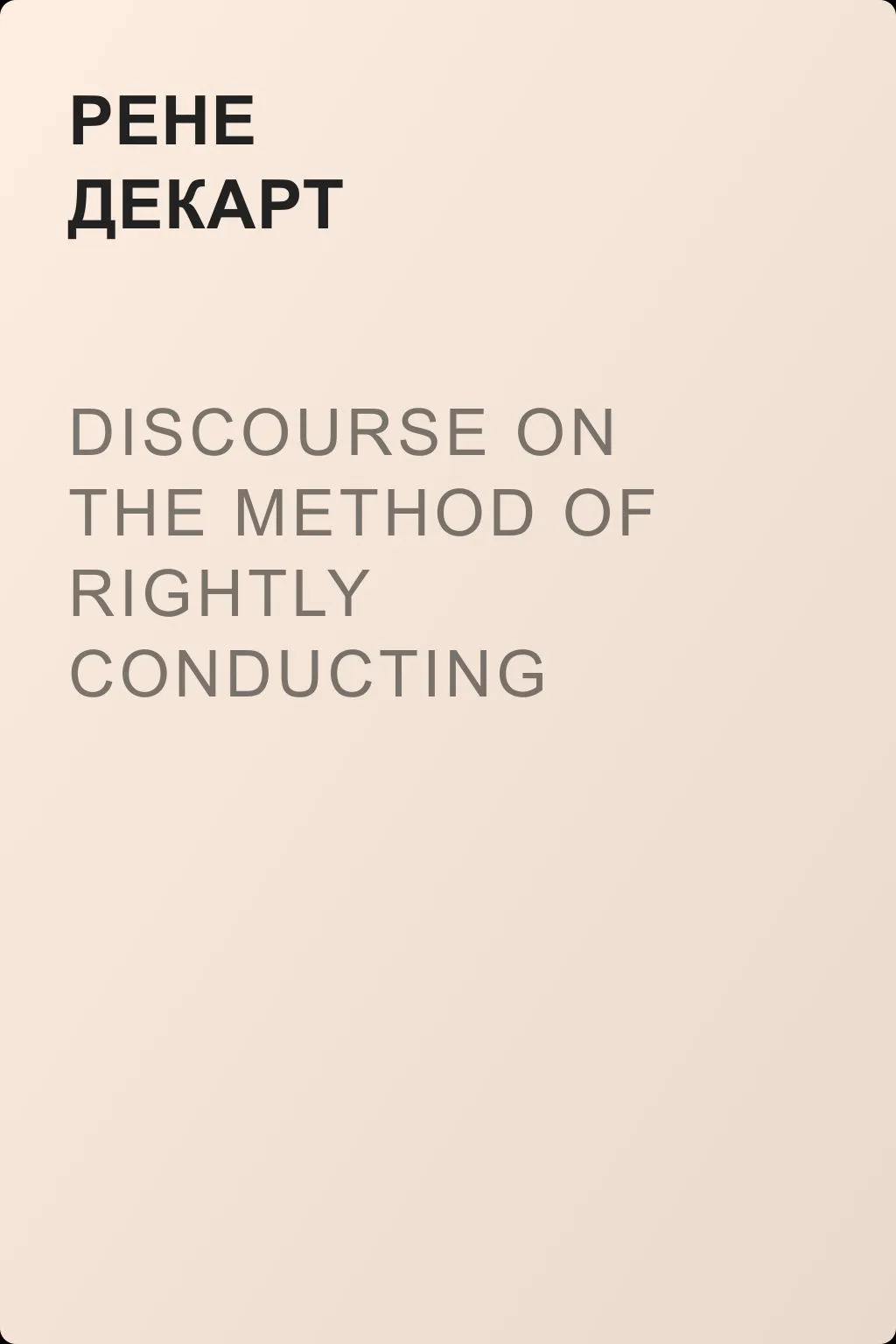
Discourse on the Method of Rightly Conducting One's Reason and of Seeking Truth in the Sciences
Автор Рене Декарт12+
Удобнее читать в приложении
Дата написания1970-01-01
Язык книгиen
Язык оригиналаfr
Возрастное ограничение12+
Описание
Рене Декарт в своём дискурсе развивает метод сомнения, подчёркивая равенство разума, критика традиционного образования и важность практического опыта. Он формулирует четыре принципа метода, применяет их к математике и другим наукам, и в заключении размышляет о природе, душе и физиологии, оставляя свои работы частично непубликуемыми из‑за опасений.
Главный конфликт / проблема
Как достичь истинного знания, избегая ошибок и сомнений, и как применить метод сомнения к разным областям науки и жизни.
Ключевые идеи
- Разум одинаково распространён, различия в мнениях обусловлены разными путями мышления.
- Сильный ум требует правильного применения; без него даже великие могут ошибаться.
- Традиционное образование может усиливать невежество, если не сопровождается критическим мышлением.
- Практический опыт и наблюдение за реальными людьми более ценны, чем абстрактные теории.
- Самопознание и изучение мира через собственный опыт являются ключом к истинному знанию.
- Совершенство достигается, когда работа создаётся одним автором.
- Реформы государства и науки невозможны без полного пересмотра их основ.
- Метод сомнения основан на четырёх принципах: ясность, разложение, последовательность и полнота.
- Идеи, ясно и отчетливо понятные, истинны, потому что они исходят от совершенного разума.
- Единственный принципы – существование Бога и души; остальные истины вытекают из геометрических доказательств.
- Мир возник из хаоса, управляемого законами природы; свет распространяется мгновенно и отражается от небесных тел.
- Физиология сердца и кровеносной системы объясняется через тепло, клапаны и циркуляцию крови.
Вывод
Идея, что истинные знания исходят от разума и Бога, и метод сомнения позволяет их достичь, при этом практический опыт и критическое мышление являются ключевыми инструментами.
Кому полезна
- Философы
- Учёные
- Студенты философии и естественных наук
- Люди, интересующиеся методологией и критическим мышлением
Главные темы
- Метод сомнения
- Критика традиционного образования
- Практический опыт
- Философия разума и Бога
- Физиология и природа
Персонажи
- Рене Декарт — Философ и автор, Рене Декарт, анализирует собственный путь к знанию, отвергая традиционное образование в пользу практического опыта и самопознания. Он размышляет о совершенстве, реформах и методах сомнения, стремясь к самосовершенствованию. В своих работах описывает природу, законы, создание мира, физиологию и душу, а также отказывается от публикации из‑за опасений.
- Незваный врач из Англии — Утверждает существование мелких проходов в сосудах, обеспечивающих циркуляцию крови.
Цитаты
- «Разум, или хороший смысл, равномерно распространён среди всех людей…»
- «Я решил посвятить себя самопознанию и изучению большой книги мира, используя свой разум для выбора правильного пути в жизни.»
- Я думаю, следовательно, я существую.
- Все ясно и отчетливо понятные идеи истинны, потому что они исходят от совершенного разума.
- «Я всегда оставался привержен своему первоначальному решению предполагать только тот принцип, о котором я недавно воспользовался, чтобы доказать существование Бога и души»
- «Я никогда не придавал большого значения тому, что происходит из моего разума; пока я не нашёл в своём методе никакой иной пользы, кроме удовлетворения себя в некоторых трудностях, я не считал нужным публиковать»
Сводка по автору из Wikidata
1596–1650. René Descartes. французский философ, математик, механик, физик и физиолог
Читать онлайн
Страница 2 из 17I still continued, however, to hold in esteem the studies of the schools. I was aware that the languages taught in them are necessary to the understanding of the writings of the ancients; that the grace of fable stirs the mind; that the memorable deeds of history elevate it; and, if read with discretion, aid in forming the judgment; that the perusal of all excellent books is, as it were, to interview with the noblest men of past ages, who have written them, and even a studied interview, in which are discovered to us only their choicest thoughts; that eloquence has incomparable force and beauty; that poesy has its ravishing graces and delights; that in the mathematics there are many refined discoveries eminently suited to gratify the inquisitive, as well as further all the arts an lessen the labour of man; that numerous highly useful precepts and exhortations to virtue are contained in treatises on morals; that theology points out the path to heaven; that philosophy affords the means of discoursing with an appearance of truth on all matters, and commands the admiration of the more simple; that jurisprudence, medicine, and the other sciences, secure for their cultivators honors and riches; and, in fine, that it is useful to bestow some attention upon all, even upon those abounding the most in superstition and error, that we may be in a position to determine their real value, and guard against being deceived.
But I believed that I had already given sufficient time to languages, and likewise to the reading of the writings of the ancients, to their histories and fables. For to hold converse with those of other ages and to travel, are almost the same thing. It is useful to know something of the manners of different nations, that we may be enabled to form a more correct judgment regarding our own, and be prevented from thinking that everything contrary to our customs is ridiculous and irrational, a conclusion usually come to by those whose experience has been limited to their own country. On the other hand, when too much time is occupied in traveling, we become strangers to our native country; and the over curious in the customs of the past are generally ignorant of those of the present. Besides, fictitious narratives lead us to imagine the possibility of many events that are impossible; and even the most faithful histories, if they do not wholly misrepresent matters, or exaggerate their importance to render the account of them more worthy of perusal, omit, at least, almost always the meanest and least striking of the attendant circumstances; hence it happens that the remainder does not represent the truth, and that such as regulate their conduct by examples drawn from this source, are apt to fall into the extravagances of the knight-errants of romance, and to entertain projects that exceed their powers.
I esteemed eloquence highly, and was in raptures with poesy; but I thought that both were gifts of nature rather than fruits of study. Those in whom the faculty of reason is predominant, and who most skillfully dispose their thoughts with a view to render them clear and intelligible, are always the best able to persuade others of the truth of what they lay down, though they should speak only in the language of Lower Brittany, and be wholly ignorant of the rules of rhetoric; and those whose minds are stored with the most agreeable fancies, and who can give expression to them with the greatest embellishment and harmony, are still the best poets, though unacquainted with the art of poetry.
I was especially delighted with the mathematics, on account of the certitude and evidence of their reasonings; but I had not as yet a precise knowledge of their true use; and thinking that they but contributed to the advancement of the mechanical arts, I was astonished that foundations, so strong and solid, should have had no loftier superstructure reared on them. On the other hand, I compared the disquisitions of the ancient moralists to very towering and magnificent palaces with no better foundation than sand and mud: they laud the virtues very highly, and exhibit them as estimable far above anything on earth; but they give us no adequate criterion of virtue, and frequently that which they designate with so fine a name is but apathy, or pride, or despair, or parricide.
I revered our theology, and aspired as much as any one to reach heaven: but being given assuredly to understand that the way is not less open to the most ignorant than to the most learned, and that the revealed truths which lead to heaven are above our comprehension, I did not presume to subject them to the impotency of my reason; and I thought that in order competently to undertake their examination, there was need of some special help from heaven, and of being more than man.
Of philosophy I will say nothing, except that when I saw that it had been cultivated for many ages by the most distinguished men, and that yet there is not a single matter within its sphere which is not still in dispute, and nothing, therefore, which is above doubt, I did not presume to anticipate that my success would be greater in it than that of others; and further, when I considered the number of conflicting opinions touching a single matter that may be upheld by learned men, while there can be but one true, I reckoned as well-nigh false all that was only probable.
As to the other sciences, inasmuch as these borrow their principles from philosophy, I judged that no solid superstructures could be reared on foundations so infirm; and neither the honor nor the gain held out by them was sufficient to determine me to their cultivation: for I was not, thank Heaven, in a condition which compelled me to make merchandise of science for the bettering of my fortune; and though I might not profess to scorn glory as a cynic, I yet made very slight account of that honor which I hoped to acquire only through fictitious titles. And, in fine, of false sciences I thought I knew the worth sufficiently to escape being deceived by the professions of an alchemist, the predictions of an astrologer, the impostures of a magician, or by the artifices and boasting of any of those who profess to know things of which they are ignorant.
For these reasons, as soon as my age permitted me to pass from under the control of my instructors, I entirely abandoned the study of letters, and resolved no longer to seek any other science than the knowledge of myself, or of the great book of the world. I spent the remainder of my youth in traveling, in visiting courts and armies, in holding intercourse with men of different dispositions and ranks, in collecting varied experience, in proving myself in the different situations into which fortune threw me, and, above all, in making such reflection on the matter of my experience as to secure my improvement. For it occurred to me that I should find much more truth in the reasonings of each individual with reference to the affairs in which he is personally interested, and the issue of which must presently punish him if he has judged amiss, than in those conducted by a man of letters in his study, regarding speculative matters that are of no practical moment, and followed by no consequences to himself, farther, perhaps, than that they foster his vanity the better the more remote they are from common sense; requiring, as they must in this case, the exercise of greater ingenuity and art to render them probable. In addition, I had always a most earnest desire to know how to distinguish the true from the false, in order that I might be able clearly to discriminate the right path in life, and proceed in it with confidence.
Вам также может понравиться
{"page":{"canonicalUrl":"https://bookra.app/books/2ZVNfGSh","pageTitle":"Discourse on the Method of Rightly Conducting One\u0026apos;s Reason and of Seeking Truth in the Sciences (Рене Декарт) — полный текст, краткое содержание, анализ и герои","metaDescription":"Полный текст книги «Discourse on the Method of Rightly Conducting One\u0026apos;s Reason and of Seeking Truth in the Sciences». А также краткое содержание, главные мысли, конфликт, темы, персонажи, цитаты и ответы на вопрос…","headingTitle":"«Discourse on the Method of Rightly Conducting One\u0026apos;s Reason and of Seeking Truth in the Sciences». Читать бесплатно онлайн","headingSubtitle":"Рене Декарт, John Veitch","structuredData":[{"@context":"https://schema.org","@type":"BreadcrumbList","@id":"https://bookra.app/books/2ZVNfGSh#breadcrumb","itemListElement":[{"@type":"ListItem","position":1,"name":"BookRa","item":"https://bookra.app/"},{"@type":"ListItem","position":2,"name":"зарубежная образовательная литература","item":"https://bookra.app/genre/5217"},{"@type":"ListItem","position":3,"name":"Discourse on the Method of Rightly Conducting One\u0026apos;s Reason and of Seeking Truth in the Sciences","item":"https://bookra.app/books/2ZVNfGSh"}]},{"@context":"https://schema.org","@type":"WebPage","@id":"https://bookra.app/books/2ZVNfGSh","url":"https://bookra.app/books/2ZVNfGSh","name":"«Discourse on the Method of Rightly Conducting One\u0026apos;s Reason and of Seeking Truth in the Sciences». Читать бесплатно онлайн","description":"Полный текст книги «Discourse on the Method of Rightly Conducting One\u0026apos;s Reason and of Seeking Truth in the Sciences». А также краткое содержание, главные мысли, конфликт, темы, персонажи, цитаты и ответы на вопрос…","breadcrumb":{"@id":"https://bookra.app/books/2ZVNfGSh#breadcrumb"},"mainEntity":{"@id":"https://bookra.app/books/2ZVNfGSh#work"},"primaryImageOfPage":{"@type":"ImageObject","url":"https://storage.yandexcloud.net/bookra-catalog-pd-public/content/84ebbd4a-786e-11e8-b0db-0cc47a52085c/thumbs/1200.webp"}},{"@context":"https://schema.org","@type":"Book","@id":"https://bookra.app/books/2ZVNfGSh#work","name":"Discourse on the Method of Rightly Conducting One\u0026apos;s Reason and of Seeking Truth in the Sciences","url":"https://bookra.app/books/2ZVNfGSh","description":"Рене Декарт в своём дискурсе развивает метод сомнения, подчёркивая равенство разума, критика традиционного образования и важность практического опыта. Он формулирует четыре принципа метода, применяет их к математике и другим наукам, и в заключении размышляет о природе, душе и физиологии, оставляя свои работы частично непубликуемыми из‑за опасений.","image":"https://storage.yandexcloud.net/bookra-catalog-pd-public/content/84ebbd4a-786e-11e8-b0db-0cc47a52085c/thumbs/1200.webp","inLanguage":"en","genre":["зарубежная образовательная литература","зарубежная старинная литература","книги по философии"],"author":[{"@type":"Person","@id":"https://bookra.app/author/9fd5af77-2a93-102a-9ac3-800cba805322#person","name":"Рене Декарт","url":"https://bookra.app/author/9fd5af77-2a93-102a-9ac3-800cba805322","sameAs":["https://ru.wikipedia.org/wiki/%D0%94%D0%B5%D0%BA%D0%B0%D1%80%D1%82%2C_%D0%A0%D0%B5%D0%BD%D0%B5","https://www.wikidata.org/wiki/Q9191"]}],"about":[{"@type":"Thing","name":"зарубежная образовательная литература"},{"@type":"Thing","name":"зарубежная старинная литература"},{"@type":"Thing","name":"книги по философии"},{"@type":"Thing","name":"чтение онлайн"},{"@type":"Thing","name":"саммари"},{"@type":"Thing","name":"AI-разбор"},{"@type":"Thing","name":"персонажи"},{"@type":"Thing","name":"цитаты"}],"workExample":{"@type":"Book","@id":"https://bookra.app/books/2ZVNfGSh#edition","url":"https://bookra.app/books/2ZVNfGSh","bookFormat":"https://schema.org/EBook","inLanguage":"en","isAccessibleForFree":true,"potentialAction":{"@type":"ReadAction","name":"Читать бесплатно онлайн «Discourse on the Method of Rightly Conducting One\u0026apos;s Reason and of Seeking Truth in the Sciences»","target":{"@type":"EntryPoint","urlTemplate":"https://bookra.app/books/2ZVNfGSh","actionPlatform":["https://schema.org/DesktopWebPlatform"]},"expectsAcceptanceOf":{"@type":"Offer","category":"nologinrequired"}}}}],"book":{"idCatalog":795141,"shortId":"2ZVNfGSh","title":"Discourse on the Method of Rightly Conducting One\u0026apos;s Reason and of Seeking Truth in the Sciences","coverUrl":"https://storage.yandexcloud.net/bookra-catalog-pd-public/content/84ebbd4a-786e-11e8-b0db-0cc47a52085c/thumbs/1200.webp","annotationText":"","catalogType":"PUBLIC_DOMAIN","catalogTypeLabel":"Общественное достояние","authorLine":"Рене Декарт, John Veitch","authors":[{"id":"9fd5af77-2a93-102a-9ac3-800cba805322","displayName":"Рене Декарт","protectedUrl":"/author/9fd5af77-2a93-102a-9ac3-800cba805322","wikipediaUrl":"https://ru.wikipedia.org/wiki/%D0%94%D0%B5%D0%BA%D0%B0%D1%80%D1%82%2C_%D0%A0%D0%B5%D0%BD%D0%B5","wikidataUrl":"https://www.wikidata.org/wiki/Q9191"},{"id":"9ddfb98d-7512-11e8-b0db-0cc47a52085c","displayName":"John Veitch","protectedUrl":"/author/9ddfb98d-7512-11e8-b0db-0cc47a52085c","wikipediaUrl":null,"wikidataUrl":null}],"genres":[{"id":5217,"title":"зарубежная образовательная литература","token":null,"publicUrl":"https://bookra.app/genre/5217"},{"id":5215,"title":"зарубежная старинная литература","token":null,"publicUrl":"https://bookra.app/genre/5215"},{"id":6442,"title":"книги по философии","token":null,"publicUrl":"https://bookra.app/genre/6442"}],"keywords":[],"facts":[{"key":"dateWritten","label":"Дата написания","value":"1970-01-01"},{"key":"bookLanguage","label":"Язык книги","value":"en"},{"key":"sourceLanguage","label":"Язык оригинала","value":"fr"},{"key":"adult","label":"Возрастное ограничение","value":"12+"}],"seoSections":[{"key":"summaryShort","title":"Описание","body":"Рене Декарт в своём дискурсе развивает метод сомнения, подчёркивая равенство разума, критика традиционного образования и важность практического опыта. Он формулирует четыре принципа метода, применяет их к математике и другим наукам, и в заключении размышляет о природе, душе и физиологии, оставляя свои работы частично непубликуемыми из‑за опасений."},{"key":"conflict","title":"Главный конфликт / проблема","body":"Как достичь истинного знания, избегая ошибок и сомнений, и как применить метод сомнения к разным областям науки и жизни."},{"key":"keyIdeas","title":"Ключевые идеи","body":["Разум одинаково распространён, различия в мнениях обусловлены разными путями мышления.","Сильный ум требует правильного применения; без него даже великие могут ошибаться.","Традиционное образование может усиливать невежество, если не сопровождается критическим мышлением.","Практический опыт и наблюдение за реальными людьми более ценны, чем абстрактные теории.","Самопознание и изучение мира через собственный опыт являются ключом к истинному знанию.","Совершенство достигается, когда работа создаётся одним автором.","Реформы государства и науки невозможны без полного пересмотра их основ.","Метод сомнения основан на четырёх принципах: ясность, разложение, последовательность и полнота.","Идеи, ясно и отчетливо понятные, истинны, потому что они исходят от совершенного разума.","Единственный принципы – существование Бога и души; остальные истины вытекают из геометрических доказательств.","Мир возник из хаоса, управляемого законами природы; свет распространяется мгновенно и отражается от небесных тел.","Физиология сердца и кровеносной системы объясняется через тепло, клапаны и циркуляцию крови."]},{"key":"conclusion","title":"Вывод","body":"Идея, что истинные знания исходят от разума и Бога, и метод сомнения позволяет их достичь, при этом практический опыт и критическое мышление являются ключевыми инструментами."},{"key":"audience","title":"Кому полезна","body":["Философы","Учёные","Студенты философии и естественных наук","Люди, интересующиеся методологией и критическим мышлением"]},{"key":"topics","title":"Главные темы","body":["Метод сомнения","Критика традиционного образования","Практический опыт","Философия разума и Бога","Физиология и природа"]},{"key":"characters","title":"Персонажи","body":["Рене Декарт — Философ и автор, Рене Декарт, анализирует собственный путь к знанию, отвергая традиционное образование в пользу практического опыта и самопознания. Он размышляет о совершенстве, реформах и методах сомнения, стремясь к самосовершенствованию. В своих работах описывает природу, законы, создание мира, физиологию и душу, а также отказывается от публикации из‑за опасений.","Незваный врач из Англии — Утверждает существование мелких проходов в сосудах, обеспечивающих циркуляцию крови."]},{"key":"quotes","title":"Цитаты","body":["«Разум, или хороший смысл, равномерно распространён среди всех людей…»","«Я решил посвятить себя самопознанию и изучению большой книги мира, используя свой разум для выбора правильного пути в жизни.»","Я думаю, следовательно, я существую.","Все ясно и отчетливо понятные идеи истинны, потому что они исходят от совершенного разума.","«Я всегда оставался привержен своему первоначальному решению предполагать только тот принцип, о котором я недавно воспользовался, чтобы доказать существование Бога и души»","«Я никогда не придавал большого значения тому, что происходит из моего разума; пока я не нашёл в своём методе никакой иной пользы, кроме удовлетворения себя в некоторых трудностях, я не считал нужным публиковать»"]}],"authorSummary":{"key":"authorSummary","title":"Сводка по автору из Wikidata","body":"1596–1650. René Descartes. французский философ, математик, механик, физик и физиолог"},"hasArtifacts":true,"canReadInApp":true,"readUrl":"https://web.bookra.app/?startapp=r_795141","artifactsUrl":"https://web.bookra.app/?startapp=b_795141","readCtaLabel":"Читать бесплатно","artifactsCtaLabel":"AI-разбор","appReadLinks":{"tg":"https://t.me/bookra_lib_bot/BookRa?startapp=r_795141","vk":"https://vk.com/app54470698#startapp=r_795141","max":"https://max.ru/id7751370047_bot?startapp=r_795141","web":"https://web.bookra.app/?startapp=r_795141"},"appAnalysisLinks":{"tg":"https://t.me/bookra_lib_bot/BookRa?startapp=b_795141","vk":"https://vk.com/app54470698#startapp=b_795141","max":"https://max.ru/id7751370047_bot?startapp=b_795141","web":"https://web.bookra.app/?startapp=b_795141"},"guestReaderUrl":"/books/2ZVNfGSh?page=2#reader-content","authorCtaLabel":"Все книги автора","authorProtectedUrl":"/author/9fd5af77-2a93-102a-9ac3-800cba805322","readersCount":0,"adultLabel":"12+","yearLabel":null,"datePublished":null,"publisherLabel":null,"isbn":null,"oclc":null,"lccn":null,"partnerUrl":null,"accessNote":"Полный текст книги и AI-разбор откроются на защищенных страницах BookRa после входа."},"reader":{"page":2,"totalPages":17,"hasPrev":true,"hasNext":true,"prevPageUrl":"/books/2ZVNfGSh#reader-content","nextPageUrl":"/books/2ZVNfGSh?page=3#reader-content","progressLabel":"Страница 2 из 17","sections":[{"id":"id16:7","kind":"paragraph","text":"I still continued, however, to hold in esteem the studies of the schools. I was aware that the languages taught in them are necessary to the understanding of the writings of the ancients; that the grace of fable stirs the mind; that the memorable deeds of history elevate it; and, if read with discretion, aid in forming the judgment; that the perusal of all excellent books is, as it were, to interview with the noblest men of past ages, who have written them, and even a studied interview, in which are discovered to us only their choicest thoughts; that eloquence has incomparable force and beauty; that poesy has its ravishing graces and delights; that in the mathematics there are many refined discoveries eminently suited to gratify the inquisitive, as well as further all the arts an lessen the labour of man; that numerous highly useful precepts and exhortations to virtue are contained in treatises on morals; that theology points out the path to heaven; that philosophy affords the means of discoursing with an appearance of truth on all matters, and commands the admiration of the more simple; that jurisprudence, medicine, and the other sciences, secure for their cultivators honors and riches; and, in fine, that it is useful to bestow some attention upon all, even upon those abounding the most in superstition and error, that we may be in a position to determine their real value, and guard against being deceived."},{"id":"id16:8","kind":"paragraph","text":"But I believed that I had already given sufficient time to languages, and likewise to the reading of the writings of the ancients, to their histories and fables. For to hold converse with those of other ages and to travel, are almost the same thing. It is useful to know something of the manners of different nations, that we may be enabled to form a more correct judgment regarding our own, and be prevented from thinking that everything contrary to our customs is ridiculous and irrational, a conclusion usually come to by those whose experience has been limited to their own country. On the other hand, when too much time is occupied in traveling, we become strangers to our native country; and the over curious in the customs of the past are generally ignorant of those of the present. Besides, fictitious narratives lead us to imagine the possibility of many events that are impossible; and even the most faithful histories, if they do not wholly misrepresent matters, or exaggerate their importance to render the account of them more worthy of perusal, omit, at least, almost always the meanest and least striking of the attendant circumstances; hence it happens that the remainder does not represent the truth, and that such as regulate their conduct by examples drawn from this source, are apt to fall into the extravagances of the knight-errants of romance, and to entertain projects that exceed their powers."},{"id":"id16:9","kind":"paragraph","text":"I esteemed eloquence highly, and was in raptures with poesy; but I thought that both were gifts of nature rather than fruits of study. Those in whom the faculty of reason is predominant, and who most skillfully dispose their thoughts with a view to render them clear and intelligible, are always the best able to persuade others of the truth of what they lay down, though they should speak only in the language of Lower Brittany, and be wholly ignorant of the rules of rhetoric; and those whose minds are stored with the most agreeable fancies, and who can give expression to them with the greatest embellishment and harmony, are still the best poets, though unacquainted with the art of poetry."},{"id":"id16:10","kind":"paragraph","text":"I was especially delighted with the mathematics, on account of the certitude and evidence of their reasonings; but I had not as yet a precise knowledge of their true use; and thinking that they but contributed to the advancement of the mechanical arts, I was astonished that foundations, so strong and solid, should have had no loftier superstructure reared on them. On the other hand, I compared the disquisitions of the ancient moralists to very towering and magnificent palaces with no better foundation than sand and mud: they laud the virtues very highly, and exhibit them as estimable far above anything on earth; but they give us no adequate criterion of virtue, and frequently that which they designate with so fine a name is but apathy, or pride, or despair, or parricide."},{"id":"id16:11","kind":"paragraph","text":"I revered our theology, and aspired as much as any one to reach heaven: but being given assuredly to understand that the way is not less open to the most ignorant than to the most learned, and that the revealed truths which lead to heaven are above our comprehension, I did not presume to subject them to the impotency of my reason; and I thought that in order competently to undertake their examination, there was need of some special help from heaven, and of being more than man."},{"id":"id16:12","kind":"paragraph","text":"Of philosophy I will say nothing, except that when I saw that it had been cultivated for many ages by the most distinguished men, and that yet there is not a single matter within its sphere which is not still in dispute, and nothing, therefore, which is above doubt, I did not presume to anticipate that my success would be greater in it than that of others; and further, when I considered the number of conflicting opinions touching a single matter that may be upheld by learned men, while there can be but one true, I reckoned as well-nigh false all that was only probable."},{"id":"id16:13","kind":"paragraph","text":"As to the other sciences, inasmuch as these borrow their principles from philosophy, I judged that no solid superstructures could be reared on foundations so infirm; and neither the honor nor the gain held out by them was sufficient to determine me to their cultivation: for I was not, thank Heaven, in a condition which compelled me to make merchandise of science for the bettering of my fortune; and though I might not profess to scorn glory as a cynic, I yet made very slight account of that honor which I hoped to acquire only through fictitious titles. And, in fine, of false sciences I thought I knew the worth sufficiently to escape being deceived by the professions of an alchemist, the predictions of an astrologer, the impostures of a magician, or by the artifices and boasting of any of those who profess to know things of which they are ignorant."},{"id":"id16:14","kind":"paragraph","text":"For these reasons, as soon as my age permitted me to pass from under the control of my instructors, I entirely abandoned the study of letters, and resolved no longer to seek any other science than the knowledge of myself, or of the great book of the world. I spent the remainder of my youth in traveling, in visiting courts and armies, in holding intercourse with men of different dispositions and ranks, in collecting varied experience, in proving myself in the different situations into which fortune threw me, and, above all, in making such reflection on the matter of my experience as to secure my improvement. For it occurred to me that I should find much more truth in the reasonings of each individual with reference to the affairs in which he is personally interested, and the issue of which must presently punish him if he has judged amiss, than in those conducted by a man of letters in his study, regarding speculative matters that are of no practical moment, and followed by no consequences to himself, farther, perhaps, than that they foster his vanity the better the more remote they are from common sense; requiring, as they must in this case, the exercise of greater ingenuity and art to render them probable. In addition, I had always a most earnest desire to know how to distinguish the true from the false, in order that I might be able clearly to discriminate the right path in life, and proceed in it with confidence."}],"toc":[{"id":"id18:0:1","label":"Rene Descartes Discourse on the method of rightly conducting the reason, and seeking truth in the sciences","page":1,"pageUrl":"/books/2ZVNfGSh#reader-content"},{"id":"id17:0:1","label":"Prefatory note by the Author","page":1,"pageUrl":"/books/2ZVNfGSh#reader-content"},{"id":"id16:0:1","label":"1","page":1,"pageUrl":"/books/2ZVNfGSh#reader-content"},{"id":"id15:0:3","label":"2","page":3,"pageUrl":"/books/2ZVNfGSh?page=3#reader-content"},{"id":"id14:0:6","label":"3","page":6,"pageUrl":"/books/2ZVNfGSh?page=6#reader-content"},{"id":"id13:0:8","label":"4","page":8,"pageUrl":"/books/2ZVNfGSh?page=8#reader-content"},{"id":"id12:0:10","label":"5","page":10,"pageUrl":"/books/2ZVNfGSh?page=10#reader-content"},{"id":"id11:0:13","label":"6","page":13,"pageUrl":"/books/2ZVNfGSh?page=13#reader-content"}]},"similarBooks":[{"idCatalog":792538,"shortId":"3mVN2TRg","title":"Государь","authorLine":"Никколо Макиавелли","primaryAuthorId":"7fcb44f8-2a81-102a-9ae1-2dfe723fe7c7","coverUrl":"https://storage.yandexcloud.net/bookra-catalog-pd-public/content/de5c6783-ed65-538d-be5c-e8a41100356b/thumbs/400.webp","publicUrl":"https://bookra.app/books/3mVN2TRg"},{"idCatalog":803360,"shortId":"20EgCd5y","title":"Диалоги","authorLine":"Платон","primaryAuthorId":"bfbcc84f-2a93-102a-9ac3-800cba805322","coverUrl":"https://storage.yandexcloud.net/bookra-catalog-pd-public/content/d0a029c9-5474-11e9-aa86-0cc47a5453d6/thumbs/400.webp","publicUrl":"https://bookra.app/books/20EgCd5y"},{"idCatalog":163478,"shortId":"1T5NB3Ce","title":"Трактат о военном искусстве","authorLine":"Сунь-цзы, Николай Иосифович Конрад","primaryAuthorId":"af833b18-2a93-102a-9ac3-800cba805322","coverUrl":"https://storage.yandexcloud.net/bookra-catalog-litres-public/content/66c147fd-191c-11e7-9b47-0cc47a5203ba/thumbs/400.webp","publicUrl":"https://bookra.app/books/1T5NB3Ce"},{"idCatalog":794304,"shortId":"2Gcx9zNO","title":"МЕТАФИЗИКА","authorLine":"Аристотель","primaryAuthorId":"76572bf3-2a93-102a-9ac3-800cba805322","coverUrl":"https://storage.yandexcloud.net/bookra-catalog-pd-public/content/67e57a46-33ce-52fa-9b09-72ebec56a682/thumbs/400.webp","publicUrl":"https://bookra.app/books/2Gcx9zNO"},{"idCatalog":803361,"shortId":"3ZYkMgZn","title":"Апология Сократа","authorLine":"Платон, Михаил Сергеевич Соловьев","primaryAuthorId":"bfbcc84f-2a93-102a-9ac3-800cba805322","coverUrl":"https://storage.yandexcloud.net/bookra-catalog-pd-public/content/e9085dd7-2175-11e8-9a05-0cc47a52085c/thumbs/400.webp","publicUrl":"https://bookra.app/books/3ZYkMgZn"},{"idCatalog":803364,"shortId":"4BU69zeg","title":"Пир","authorLine":"Платон, Василий Николаевич Карпов","primaryAuthorId":"bfbcc84f-2a93-102a-9ac3-800cba805322","coverUrl":"https://storage.yandexcloud.net/bookra-catalog-pd-public/content/1af9e6cd-217a-11e8-9a05-0cc47a52085c/thumbs/400.webp","publicUrl":"https://bookra.app/books/4BU69zeg"},{"idCatalog":78865,"shortId":"4D2jf48p","title":"О природе вещей","authorLine":"И. Рачинский, Тит Лукреций Кар","primaryAuthorId":"825f947f-7c07-11e2-8493-002590591ed2","coverUrl":"https://storage.yandexcloud.net/bookra-catalog-litres-public/content/ed0916f3-7c07-11e2-8493-002590591ed2/thumbs/400.webp","publicUrl":"https://bookra.app/books/4D2jf48p"},{"idCatalog":794536,"shortId":"4Ca43bP4","title":"Риторика","authorLine":"Аристотель, Надежда Николаевна Платонова","primaryAuthorId":"76572bf3-2a93-102a-9ac3-800cba805322","coverUrl":"https://storage.yandexcloud.net/bookra-catalog-pd-public/content/99d87ece-3c8c-11e7-b2fb-0cc47a52085c/thumbs/400.webp","publicUrl":"https://bookra.app/books/4Ca43bP4"},{"idCatalog":95288,"shortId":"2sHsbvTy","title":"Книга о Пути жизни (Дао-Дэ цзин). С комментариями и объяснениями","authorLine":"Владимир Вячеславович Малявин, Лао-цзы","primaryAuthorId":"84b6c212-2a82-102a-9ae1-2dfe723fe7c7","coverUrl":"https://storage.yandexcloud.net/bookra-catalog-litres-public/content/9B02CF1A-7CD8-4E63-8B01-C506EE12CD3B/thumbs/400.webp","publicUrl":"https://bookra.app/books/2sHsbvTy"},{"idCatalog":803366,"shortId":"3xLiT3DE","title":"Федон","authorLine":"Платон, Василий Николаевич Карпов","primaryAuthorId":"bfbcc84f-2a93-102a-9ac3-800cba805322","coverUrl":"https://storage.yandexcloud.net/bookra-catalog-pd-public/content/a6d7361b-2179-11e8-9a05-0cc47a52085c/thumbs/400.webp","publicUrl":"https://bookra.app/books/3xLiT3DE"},{"idCatalog":168299,"shortId":"0gdlRk1x","title":"Тускуланские беседы","authorLine":"Марк Туллий Цицерон, Михаил Леонович Гаспаров","primaryAuthorId":"4b546979-9918-102d-97f8-f3053e270bc3","coverUrl":"https://storage.yandexcloud.net/bookra-catalog-litres-public/content/8d5ac3e3-423f-11e7-aec0-0cc47a5453d6/thumbs/400.webp","publicUrl":"https://bookra.app/books/0gdlRk1x"},{"idCatalog":803367,"shortId":"3P6jwGzt","title":"Федр","authorLine":"Платон, Василий Николаевич Карпов","primaryAuthorId":"bfbcc84f-2a93-102a-9ac3-800cba805322","coverUrl":"https://storage.yandexcloud.net/bookra-catalog-pd-public/content/07f4c258-217a-11e8-9a05-0cc47a52085c/thumbs/400.webp","publicUrl":"https://bookra.app/books/3P6jwGzt"}],"similarBooksPagination":{"page":1,"pageSize":12,"totalItems":26,"totalPages":3,"hasPrev":false,"hasNext":true}},"notFound":false}