Читать бесплатно онлайн
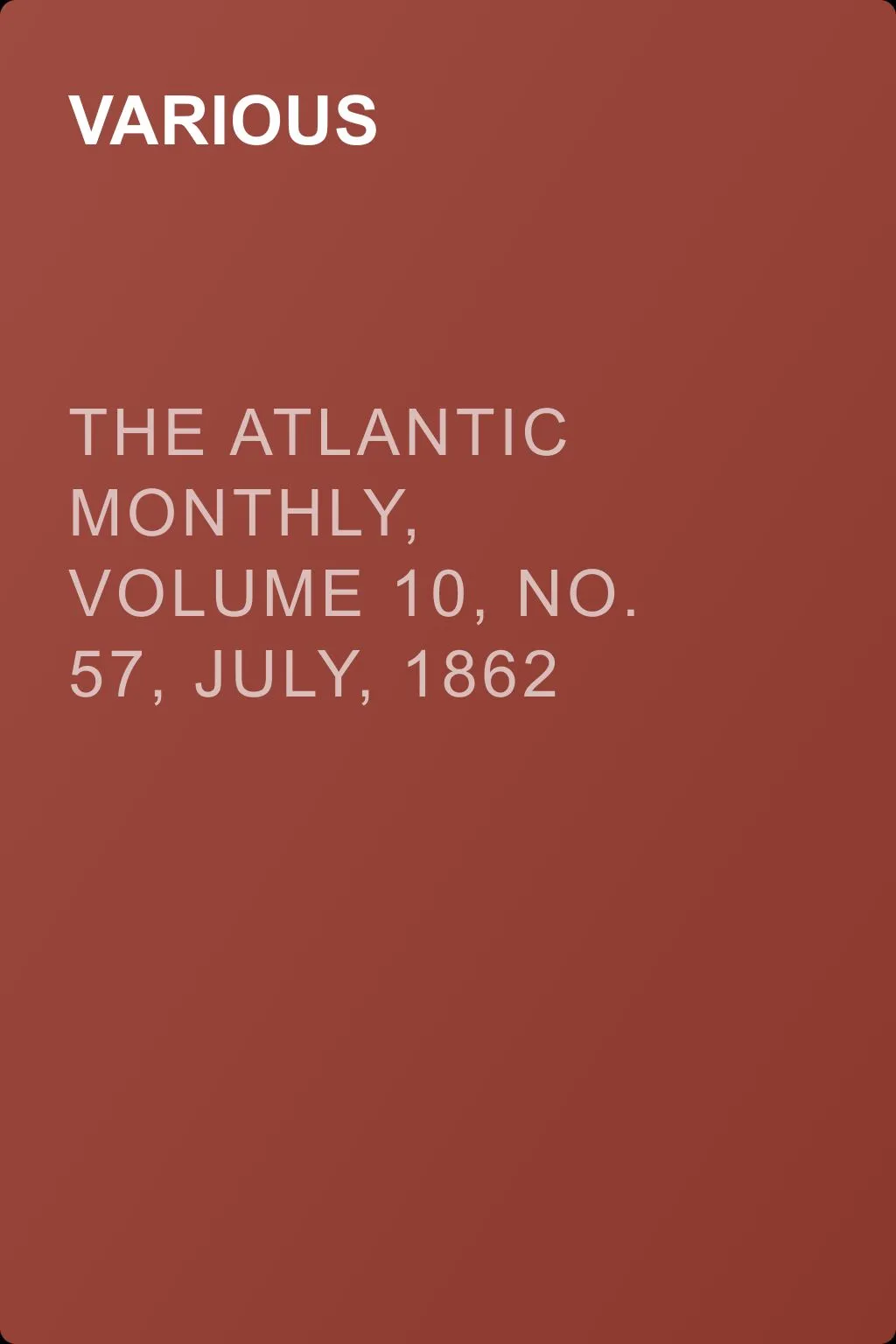
The Atlantic Monthly, Volume 10, No. 57, July, 1862
Автор Various0+
Удобнее читать в приложении
AI-разбор доступен после входа
Суть книги, пересказ, главный конфликт, ключевые идеи, вывод, кому полезна, главные темы, персонажи и цитаты можно получить после входа в BookRa.
auto_awesomeПолучить AI-разборО книге
Дата написания1970-01-01
Язык книгиen
Возрастное ограничение0+
Читать онлайн
Страница 1 из 69Various The Atlantic Monthly, Volume 10, No. 57, July, 1862 / A Magazine of Literature, Art, and Politics
SOME SOLDIER-POETRY
It is certain that since the time of Homer the deeds and circumstances of war have not been felicitously sung. If any ideas have been the subject of the strife, they seldom appear to advantage in the poems which chronicle it, or in the verses devoted to the praise of heroes. Remove the "Iliad," the "Nibelungenlied," some English, Spanish, and Northern ballads, two or three Old-Bohemian, the war-songs composed by Ziska, and one or two Romaic, from the field of investigation, and one is astonished at the scanty gleaning of battle-poetry, camp-songs, and rhymes that have been scattered in the wake of great campaigns, and many of the above-mentioned are more historical or mythological than descriptive of war. The quantity of political songs and ballads, serious and satirical, which were suggested by the great critical moments of modern history, is immense. Every country has, or might have, its own peculiar collections. In France the troubles of the League gave an impulse to song-writing, and the productions of Desportes and Bertaut are relics of that time. Historical and revolutionary songs abound in all countries; but even the "Marseillaise," the gay, ferocious "Carmagnole," and the "Ça Ira," which somebody wrote upon a drum-head in the Champ de Mars, do not belong to fighting-poetry. The actual business of following into the field the men who represent the tendencies of any time, and of helping to get through with the unavoidable fighting-jobs which they organize, seems to inspire the same rhetoric in every age, and to reproduce the same set of conventional war-images. The range of feeling is narrow; the enthusiasm for great generals is expressed in pompous commonplaces; even the dramatic circumstances of a campaign full of the movement and suffering of great masses of men, in bivouac, upon the march, in the gloomy and perilous defile, during a retreat, and in the hours when wavering victory suddenly turns and lets her hot lips be kissed, are scarcely seen, or feebly hinted at. The horizon of the battle-field itself is limited, and it is impossible to obtain a total impression of the picturesque and terrible fact. After the smoke has rolled away, the historian finds a position whence the scenes deliberately reveal to him all their connection, and reenact their passion. He is the real poet of these solemn passages in the life of man.1
One would think that a poet in the ranks would sometimes exchange the pike or musket for the pen in his knapsack, and let all the feelings and landscapes of war distil through his fine fancy from it drop by drop. But the knapsack makes too heavy a draught upon the nervous power which the cerebellum supplies for marching orders; concentration goes to waste in doing porter's work; his tent-lines are the only kind a poet cares for. If he extemporizes a song or hymn, it is lucky if it becomes a favorite of the camp. The great song which the soldier lifts during his halt, or on the edge of battle, is generally written beforehand by some pen unconscious that its glow would tip the points of bayonets, and cheer hearts in suspense for the first cannon-shot of the foe. If anybody undertakes to furnish songs for camps, he prospers as one who resolves to write anthems for a prize-committee to sit on: it is sutler's work, and falls a prey to the provost-marshal.
Nor are poets any more successful, when they propose to make camp-life and soldiers' feelings subjects for aesthetic consideration. Their lines are smooth, their images are spirited; but as well might the campaign itself have been conducted in the poet's study as its situations be deliberately transferred there to verse. The "Wallenstein's Camp" of Schiller is not poetry, but racy and sparkling pamphleteering. Its rhyming does not prevent it from belonging to the historical treatment of periods that are picturesque with many passions and interests, that go clad in jaunty regimental costumes, and require not to be idealized, but simply to be described. Goethe, in his soldier's song in "Faust," idealizes at a touch the rough work, the storming and marauding of the mediaeval Lanzknecht; set to music, it might be sung by fine dilettanti tenors in garrison, but would be stopped at any outpost in the field for want of the countersign. But when Goethe describes what he saw and felt in the campaign in France, with that lucid and observant prose, he reproduces an actual situation. So does Chamisso, in that powerful letter which describes the scenes in Hameln, when it was delivered to the French. But Chamisso has written a genuine soldier's song, which we intend to give. The songs of Körner are well known already in various English dresses.2
But the early poetry which attempts the description of feats at arms which were points in the welfare of nations—when, for instance, Germany was struggling to have her middle class against the privileges of the barons—is more interesting than all the modern songs which nicely depict soldiers' moods. Language itself was fighting for recognition, as well as industrial and social rights. The verses mark successive steps of a people into consciousness and civilization. Some of this battle-poetry is worth preserving; a few camp-rhymes, also, were famous enough in their day to justify translating. Here are some relics, of pattern more or less antique, picked up from that field of Europe where so many centuries have met in arms.3
The Northern war-poetry, before the introduction of Christianity, is vigorous enough, but it abounds in disagreeable commonplaces: trunks are cleft till each half falls sideways; limbs are carved for ravens, who appear as invariably as the Valkyrs, and while the latter pounce upon the souls that issue with the expiring breath, the former banquet upon the remains. The celebration of a victory is an exulting description of actual scenes of revelling, mead-drinking from mounted skulls, division of the spoils, and half-drunken brags4 of future prowess. The sense of dependence upon an unseen Power is manifested only in superstitious vows for luck and congratulations that the Strong Ones have been upon the conquering side. There is no lifting up of the heart which checks for a time the joy of victory. They are ferociously glad that they have beaten. This prize-fighting imagery belongs also to the Anglo-Saxon poetry, and is in marked contrast with the commemorative poetry of Franks and Germans after the introduction of Christianity. The allusions may be quite as conventional, but they show that another power has taken the field, and is willing to risk the fortunes of war. Norse poetry loses its vigor when the secure establishment of Christianity abolishes piracy and puts fighting upon an allowance. Its muscle was its chief characteristic. We speak only of war-poetry.
Вам также может понравиться
{"page":{"canonicalUrl":"https://bookra.app/books/3SyL5m5f","pageTitle":"The Atlantic Monthly, Volume 10, No. 57, July, 1862 (Various) — полный текст, краткое содержание, анализ и герои","metaDescription":"Полный текст книги «The Atlantic Monthly, Volume 10, No. 57, July, 1862». А также краткое содержание, главные мысли, конфликт, темы, персонажи, цитаты и ответы на вопросы.","headingTitle":"«The Atlantic Monthly, Volume 10, No. 57, July, 1862». Читать бесплатно онлайн","headingSubtitle":"Various","structuredData":[{"@context":"https://schema.org","@type":"BreadcrumbList","@id":"https://bookra.app/books/3SyL5m5f#breadcrumb","itemListElement":[{"@type":"ListItem","position":1,"name":"BookRa","item":"https://bookra.app/"},{"@type":"ListItem","position":2,"name":"зарубежная образовательная литература","item":"https://bookra.app/genre/5217"},{"@type":"ListItem","position":3,"name":"The Atlantic Monthly, Volume 10, No. 57, July, 1862","item":"https://bookra.app/books/3SyL5m5f"}]},{"@context":"https://schema.org","@type":"WebPage","@id":"https://bookra.app/books/3SyL5m5f","url":"https://bookra.app/books/3SyL5m5f","name":"«The Atlantic Monthly, Volume 10, No. 57, July, 1862». Читать бесплатно онлайн","description":"Полный текст книги «The Atlantic Monthly, Volume 10, No. 57, July, 1862». А также краткое содержание, главные мысли, конфликт, темы, персонажи, цитаты и ответы на вопросы.","breadcrumb":{"@id":"https://bookra.app/books/3SyL5m5f#breadcrumb"},"mainEntity":{"@id":"https://bookra.app/books/3SyL5m5f#work"},"primaryImageOfPage":{"@type":"ImageObject","url":"https://storage.yandexcloud.net/bookra-catalog-pd-public/content/bb91a9fa-871a-11e8-bef6-0cc47a5f3f85/thumbs/1200.webp"}},{"@context":"https://schema.org","@type":"Book","@id":"https://bookra.app/books/3SyL5m5f#work","name":"The Atlantic Monthly, Volume 10, No. 57, July, 1862","url":"https://bookra.app/books/3SyL5m5f","description":"Полный текст книги «The Atlantic Monthly, Volume 10, No. 57, July, 1862». А также краткое содержание, главные мысли, конфликт, темы, персонажи, цитаты и ответы на вопросы.","image":"https://storage.yandexcloud.net/bookra-catalog-pd-public/content/bb91a9fa-871a-11e8-bef6-0cc47a5f3f85/thumbs/1200.webp","inLanguage":"en","genre":["зарубежная образовательная литература","зарубежная старинная литература"],"sameAs":["https://litres.ru/book/various-10848091/the-atlantic-monthly-volume-10-no-57-july-1862-35501891/"],"author":[{"@type":"Person","@id":"https://bookra.app/author/6bc78809-ff55-11e6-9c73-0cc47a1952f2#person","name":"Various","url":"https://bookra.app/author/6bc78809-ff55-11e6-9c73-0cc47a1952f2"}],"about":[{"@type":"Thing","name":"зарубежная образовательная литература"},{"@type":"Thing","name":"зарубежная старинная литература"},{"@type":"Thing","name":"чтение онлайн"},{"@type":"Thing","name":"саммари"},{"@type":"Thing","name":"AI-разбор"},{"@type":"Thing","name":"персонажи"},{"@type":"Thing","name":"цитаты"}],"workExample":{"@type":"Book","@id":"https://bookra.app/books/3SyL5m5f#edition","url":"https://bookra.app/books/3SyL5m5f","bookFormat":"https://schema.org/EBook","inLanguage":"en","sameAs":["https://litres.ru/book/various-10848091/the-atlantic-monthly-volume-10-no-57-july-1862-35501891/"],"isAccessibleForFree":true,"potentialAction":{"@type":"ReadAction","name":"Читать бесплатно онлайн «The Atlantic Monthly, Volume 10, No. 57, July, 1862»","target":{"@type":"EntryPoint","urlTemplate":"https://bookra.app/books/3SyL5m5f","actionPlatform":["https://schema.org/DesktopWebPlatform"]},"expectsAcceptanceOf":{"@type":"Offer","category":"nologinrequired"}}}}],"book":{"idCatalog":764717,"shortId":"3SyL5m5f","title":"The Atlantic Monthly, Volume 10, No. 57, July, 1862","coverUrl":"https://storage.yandexcloud.net/bookra-catalog-pd-public/content/bb91a9fa-871a-11e8-bef6-0cc47a5f3f85/thumbs/1200.webp","annotationText":"","catalogType":"PUBLIC_DOMAIN","catalogTypeLabel":"Общественное достояние","authorLine":"Various","authors":[{"id":"6bc78809-ff55-11e6-9c73-0cc47a1952f2","displayName":"Various","protectedUrl":"/author/6bc78809-ff55-11e6-9c73-0cc47a1952f2","wikipediaUrl":null,"wikidataUrl":null}],"genres":[{"id":5217,"title":"зарубежная образовательная литература","token":null,"publicUrl":"https://bookra.app/genre/5217"},{"id":5215,"title":"зарубежная старинная литература","token":null,"publicUrl":"https://bookra.app/genre/5215"}],"keywords":[],"facts":[{"key":"dateWritten","label":"Дата написания","value":"1970-01-01"},{"key":"bookLanguage","label":"Язык книги","value":"en"},{"key":"adult","label":"Возрастное ограничение","value":"0+"}],"seoSections":[],"authorSummary":null,"hasArtifacts":false,"canReadInApp":true,"readUrl":"https://web.bookra.app/?startapp=r_764717","artifactsUrl":"https://web.bookra.app/?startapp=b_764717","readCtaLabel":"Читать бесплатно","artifactsCtaLabel":"AI-разбор","appReadLinks":{"tg":"https://t.me/bookra_lib_bot/BookRa?startapp=r_764717","vk":"https://vk.com/app54470698#startapp=r_764717","max":"https://max.ru/id7751370047_bot?startapp=r_764717","web":"https://web.bookra.app/?startapp=r_764717"},"appAnalysisLinks":{"tg":"https://t.me/bookra_lib_bot/BookRa?startapp=b_764717","vk":"https://vk.com/app54470698#startapp=b_764717","max":"https://max.ru/id7751370047_bot?startapp=b_764717","web":"https://web.bookra.app/?startapp=b_764717"},"guestReaderUrl":"/books/3SyL5m5f#reader-content","authorCtaLabel":"Все книги автора","authorProtectedUrl":"/author/6bc78809-ff55-11e6-9c73-0cc47a1952f2","readersCount":0,"adultLabel":"0+","yearLabel":null,"datePublished":null,"publisherLabel":null,"isbn":null,"oclc":null,"lccn":null,"partnerUrl":null,"accessNote":"Полный текст книги и AI-разбор откроются на защищенных страницах BookRa после входа."},"reader":{"page":1,"totalPages":69,"hasPrev":false,"hasNext":true,"prevPageUrl":null,"nextPageUrl":"/books/3SyL5m5f?page=2#reader-content","progressLabel":"Страница 1 из 69","sections":[{"id":"content0:0","kind":"heading","text":"Various The Atlantic Monthly, Volume 10, No. 57, July, 1862 / A Magazine of Literature, Art, and Politics"},{"id":"content0:1","kind":"heading","text":"SOME SOLDIER-POETRY"},{"id":"content0:2","kind":"paragraph","text":"It is certain that since the time of Homer the deeds and circumstances of war have not been felicitously sung. If any ideas have been the subject of the strife, they seldom appear to advantage in the poems which chronicle it, or in the verses devoted to the praise of heroes. Remove the \"Iliad,\" the \"Nibelungenlied,\" some English, Spanish, and Northern ballads, two or three Old-Bohemian, the war-songs composed by Ziska, and one or two Romaic, from the field of investigation, and one is astonished at the scanty gleaning of battle-poetry, camp-songs, and rhymes that have been scattered in the wake of great campaigns, and many of the above-mentioned are more historical or mythological than descriptive of war. The quantity of political songs and ballads, serious and satirical, which were suggested by the great critical moments of modern history, is immense. Every country has, or might have, its own peculiar collections. In France the troubles of the League gave an impulse to song-writing, and the productions of Desportes and Bertaut are relics of that time. Historical and revolutionary songs abound in all countries; but even the \"Marseillaise,\" the gay, ferocious \"Carmagnole,\" and the \"Ça Ira,\" which somebody wrote upon a drum-head in the Champ de Mars, do not belong to fighting-poetry. The actual business of following into the field the men who represent the tendencies of any time, and of helping to get through with the unavoidable fighting-jobs which they organize, seems to inspire the same rhetoric in every age, and to reproduce the same set of conventional war-images. The range of feeling is narrow; the enthusiasm for great generals is expressed in pompous commonplaces; even the dramatic circumstances of a campaign full of the movement and suffering of great masses of men, in bivouac, upon the march, in the gloomy and perilous defile, during a retreat, and in the hours when wavering victory suddenly turns and lets her hot lips be kissed, are scarcely seen, or feebly hinted at. The horizon of the battle-field itself is limited, and it is impossible to obtain a total impression of the picturesque and terrible fact. After the smoke has rolled away, the historian finds a position whence the scenes deliberately reveal to him all their connection, and reenact their passion. He is the real poet of these solemn passages in the life of man.1"},{"id":"content0:3","kind":"paragraph","text":"One would think that a poet in the ranks would sometimes exchange the pike or musket for the pen in his knapsack, and let all the feelings and landscapes of war distil through his fine fancy from it drop by drop. But the knapsack makes too heavy a draught upon the nervous power which the cerebellum supplies for marching orders; concentration goes to waste in doing porter's work; his tent-lines are the only kind a poet cares for. If he extemporizes a song or hymn, it is lucky if it becomes a favorite of the camp. The great song which the soldier lifts during his halt, or on the edge of battle, is generally written beforehand by some pen unconscious that its glow would tip the points of bayonets, and cheer hearts in suspense for the first cannon-shot of the foe. If anybody undertakes to furnish songs for camps, he prospers as one who resolves to write anthems for a prize-committee to sit on: it is sutler's work, and falls a prey to the provost-marshal."},{"id":"content0:4","kind":"paragraph","text":"Nor are poets any more successful, when they propose to make camp-life and soldiers' feelings subjects for aesthetic consideration. Their lines are smooth, their images are spirited; but as well might the campaign itself have been conducted in the poet's study as its situations be deliberately transferred there to verse. The \"Wallenstein's Camp\" of Schiller is not poetry, but racy and sparkling pamphleteering. Its rhyming does not prevent it from belonging to the historical treatment of periods that are picturesque with many passions and interests, that go clad in jaunty regimental costumes, and require not to be idealized, but simply to be described. Goethe, in his soldier's song in \"Faust,\" idealizes at a touch the rough work, the storming and marauding of the mediaeval Lanzknecht; set to music, it might be sung by fine dilettanti tenors in garrison, but would be stopped at any outpost in the field for want of the countersign. But when Goethe describes what he saw and felt in the campaign in France, with that lucid and observant prose, he reproduces an actual situation. So does Chamisso, in that powerful letter which describes the scenes in Hameln, when it was delivered to the French. But Chamisso has written a genuine soldier's song, which we intend to give. The songs of Körner are well known already in various English dresses.2"},{"id":"content0:5","kind":"paragraph","text":"But the early poetry which attempts the description of feats at arms which were points in the welfare of nations—when, for instance, Germany was struggling to have her middle class against the privileges of the barons—is more interesting than all the modern songs which nicely depict soldiers' moods. Language itself was fighting for recognition, as well as industrial and social rights. The verses mark successive steps of a people into consciousness and civilization. Some of this battle-poetry is worth preserving; a few camp-rhymes, also, were famous enough in their day to justify translating. Here are some relics, of pattern more or less antique, picked up from that field of Europe where so many centuries have met in arms.3"},{"id":"content0:6","kind":"paragraph","text":"The Northern war-poetry, before the introduction of Christianity, is vigorous enough, but it abounds in disagreeable commonplaces: trunks are cleft till each half falls sideways; limbs are carved for ravens, who appear as invariably as the Valkyrs, and while the latter pounce upon the souls that issue with the expiring breath, the former banquet upon the remains. The celebration of a victory is an exulting description of actual scenes of revelling, mead-drinking from mounted skulls, division of the spoils, and half-drunken brags4 of future prowess. The sense of dependence upon an unseen Power is manifested only in superstitious vows for luck and congratulations that the Strong Ones have been upon the conquering side. There is no lifting up of the heart which checks for a time the joy of victory. They are ferociously glad that they have beaten. This prize-fighting imagery belongs also to the Anglo-Saxon poetry, and is in marked contrast with the commemorative poetry of Franks and Germans after the introduction of Christianity. The allusions may be quite as conventional, but they show that another power has taken the field, and is willing to risk the fortunes of war. Norse poetry loses its vigor when the secure establishment of Christianity abolishes piracy and puts fighting upon an allowance. Its muscle was its chief characteristic. We speak only of war-poetry."}],"toc":[{"id":"content0:0:1","label":"Various The Atlantic Monthly, Volume 10, No. 57, July, 1862 / A Magazine of Literature, Art, and Politics","page":1,"pageUrl":"/books/3SyL5m5f#reader-content"},{"id":"content0:1:1","label":"SOME SOLDIER-POETRY","page":1,"pageUrl":"/books/3SyL5m5f#reader-content"},{"id":"content0:52:6","label":"VICTORY-SONG AFTER THE BATTLE NEAR PRAGUE","page":6,"pageUrl":"/books/3SyL5m5f?page=6#reader-content"},{"id":"content0:55:6","label":"THE INVALIDES AT FATHER FREDERIC'S GRAVE","page":6,"pageUrl":"/books/3SyL5m5f?page=6#reader-content"},{"id":"content0:75:7","label":"THE VETERAN TO HIS CLOAK","page":7,"pageUrl":"/books/3SyL5m5f?page=7#reader-content"},{"id":"content0:78:7","label":"THE CANTEEN","page":7,"pageUrl":"/books/3SyL5m5f?page=7#reader-content"},{"id":"content1:0:8","label":"FROUDE'S HENRY THE EIGHTH","page":8,"pageUrl":"/books/3SyL5m5f?page=8#reader-content"},{"id":"content1:21:15","label":"* * * * *","page":15,"pageUrl":"/books/3SyL5m5f?page=15#reader-content"},{"id":"content2:0:15","label":"WHY THEIR CREEDS DIFFERED","page":15,"pageUrl":"/books/3SyL5m5f?page=15#reader-content"},{"id":"content2:3:15","label":"PRESENCE","page":15,"pageUrl":"/books/3SyL5m5f?page=15#reader-content"},{"id":"content2:51:21","label":"* * * * *","page":21,"pageUrl":"/books/3SyL5m5f?page=21#reader-content"},{"id":"content2:52:21","label":"CHIEFLY ABOUT WAR-MATTERS","page":21,"pageUrl":"/books/3SyL5m5f?page=21#reader-content"},{"id":"content2:53:21","label":"BY A PEACEABLE MAN","page":21,"pageUrl":"/books/3SyL5m5f?page=21#reader-content"},{"id":"content2:61:23","label":"* * * * *","page":23,"pageUrl":"/books/3SyL5m5f?page=23#reader-content"},{"id":"content2:68:24","label":"* * * * *","page":24,"pageUrl":"/books/3SyL5m5f?page=24#reader-content"},{"id":"content3:0:31","label":"THE MINUTE-GUNS","page":31,"pageUrl":"/books/3SyL5m5f?page=31#reader-content"},{"id":"content3:2:32","label":"ORIGINALITY","page":32,"pageUrl":"/books/3SyL5m5f?page=32#reader-content"},{"id":"content4:0:34","label":"ERICSSON AND HIS INVENTIONS","page":34,"pageUrl":"/books/3SyL5m5f?page=34#reader-content"},{"id":"content4:65:42","label":"* * * * *","page":42,"pageUrl":"/books/3SyL5m5f?page=42#reader-content"},{"id":"content5:0:42","label":"MOVING","page":42,"pageUrl":"/books/3SyL5m5f?page=42#reader-content"},{"id":"content5:17:46","label":"* * * * *","page":46,"pageUrl":"/books/3SyL5m5f?page=46#reader-content"},{"id":"content6:0:46","label":"METHODS OF STUDY IN NATURAL HISTORY","page":46,"pageUrl":"/books/3SyL5m5f?page=46#reader-content"},{"id":"content7:0:51","label":"LYRICS OF THE STREET","page":51,"pageUrl":"/books/3SyL5m5f?page=51#reader-content"},{"id":"content7:1:51","label":"II","page":51,"pageUrl":"/books/3SyL5m5f?page=51#reader-content"},{"id":"content7:2:51","label":"THE WEDDING","page":51,"pageUrl":"/books/3SyL5m5f?page=51#reader-content"},{"id":"content7:4:51","label":"* * * * *","page":51,"pageUrl":"/books/3SyL5m5f?page=51#reader-content"},{"id":"content7:5:51","label":"FRIEND ELI'S DAUGHTER","page":51,"pageUrl":"/books/3SyL5m5f?page=51#reader-content"},{"id":"content7:6:51","label":"I","page":51,"pageUrl":"/books/3SyL5m5f?page=51#reader-content"},{"id":"content7:25:52","label":"II","page":52,"pageUrl":"/books/3SyL5m5f?page=52#reader-content"},{"id":"content7:63:54","label":"III","page":54,"pageUrl":"/books/3SyL5m5f?page=54#reader-content"},{"id":"content7:114:55","label":"IV","page":55,"pageUrl":"/books/3SyL5m5f?page=55#reader-content"},{"id":"content7:138:57","label":"V","page":57,"pageUrl":"/books/3SyL5m5f?page=57#reader-content"},{"id":"content8:0:60","label":"TAXATION NO BURDEN","page":60,"pageUrl":"/books/3SyL5m5f?page=60#reader-content"},{"id":"content9:0:62","label":"THE POET TO HIS READERS","page":62,"pageUrl":"/books/3SyL5m5f?page=62#reader-content"},{"id":"content9:2:62","label":"* * * * *","page":62,"pageUrl":"/books/3SyL5m5f?page=62#reader-content"},{"id":"content9:3:62","label":"THE CHILDREN'S CITIES","page":62,"pageUrl":"/books/3SyL5m5f?page=62#reader-content"},{"id":"content9:4:62","label":"BY THE AUTHOR OF \"CHARLES AUCHESTER.\"","page":62,"pageUrl":"/books/3SyL5m5f?page=62#reader-content"},{"id":"content10:0:64","label":"REVIEWS AND LITERARY NOTICES","page":64,"pageUrl":"/books/3SyL5m5f?page=64#reader-content"},{"id":"content10:7:65","label":"* * * * *","page":65,"pageUrl":"/books/3SyL5m5f?page=65#reader-content"},{"id":"content10:19:67","label":"* * * * *","page":67,"pageUrl":"/books/3SyL5m5f?page=67#reader-content"},{"id":"content11:0:67","label":"RECENT AMERICAN PUBLICATIONS","page":67,"pageUrl":"/books/3SyL5m5f?page=67#reader-content"},{"id":"content11:1:67","label":"RECEIVED BY THE EDITORS OF THE ATLANTIC MONTHLY","page":67,"pageUrl":"/books/3SyL5m5f?page=67#reader-content"},{"id":"contentnotes0:0:67","label":"1","page":67,"pageUrl":"/books/3SyL5m5f?page=67#reader-content"},{"id":"contentnotes0:3:67","label":"2","page":67,"pageUrl":"/books/3SyL5m5f?page=67#reader-content"},{"id":"contentnotes0:6:68","label":"3","page":68,"pageUrl":"/books/3SyL5m5f?page=68#reader-content"},{"id":"contentnotes0:9:68","label":"4","page":68,"pageUrl":"/books/3SyL5m5f?page=68#reader-content"},{"id":"contentnotes0:12:68","label":"5","page":68,"pageUrl":"/books/3SyL5m5f?page=68#reader-content"},{"id":"contentnotes0:15:68","label":"6","page":68,"pageUrl":"/books/3SyL5m5f?page=68#reader-content"},{"id":"contentnotes0:18:68","label":"7","page":68,"pageUrl":"/books/3SyL5m5f?page=68#reader-content"},{"id":"contentnotes0:21:68","label":"8","page":68,"pageUrl":"/books/3SyL5m5f?page=68#reader-content"},{"id":"contentnotes0:24:68","label":"9","page":68,"pageUrl":"/books/3SyL5m5f?page=68#reader-content"},{"id":"contentnotes0:27:68","label":"10","page":68,"pageUrl":"/books/3SyL5m5f?page=68#reader-content"},{"id":"contentnotes0:30:68","label":"11","page":68,"pageUrl":"/books/3SyL5m5f?page=68#reader-content"},{"id":"contentnotes0:34:68","label":"12","page":68,"pageUrl":"/books/3SyL5m5f?page=68#reader-content"},{"id":"contentnotes0:37:68","label":"13","page":68,"pageUrl":"/books/3SyL5m5f?page=68#reader-content"},{"id":"contentnotes0:40:68","label":"14","page":68,"pageUrl":"/books/3SyL5m5f?page=68#reader-content"},{"id":"contentnotes0:43:68","label":"15","page":68,"pageUrl":"/books/3SyL5m5f?page=68#reader-content"},{"id":"contentnotes0:46:68","label":"16","page":68,"pageUrl":"/books/3SyL5m5f?page=68#reader-content"},{"id":"contentnotes0:49:68","label":"17","page":68,"pageUrl":"/books/3SyL5m5f?page=68#reader-content"},{"id":"contentnotes0:52:68","label":"18","page":68,"pageUrl":"/books/3SyL5m5f?page=68#reader-content"},{"id":"contentnotes0:55:68","label":"19","page":68,"pageUrl":"/books/3SyL5m5f?page=68#reader-content"},{"id":"contentnotes0:58:68","label":"20","page":68,"pageUrl":"/books/3SyL5m5f?page=68#reader-content"},{"id":"contentnotes0:61:69","label":"21","page":69,"pageUrl":"/books/3SyL5m5f?page=69#reader-content"},{"id":"contentnotes0:64:69","label":"22","page":69,"pageUrl":"/books/3SyL5m5f?page=69#reader-content"},{"id":"contentnotes0:67:69","label":"23","page":69,"pageUrl":"/books/3SyL5m5f?page=69#reader-content"},{"id":"contentnotes0:70:69","label":"24","page":69,"pageUrl":"/books/3SyL5m5f?page=69#reader-content"},{"id":"contentnotes0:73:69","label":"25","page":69,"pageUrl":"/books/3SyL5m5f?page=69#reader-content"},{"id":"contentnotes0:76:69","label":"26","page":69,"pageUrl":"/books/3SyL5m5f?page=69#reader-content"},{"id":"contentnotes0:79:69","label":"27","page":69,"pageUrl":"/books/3SyL5m5f?page=69#reader-content"},{"id":"contentnotes0:83:69","label":"28","page":69,"pageUrl":"/books/3SyL5m5f?page=69#reader-content"}]},"similarBooks":[{"idCatalog":792538,"shortId":"3mVN2TRg","title":"Государь","authorLine":"Никколо Макиавелли","primaryAuthorId":"7fcb44f8-2a81-102a-9ae1-2dfe723fe7c7","coverUrl":"https://storage.yandexcloud.net/bookra-catalog-pd-public/content/de5c6783-ed65-538d-be5c-e8a41100356b/thumbs/400.webp","publicUrl":"https://bookra.app/books/3mVN2TRg"},{"idCatalog":803360,"shortId":"20EgCd5y","title":"Диалоги","authorLine":"Платон","primaryAuthorId":"bfbcc84f-2a93-102a-9ac3-800cba805322","coverUrl":"https://storage.yandexcloud.net/bookra-catalog-pd-public/content/d0a029c9-5474-11e9-aa86-0cc47a5453d6/thumbs/400.webp","publicUrl":"https://bookra.app/books/20EgCd5y"},{"idCatalog":16956,"shortId":"3eahNTLe","title":"История","authorLine":"Геродот, Георгий Андреевич Стратановский","primaryAuthorId":"bf200f87-2a93-102a-9ac3-800cba805322","coverUrl":"https://storage.yandexcloud.net/bookra-catalog-litres-public/content/0179c752-4be8-11e5-87ef-0025905a06ea/thumbs/400.webp","publicUrl":"https://bookra.app/books/3eahNTLe"},{"idCatalog":163478,"shortId":"1T5NB3Ce","title":"Трактат о военном искусстве","authorLine":"Сунь-цзы, Николай Иосифович Конрад","primaryAuthorId":"af833b18-2a93-102a-9ac3-800cba805322","coverUrl":"https://storage.yandexcloud.net/bookra-catalog-litres-public/content/66c147fd-191c-11e7-9b47-0cc47a5203ba/thumbs/400.webp","publicUrl":"https://bookra.app/books/1T5NB3Ce"},{"idCatalog":794304,"shortId":"2Gcx9zNO","title":"МЕТАФИЗИКА","authorLine":"Аристотель","primaryAuthorId":"76572bf3-2a93-102a-9ac3-800cba805322","coverUrl":"https://storage.yandexcloud.net/bookra-catalog-pd-public/content/67e57a46-33ce-52fa-9b09-72ebec56a682/thumbs/400.webp","publicUrl":"https://bookra.app/books/2Gcx9zNO"},{"idCatalog":803361,"shortId":"3ZYkMgZn","title":"Апология Сократа","authorLine":"Платон, Михаил Сергеевич Соловьев","primaryAuthorId":"bfbcc84f-2a93-102a-9ac3-800cba805322","coverUrl":"https://storage.yandexcloud.net/bookra-catalog-pd-public/content/e9085dd7-2175-11e8-9a05-0cc47a52085c/thumbs/400.webp","publicUrl":"https://bookra.app/books/3ZYkMgZn"},{"idCatalog":229496,"shortId":"4VRUv1qU","title":"Бусидо","authorLine":"Юдзан Дайдодзи, Цунэтомо Ямамото, А. А. Петрова, Р. В. Котенко, А. А. Мищенко","primaryAuthorId":"298e0100-5115-11e2-b3a9-002590591dd6","coverUrl":"https://storage.yandexcloud.net/bookra-catalog-litres-public/content/30b8b29f-c19e-11e8-bb1b-0cc47a5203ba/thumbs/400.webp","publicUrl":"https://bookra.app/books/4VRUv1qU"},{"idCatalog":803364,"shortId":"4BU69zeg","title":"Пир","authorLine":"Платон, Василий Николаевич Карпов","primaryAuthorId":"bfbcc84f-2a93-102a-9ac3-800cba805322","coverUrl":"https://storage.yandexcloud.net/bookra-catalog-pd-public/content/1af9e6cd-217a-11e8-9a05-0cc47a52085c/thumbs/400.webp","publicUrl":"https://bookra.app/books/4BU69zeg"},{"idCatalog":78865,"shortId":"4D2jf48p","title":"О природе вещей","authorLine":"И. Рачинский, Тит Лукреций Кар","primaryAuthorId":"825f947f-7c07-11e2-8493-002590591ed2","coverUrl":"https://storage.yandexcloud.net/bookra-catalog-litres-public/content/ed0916f3-7c07-11e2-8493-002590591ed2/thumbs/400.webp","publicUrl":"https://bookra.app/books/4D2jf48p"},{"idCatalog":794536,"shortId":"4Ca43bP4","title":"Риторика","authorLine":"Аристотель, Надежда Николаевна Платонова","primaryAuthorId":"76572bf3-2a93-102a-9ac3-800cba805322","coverUrl":"https://storage.yandexcloud.net/bookra-catalog-pd-public/content/99d87ece-3c8c-11e7-b2fb-0cc47a52085c/thumbs/400.webp","publicUrl":"https://bookra.app/books/4Ca43bP4"},{"idCatalog":66597,"shortId":"2dyvti99","title":"История Рима от основания Города","authorLine":"Тит Ливий, П. Андрианов","primaryAuthorId":"bfab7b16-2a93-102a-9ac3-800cba805322","coverUrl":"https://storage.yandexcloud.net/bookra-catalog-litres-public/content/8ef6df4c-1f78-11e1-aac2-5924aae99221/thumbs/400.webp","publicUrl":"https://bookra.app/books/2dyvti99"},{"idCatalog":60340,"shortId":"2bXVBb6o","title":"Мифы и легенды Греции и Рима","authorLine":"Эдит Гамильтон, Л. А. Игоревский","primaryAuthorId":"75b1416f-7dab-11e0-9959-47117d41cf4b","coverUrl":"https://storage.yandexcloud.net/bookra-catalog-litres-public/content/89fd37ea-7dab-11e0-9959-47117d41cf4b/thumbs/400.webp","publicUrl":"https://bookra.app/books/2bXVBb6o"}],"similarBooksPagination":{"page":1,"pageSize":12,"totalItems":803,"totalPages":67,"hasPrev":false,"hasNext":true}},"notFound":false}