Читать бесплатно онлайн
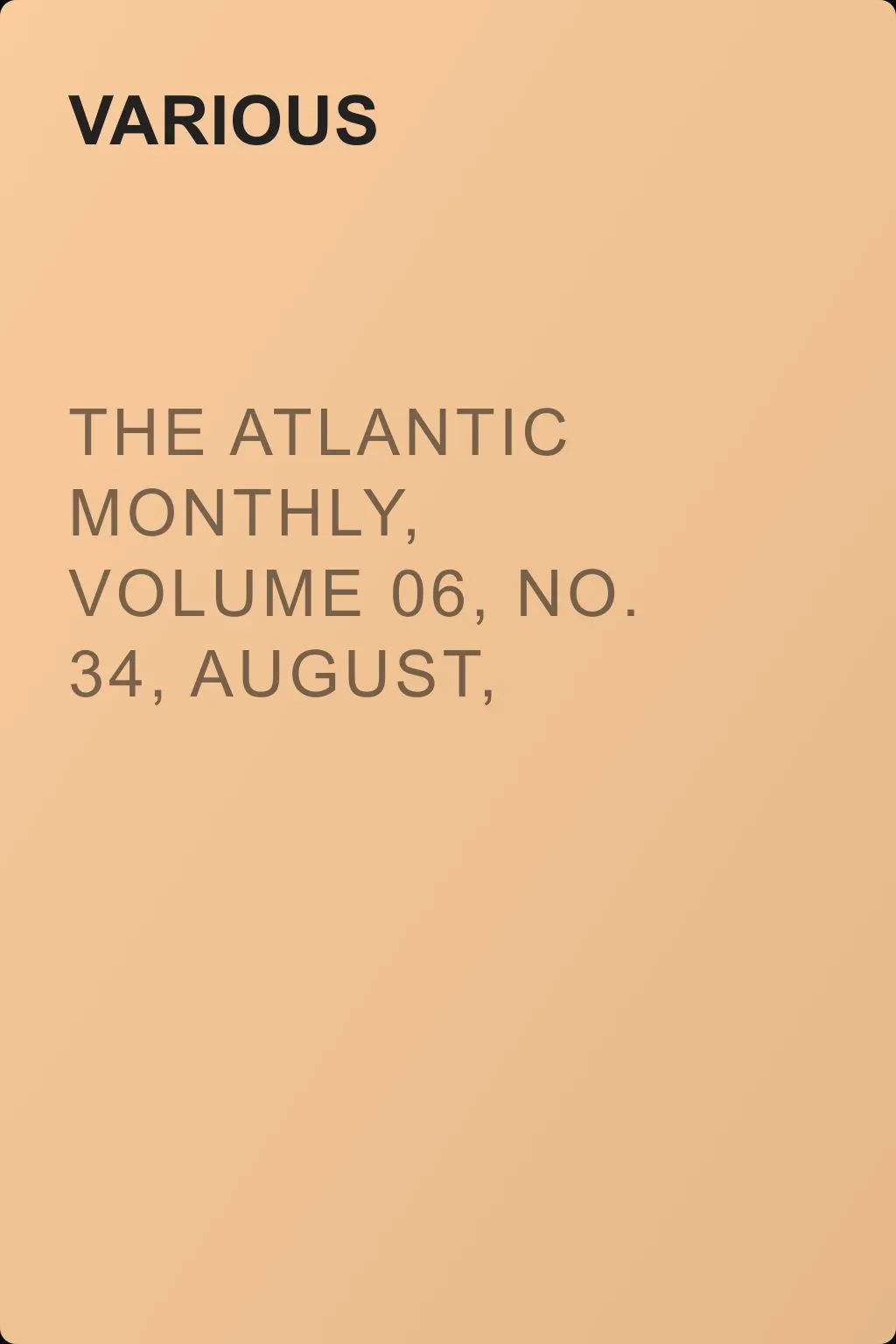
The Atlantic Monthly, Volume 06, No. 34, August, 1860
Автор Various12+
Удобнее читать в приложении
AI-разбор доступен после входа
Суть книги, пересказ, главный конфликт, ключевые идеи, вывод, кому полезна, главные темы, персонажи и цитаты можно получить после входа в BookRa.
auto_awesomeПолучить AI-разборО книге
Дата написания1970-01-01
Язык книгиen
Возрастное ограничение12+
Читать онлайн
Страница 1 из 71Various The Atlantic Monthly, Volume 06, No. 34, August, 1860 / A Magazine Of Literature, Art, And Politics
THE CARNIVAL OF THE ROMANTIC
Whither went the nine old Muses, daughters of Jupiter and the Goddess of Memory, after their seats on Helicon, Parnassus, and Olympus were barbarized? Not far away. They hovered like witches around the seething caldron of early Christian Europe, in which, "with bubble, bubble, toil and trouble," a new civilization was forming, mindful of the brilliant lineage of their worshippers, from Homer to Boethius, looking upon the vexed and beclouded Nature, and expecting the time when Humanity should gird itself anew with the beauty of ideas and institutions. They were sorrowful, but not in despair; for they knew that the children of men were strong with recuperative power.
The ear of Fancy, not long since, heard the hoofs of winged Pegasus striking the clouds. The long-idle Muses, it seemed, had become again interested in human efforts, and were paying a flying visit to the haunts of modern genius from the Hellespont to the Mississippi. They lingered in sunny Provence, and in the dark forest-land of the Minnesingers. In the great capitals, as Rome, Berlin, Paris, London,—in smaller capitals, as Florence, Weimar, and Boston,—in many a village which had a charm for them, as Stratford-on-Avon, Ferney, and Concord in Massachusetts,—in the homes of wonderful suffering, as Ferrara and Haworth.—on many enchanted waters, as the Guadalquivir, the Rhine, the Tweed, the Hudson, Windermere, and Leman,—in many a monastic nook whence had issued a chronicle or history, in many a wild birthplace of a poem or romance, around many an old castle and stately ruin, in many a decayed seat of revelry and joyous repartee,—through the long list of the nurseries of genius and the laboratories of art, they wandered pensive and strangely affected. At length they rested from their journey to hold a council on modern literature. The long results of Christian time were unrolled before them as in a chart. They beheld the dawn of a new historic day, marked by songs of fantastic tenderness, and unwieldy, long, and jointless romances and poems, like the monsters which played in the unfinished universe before the creation of man. The Muses smiled with a look more of complaisance than approval, as they reviewed the army of Troubadours and Minnesingers and the crowd of romancers who followed in their train. They decided that the joyous array of early mediæval literature was full of promise, though something of its tone and temper was past the comprehension of pagan goddesses. The legends of saints and pictures of martyrdoms were especially mysterious to them, and they regarded them raptly, not smilingly, and bowed their heads. Anon their eyes rested on an Italian city, where uprose, as if in interstellar space, an erect figure, with a piercing eye, pleasant as Plato's voice. His countenance was fixed upon the empyrean, and a more than Minerva-like form hovered above him, interpreting the Christian universe; and as he wrote what she dictated, the verses of his poem were musical even to the Muses. Dante, Beatrice, and the "Divine Comedy," with a Gothic church as a make-weight, were balanced in Muses' minds in comparison with the "Iliad" and the age of Pericles; and again they put on the rapt look of mystery, but a smile also, and their admiration and applause were more and more. To England they soon turned, and contemplated the round, many-colored globe of Shakspeare's works. As playful swallows sometimes dart round and round a lithe and wondering wingless animal, so they, admiringly and timidly, attracted, yet hesitating, delighting in his alertness, but not quite understanding it, flitted like a troubled and beautiful flock around the great magician of modern civilization. Their glance became lighter and less intent, as if they were nearer to knowledge, the pain of perplexity disappeared like a shadow from their countenances, their plaudits were more unreserved, and it seemed likely that the high desert of Shakspeare would win for our new literature a favorable recognition from the aristocratic goddesses of antiquity. Knowing that Jove had made perfection unattainable by mortals, they yet found in the chart before them epics, dramas, lyrics, histories, and philosophies that were no unworthy companions to the creations of classical genius, and they were jubilant in the triumphs of a period in which they had been rather ignorantly and ironically worshipped. Their sitting was long, and their review thorough, yet they found but one department of modern literature which was regarded with a distrust that grew to an aversion. The romances, the tales, the stories, the novels were contemned more and more, from the first of them to the last. Nothing like them had been known among the glories of Hellenic literary art, and no Muse now stood forth to be their defender and patron. Calliope declared that they were not epical, Euterpe and Erato that they were not lyrical, Melpomene and Thalia that they were neither tragical nor comical, Clio that they were not historical, Urania that they were not sublime in conception, Polymnia that they had no stately or simple charm in execution, and Terpsichore, who had joined with Melpomene in admiring the opera, found nothing in the novel which she could own and bless. Fleeting passages, remote and slight fragments, were pleasing to them all, like the oases of a Sahara, or the sites of high civilization on the earth; but the whole world of novels seemed to them a chaos undisciplined by art and unformed to beauty. The gates of the halls where the classics live in immortal youth were beginning to close against the voluminous prose romances that have sprung from modern thought, when the deliberations of the Muses were suddenly interrupted. They had disturbed the divine elements of modern society. Forth from all the recesses of the air came troops of Gothic elves, trolls, fairies, sprites, and all the other romantic beings which had inspired the modern mind to novel-writing,—marching or gambolling, pride in their port, defiance in their eye, mischief in their purpose,—and began so vigorous an attack upon their classic visitors and critics, that the latter were glad to betake themselves to the mighty-winged Pegasus, who rapidly bore them in retreat to the present home of the Dii Majores, that point of the empyrean directly above Olympus.
Вам также может понравиться
{"page":{"canonicalUrl":"https://bookra.app/books/3rZLyPGu","pageTitle":"The Atlantic Monthly, Volume 06, No. 34, August, 1860 (Various) — полный текст, краткое содержание, анализ и герои","metaDescription":"Полный текст книги «The Atlantic Monthly, Volume 06, No. 34, August, 1860». А также краткое содержание, главные мысли, конфликт, темы, персонажи, цитаты и ответы на вопросы.","headingTitle":"«The Atlantic Monthly, Volume 06, No. 34, August, 1860». Читать бесплатно онлайн","headingSubtitle":"Various","structuredData":[{"@context":"https://schema.org","@type":"BreadcrumbList","@id":"https://bookra.app/books/3rZLyPGu#breadcrumb","itemListElement":[{"@type":"ListItem","position":1,"name":"BookRa","item":"https://bookra.app/"},{"@type":"ListItem","position":2,"name":"зарубежная образовательная литература","item":"https://bookra.app/genre/5217"},{"@type":"ListItem","position":3,"name":"The Atlantic Monthly, Volume 06, No. 34, August, 1860","item":"https://bookra.app/books/3rZLyPGu"}]},{"@context":"https://schema.org","@type":"WebPage","@id":"https://bookra.app/books/3rZLyPGu","url":"https://bookra.app/books/3rZLyPGu","name":"«The Atlantic Monthly, Volume 06, No. 34, August, 1860». Читать бесплатно онлайн","description":"Полный текст книги «The Atlantic Monthly, Volume 06, No. 34, August, 1860». А также краткое содержание, главные мысли, конфликт, темы, персонажи, цитаты и ответы на вопросы.","breadcrumb":{"@id":"https://bookra.app/books/3rZLyPGu#breadcrumb"},"mainEntity":{"@id":"https://bookra.app/books/3rZLyPGu#work"},"primaryImageOfPage":{"@type":"ImageObject","url":"https://storage.yandexcloud.net/bookra-catalog-pd-public/content/badbb293-871a-11e8-bef6-0cc47a5f3f85/thumbs/1200.webp"}},{"@context":"https://schema.org","@type":"Book","@id":"https://bookra.app/books/3rZLyPGu#work","name":"The Atlantic Monthly, Volume 06, No. 34, August, 1860","url":"https://bookra.app/books/3rZLyPGu","description":"Полный текст книги «The Atlantic Monthly, Volume 06, No. 34, August, 1860». А также краткое содержание, главные мысли, конфликт, темы, персонажи, цитаты и ответы на вопросы.","image":"https://storage.yandexcloud.net/bookra-catalog-pd-public/content/badbb293-871a-11e8-bef6-0cc47a5f3f85/thumbs/1200.webp","inLanguage":"en","genre":["зарубежная образовательная литература","зарубежная старинная литература"],"sameAs":["https://litres.ru/book/various-10848091/the-atlantic-monthly-volume-06-no-34-august-1860-35501723/"],"author":[{"@type":"Person","@id":"https://bookra.app/author/6bc78809-ff55-11e6-9c73-0cc47a1952f2#person","name":"Various","url":"https://bookra.app/author/6bc78809-ff55-11e6-9c73-0cc47a1952f2"}],"about":[{"@type":"Thing","name":"зарубежная образовательная литература"},{"@type":"Thing","name":"зарубежная старинная литература"},{"@type":"Thing","name":"чтение онлайн"},{"@type":"Thing","name":"саммари"},{"@type":"Thing","name":"AI-разбор"},{"@type":"Thing","name":"персонажи"},{"@type":"Thing","name":"цитаты"}],"workExample":{"@type":"Book","@id":"https://bookra.app/books/3rZLyPGu#edition","url":"https://bookra.app/books/3rZLyPGu","bookFormat":"https://schema.org/EBook","inLanguage":"en","sameAs":["https://litres.ru/book/various-10848091/the-atlantic-monthly-volume-06-no-34-august-1860-35501723/"],"isAccessibleForFree":true,"potentialAction":{"@type":"ReadAction","name":"Читать бесплатно онлайн «The Atlantic Monthly, Volume 06, No. 34, August, 1860»","target":{"@type":"EntryPoint","urlTemplate":"https://bookra.app/books/3rZLyPGu","actionPlatform":["https://schema.org/DesktopWebPlatform"]},"expectsAcceptanceOf":{"@type":"Offer","category":"nologinrequired"}}}}],"book":{"idCatalog":764682,"shortId":"3rZLyPGu","title":"The Atlantic Monthly, Volume 06, No. 34, August, 1860","coverUrl":"https://storage.yandexcloud.net/bookra-catalog-pd-public/content/badbb293-871a-11e8-bef6-0cc47a5f3f85/thumbs/1200.webp","annotationText":"","catalogType":"PUBLIC_DOMAIN","catalogTypeLabel":"Общественное достояние","authorLine":"Various","authors":[{"id":"6bc78809-ff55-11e6-9c73-0cc47a1952f2","displayName":"Various","protectedUrl":"/author/6bc78809-ff55-11e6-9c73-0cc47a1952f2","wikipediaUrl":null,"wikidataUrl":null}],"genres":[{"id":5217,"title":"зарубежная образовательная литература","token":null,"publicUrl":"https://bookra.app/genre/5217"},{"id":5215,"title":"зарубежная старинная литература","token":null,"publicUrl":"https://bookra.app/genre/5215"}],"keywords":[],"facts":[{"key":"dateWritten","label":"Дата написания","value":"1970-01-01"},{"key":"bookLanguage","label":"Язык книги","value":"en"},{"key":"adult","label":"Возрастное ограничение","value":"12+"}],"seoSections":[],"authorSummary":null,"hasArtifacts":false,"canReadInApp":true,"readUrl":"https://web.bookra.app/?startapp=r_764682","artifactsUrl":"https://web.bookra.app/?startapp=b_764682","readCtaLabel":"Читать бесплатно","artifactsCtaLabel":"AI-разбор","appReadLinks":{"tg":"https://t.me/bookra_lib_bot/BookRa?startapp=r_764682","vk":"https://vk.com/app54470698#startapp=r_764682","max":"https://max.ru/id7751370047_bot?startapp=r_764682","web":"https://web.bookra.app/?startapp=r_764682"},"appAnalysisLinks":{"tg":"https://t.me/bookra_lib_bot/BookRa?startapp=b_764682","vk":"https://vk.com/app54470698#startapp=b_764682","max":"https://max.ru/id7751370047_bot?startapp=b_764682","web":"https://web.bookra.app/?startapp=b_764682"},"guestReaderUrl":"/books/3rZLyPGu#reader-content","authorCtaLabel":"Все книги автора","authorProtectedUrl":"/author/6bc78809-ff55-11e6-9c73-0cc47a1952f2","readersCount":0,"adultLabel":"12+","yearLabel":null,"datePublished":null,"publisherLabel":null,"isbn":null,"oclc":null,"lccn":null,"partnerUrl":null,"accessNote":"Полный текст книги и AI-разбор откроются на защищенных страницах BookRa после входа."},"reader":{"page":1,"totalPages":71,"hasPrev":false,"hasNext":true,"prevPageUrl":null,"nextPageUrl":"/books/3rZLyPGu?page=2#reader-content","progressLabel":"Страница 1 из 71","sections":[{"id":"content0:0","kind":"heading","text":"Various The Atlantic Monthly, Volume 06, No. 34, August, 1860 / A Magazine Of Literature, Art, And Politics"},{"id":"content0:1","kind":"heading","text":"THE CARNIVAL OF THE ROMANTIC"},{"id":"content0:2","kind":"paragraph","text":"Whither went the nine old Muses, daughters of Jupiter and the Goddess of Memory, after their seats on Helicon, Parnassus, and Olympus were barbarized? Not far away. They hovered like witches around the seething caldron of early Christian Europe, in which, \"with bubble, bubble, toil and trouble,\" a new civilization was forming, mindful of the brilliant lineage of their worshippers, from Homer to Boethius, looking upon the vexed and beclouded Nature, and expecting the time when Humanity should gird itself anew with the beauty of ideas and institutions. They were sorrowful, but not in despair; for they knew that the children of men were strong with recuperative power."},{"id":"content0:3","kind":"paragraph","text":"The ear of Fancy, not long since, heard the hoofs of winged Pegasus striking the clouds. The long-idle Muses, it seemed, had become again interested in human efforts, and were paying a flying visit to the haunts of modern genius from the Hellespont to the Mississippi. They lingered in sunny Provence, and in the dark forest-land of the Minnesingers. In the great capitals, as Rome, Berlin, Paris, London,—in smaller capitals, as Florence, Weimar, and Boston,—in many a village which had a charm for them, as Stratford-on-Avon, Ferney, and Concord in Massachusetts,—in the homes of wonderful suffering, as Ferrara and Haworth.—on many enchanted waters, as the Guadalquivir, the Rhine, the Tweed, the Hudson, Windermere, and Leman,—in many a monastic nook whence had issued a chronicle or history, in many a wild birthplace of a poem or romance, around many an old castle and stately ruin, in many a decayed seat of revelry and joyous repartee,—through the long list of the nurseries of genius and the laboratories of art, they wandered pensive and strangely affected. At length they rested from their journey to hold a council on modern literature. The long results of Christian time were unrolled before them as in a chart. They beheld the dawn of a new historic day, marked by songs of fantastic tenderness, and unwieldy, long, and jointless romances and poems, like the monsters which played in the unfinished universe before the creation of man. The Muses smiled with a look more of complaisance than approval, as they reviewed the army of Troubadours and Minnesingers and the crowd of romancers who followed in their train. They decided that the joyous array of early mediæval literature was full of promise, though something of its tone and temper was past the comprehension of pagan goddesses. The legends of saints and pictures of martyrdoms were especially mysterious to them, and they regarded them raptly, not smilingly, and bowed their heads. Anon their eyes rested on an Italian city, where uprose, as if in interstellar space, an erect figure, with a piercing eye, pleasant as Plato's voice. His countenance was fixed upon the empyrean, and a more than Minerva-like form hovered above him, interpreting the Christian universe; and as he wrote what she dictated, the verses of his poem were musical even to the Muses. Dante, Beatrice, and the \"Divine Comedy,\" with a Gothic church as a make-weight, were balanced in Muses' minds in comparison with the \"Iliad\" and the age of Pericles; and again they put on the rapt look of mystery, but a smile also, and their admiration and applause were more and more. To England they soon turned, and contemplated the round, many-colored globe of Shakspeare's works. As playful swallows sometimes dart round and round a lithe and wondering wingless animal, so they, admiringly and timidly, attracted, yet hesitating, delighting in his alertness, but not quite understanding it, flitted like a troubled and beautiful flock around the great magician of modern civilization. Their glance became lighter and less intent, as if they were nearer to knowledge, the pain of perplexity disappeared like a shadow from their countenances, their plaudits were more unreserved, and it seemed likely that the high desert of Shakspeare would win for our new literature a favorable recognition from the aristocratic goddesses of antiquity. Knowing that Jove had made perfection unattainable by mortals, they yet found in the chart before them epics, dramas, lyrics, histories, and philosophies that were no unworthy companions to the creations of classical genius, and they were jubilant in the triumphs of a period in which they had been rather ignorantly and ironically worshipped. Their sitting was long, and their review thorough, yet they found but one department of modern literature which was regarded with a distrust that grew to an aversion. The romances, the tales, the stories, the novels were contemned more and more, from the first of them to the last. Nothing like them had been known among the glories of Hellenic literary art, and no Muse now stood forth to be their defender and patron. Calliope declared that they were not epical, Euterpe and Erato that they were not lyrical, Melpomene and Thalia that they were neither tragical nor comical, Clio that they were not historical, Urania that they were not sublime in conception, Polymnia that they had no stately or simple charm in execution, and Terpsichore, who had joined with Melpomene in admiring the opera, found nothing in the novel which she could own and bless. Fleeting passages, remote and slight fragments, were pleasing to them all, like the oases of a Sahara, or the sites of high civilization on the earth; but the whole world of novels seemed to them a chaos undisciplined by art and unformed to beauty. The gates of the halls where the classics live in immortal youth were beginning to close against the voluminous prose romances that have sprung from modern thought, when the deliberations of the Muses were suddenly interrupted. They had disturbed the divine elements of modern society. Forth from all the recesses of the air came troops of Gothic elves, trolls, fairies, sprites, and all the other romantic beings which had inspired the modern mind to novel-writing,—marching or gambolling, pride in their port, defiance in their eye, mischief in their purpose,—and began so vigorous an attack upon their classic visitors and critics, that the latter were glad to betake themselves to the mighty-winged Pegasus, who rapidly bore them in retreat to the present home of the Dii Majores, that point of the empyrean directly above Olympus."}],"toc":[{"id":"content0:0:1","label":"Various The Atlantic Monthly, Volume 06, No. 34, August, 1860 / A Magazine Of Literature, Art, And Politics","page":1,"pageUrl":"/books/3rZLyPGu#reader-content"},{"id":"content0:1:1","label":"THE CARNIVAL OF THE ROMANTIC","page":1,"pageUrl":"/books/3rZLyPGu#reader-content"},{"id":"content0:39:8","label":"* * * * *","page":8,"pageUrl":"/books/3rZLyPGu?page=8#reader-content"},{"id":"content1:0:8","label":"A LEGEND OF MARYLAND","page":8,"pageUrl":"/books/3rZLyPGu?page=8#reader-content"},{"id":"content1:1:8","label":"\"AN OWRE TRUE TALE.\"","page":8,"pageUrl":"/books/3rZLyPGu?page=8#reader-content"},{"id":"content1:3:8","label":"CHAPTER VII","page":8,"pageUrl":"/books/3rZLyPGu?page=8#reader-content"},{"id":"content1:4:8","label":"THE OLD CITY","page":8,"pageUrl":"/books/3rZLyPGu?page=8#reader-content"},{"id":"content2:0:10","label":"CHAPTER VIII","page":10,"pageUrl":"/books/3rZLyPGu?page=10#reader-content"},{"id":"content2:1:10","label":"A PLOT","page":10,"pageUrl":"/books/3rZLyPGu?page=10#reader-content"},{"id":"content3:0:12","label":"CHAPTER IX","page":12,"pageUrl":"/books/3rZLyPGu?page=12#reader-content"},{"id":"content3:1:12","label":"TROUBLES IN COUNCIL","page":12,"pageUrl":"/books/3rZLyPGu?page=12#reader-content"},{"id":"content3:15:13","label":"CHAPTER X","page":13,"pageUrl":"/books/3rZLyPGu?page=13#reader-content"},{"id":"content3:16:13","label":"CONCLUSION","page":13,"pageUrl":"/books/3rZLyPGu?page=13#reader-content"},{"id":"content4:0:14","label":"POSTSCRIPT","page":14,"pageUrl":"/books/3rZLyPGu?page=14#reader-content"},{"id":"content4:11:14","label":"EFFINGHAM","page":14,"pageUrl":"/books/3rZLyPGu?page=14#reader-content"},{"id":"content4:16:14","label":"PRINCE ADEB","page":14,"pageUrl":"/books/3rZLyPGu?page=14#reader-content"},{"id":"content4:18:15","label":"* * * * *","page":15,"pageUrl":"/books/3rZLyPGu?page=15#reader-content"},{"id":"content5:0:15","label":"THE SAVIOURS OF GREECE","page":15,"pageUrl":"/books/3rZLyPGu?page=15#reader-content"},{"id":"content5:24:16","label":"* * * * *","page":16,"pageUrl":"/books/3rZLyPGu?page=16#reader-content"},{"id":"content5:26:17","label":"* * * * *","page":17,"pageUrl":"/books/3rZLyPGu?page=17#reader-content"},{"id":"content5:35:18","label":"* * * * *","page":18,"pageUrl":"/books/3rZLyPGu?page=18#reader-content"},{"id":"content5:64:21","label":"* * * * *","page":21,"pageUrl":"/books/3rZLyPGu?page=21#reader-content"},{"id":"content6:0:21","label":"VICTOR AND JACQUELINE","page":21,"pageUrl":"/books/3rZLyPGu?page=21#reader-content"},{"id":"content6:1:21","label":"I","page":21,"pageUrl":"/books/3rZLyPGu?page=21#reader-content"},{"id":"content7:0:23","label":"II","page":23,"pageUrl":"/books/3rZLyPGu?page=23#reader-content"},{"id":"content8:0:24","label":"III","page":24,"pageUrl":"/books/3rZLyPGu?page=24#reader-content"},{"id":"content9:0:27","label":"IV","page":27,"pageUrl":"/books/3rZLyPGu?page=27#reader-content"},{"id":"content9:22:28","label":"V","page":28,"pageUrl":"/books/3rZLyPGu?page=28#reader-content"},{"id":"content10:0:30","label":"VI","page":30,"pageUrl":"/books/3rZLyPGu?page=30#reader-content"},{"id":"content10:18:31","label":"* * * * *","page":31,"pageUrl":"/books/3rZLyPGu?page=31#reader-content"},{"id":"content10:19:31","label":"MIDSUMMER","page":31,"pageUrl":"/books/3rZLyPGu?page=31#reader-content"},{"id":"content10:21:31","label":"TOBACCO","page":31,"pageUrl":"/books/3rZLyPGu?page=31#reader-content"},{"id":"content10:139:40","label":"* * * * *","page":40,"pageUrl":"/books/3rZLyPGu?page=40#reader-content"},{"id":"content11:0:40","label":"SHAKSPEARE DONE INTO FRENCH","page":40,"pageUrl":"/books/3rZLyPGu?page=40#reader-content"},{"id":"content11:19:41","label":"ACT I","page":41,"pageUrl":"/books/3rZLyPGu?page=41#reader-content"},{"id":"content12:0:41","label":"ACT II","page":41,"pageUrl":"/books/3rZLyPGu?page=41#reader-content"},{"id":"content12:12:42","label":"ACT IV","page":42,"pageUrl":"/books/3rZLyPGu?page=42#reader-content"},{"id":"content12:20:42","label":"ACT V","page":42,"pageUrl":"/books/3rZLyPGu?page=42#reader-content"},{"id":"content12:45:43","label":"* * * * *","page":43,"pageUrl":"/books/3rZLyPGu?page=43#reader-content"},{"id":"content13:0:43","label":"THE POET'S SINGING","page":43,"pageUrl":"/books/3rZLyPGu?page=43#reader-content"},{"id":"content13:2:43","label":"A JOURNEY IN SICILY","page":43,"pageUrl":"/books/3rZLyPGu?page=43#reader-content"},{"id":"content13:3:43","label":"CHAPTER I","page":43,"pageUrl":"/books/3rZLyPGu?page=43#reader-content"},{"id":"content13:4:43","label":"PALERMO","page":43,"pageUrl":"/books/3rZLyPGu?page=43#reader-content"},{"id":"content13:28:47","label":"* * * * *","page":47,"pageUrl":"/books/3rZLyPGu?page=47#reader-content"},{"id":"content14:0:47","label":"THE PROFESSOR'S STORY","page":47,"pageUrl":"/books/3rZLyPGu?page=47#reader-content"},{"id":"content14:1:47","label":"CHAPTER XV","page":47,"pageUrl":"/books/3rZLyPGu?page=47#reader-content"},{"id":"content14:2:47","label":"PHYSIOLOGICAL","page":47,"pageUrl":"/books/3rZLyPGu?page=47#reader-content"},{"id":"content15:0:50","label":"CHAPTER XVI","page":50,"pageUrl":"/books/3rZLyPGu?page=50#reader-content"},{"id":"content15:1:50","label":"EPISTOLARY","page":50,"pageUrl":"/books/3rZLyPGu?page=50#reader-content"},{"id":"content15:36:53","label":"* * * * *","page":53,"pageUrl":"/books/3rZLyPGu?page=53#reader-content"},{"id":"content16:0:54","label":"ANNO DOMINI, 1860","page":54,"pageUrl":"/books/3rZLyPGu?page=54#reader-content"},{"id":"content16:2:54","label":"* * * * *","page":54,"pageUrl":"/books/3rZLyPGu?page=54#reader-content"},{"id":"content16:3:54","label":"DARWIN ON THE ORIGIN OF SPECIES","page":54,"pageUrl":"/books/3rZLyPGu?page=54#reader-content"},{"id":"content16:39:59","label":"* * * * *","page":59,"pageUrl":"/books/3rZLyPGu?page=59#reader-content"},{"id":"content17:0:59","label":"REVIEWS AND LITERARY NOTICES","page":59,"pageUrl":"/books/3rZLyPGu?page=59#reader-content"},{"id":"content18:0:69","label":"RECENT AMERICAN PUBLICATIONS","page":69,"pageUrl":"/books/3rZLyPGu?page=69#reader-content"},{"id":"content18:1:69","label":"RECEIVED BY THE EDITORS OF THE ATLANTIC MONTHLY","page":69,"pageUrl":"/books/3rZLyPGu?page=69#reader-content"},{"id":"contentnotes0:0:70","label":"1","page":70,"pageUrl":"/books/3rZLyPGu?page=70#reader-content"},{"id":"contentnotes0:3:70","label":"2","page":70,"pageUrl":"/books/3rZLyPGu?page=70#reader-content"},{"id":"contentnotes0:6:71","label":"3","page":71,"pageUrl":"/books/3rZLyPGu?page=71#reader-content"},{"id":"contentnotes0:9:71","label":"4","page":71,"pageUrl":"/books/3rZLyPGu?page=71#reader-content"},{"id":"contentnotes0:12:71","label":"5","page":71,"pageUrl":"/books/3rZLyPGu?page=71#reader-content"},{"id":"contentnotes0:15:71","label":"6","page":71,"pageUrl":"/books/3rZLyPGu?page=71#reader-content"},{"id":"contentnotes0:18:71","label":"7","page":71,"pageUrl":"/books/3rZLyPGu?page=71#reader-content"},{"id":"contentnotes0:21:71","label":"8","page":71,"pageUrl":"/books/3rZLyPGu?page=71#reader-content"},{"id":"contentnotes0:24:71","label":"9","page":71,"pageUrl":"/books/3rZLyPGu?page=71#reader-content"},{"id":"contentnotes0:27:71","label":"10","page":71,"pageUrl":"/books/3rZLyPGu?page=71#reader-content"},{"id":"contentnotes0:30:71","label":"11","page":71,"pageUrl":"/books/3rZLyPGu?page=71#reader-content"},{"id":"contentnotes0:33:71","label":"12","page":71,"pageUrl":"/books/3rZLyPGu?page=71#reader-content"},{"id":"contentnotes0:36:71","label":"13","page":71,"pageUrl":"/books/3rZLyPGu?page=71#reader-content"},{"id":"contentnotes0:39:71","label":"14","page":71,"pageUrl":"/books/3rZLyPGu?page=71#reader-content"},{"id":"contentnotes0:42:71","label":"15","page":71,"pageUrl":"/books/3rZLyPGu?page=71#reader-content"},{"id":"contentnotes0:45:71","label":"16","page":71,"pageUrl":"/books/3rZLyPGu?page=71#reader-content"}]},"similarBooks":[{"idCatalog":792538,"shortId":"3mVN2TRg","title":"Государь","authorLine":"Никколо Макиавелли","primaryAuthorId":"7fcb44f8-2a81-102a-9ae1-2dfe723fe7c7","coverUrl":"https://storage.yandexcloud.net/bookra-catalog-pd-public/content/de5c6783-ed65-538d-be5c-e8a41100356b/thumbs/400.webp","publicUrl":"https://bookra.app/books/3mVN2TRg"},{"idCatalog":803360,"shortId":"20EgCd5y","title":"Диалоги","authorLine":"Платон","primaryAuthorId":"bfbcc84f-2a93-102a-9ac3-800cba805322","coverUrl":"https://storage.yandexcloud.net/bookra-catalog-pd-public/content/d0a029c9-5474-11e9-aa86-0cc47a5453d6/thumbs/400.webp","publicUrl":"https://bookra.app/books/20EgCd5y"},{"idCatalog":16956,"shortId":"3eahNTLe","title":"История","authorLine":"Геродот, Георгий Андреевич Стратановский","primaryAuthorId":"bf200f87-2a93-102a-9ac3-800cba805322","coverUrl":"https://storage.yandexcloud.net/bookra-catalog-litres-public/content/0179c752-4be8-11e5-87ef-0025905a06ea/thumbs/400.webp","publicUrl":"https://bookra.app/books/3eahNTLe"},{"idCatalog":163478,"shortId":"1T5NB3Ce","title":"Трактат о военном искусстве","authorLine":"Сунь-цзы, Николай Иосифович Конрад","primaryAuthorId":"af833b18-2a93-102a-9ac3-800cba805322","coverUrl":"https://storage.yandexcloud.net/bookra-catalog-litres-public/content/66c147fd-191c-11e7-9b47-0cc47a5203ba/thumbs/400.webp","publicUrl":"https://bookra.app/books/1T5NB3Ce"},{"idCatalog":794304,"shortId":"2Gcx9zNO","title":"МЕТАФИЗИКА","authorLine":"Аристотель","primaryAuthorId":"76572bf3-2a93-102a-9ac3-800cba805322","coverUrl":"https://storage.yandexcloud.net/bookra-catalog-pd-public/content/67e57a46-33ce-52fa-9b09-72ebec56a682/thumbs/400.webp","publicUrl":"https://bookra.app/books/2Gcx9zNO"},{"idCatalog":803361,"shortId":"3ZYkMgZn","title":"Апология Сократа","authorLine":"Платон, Михаил Сергеевич Соловьев","primaryAuthorId":"bfbcc84f-2a93-102a-9ac3-800cba805322","coverUrl":"https://storage.yandexcloud.net/bookra-catalog-pd-public/content/e9085dd7-2175-11e8-9a05-0cc47a52085c/thumbs/400.webp","publicUrl":"https://bookra.app/books/3ZYkMgZn"},{"idCatalog":229496,"shortId":"4VRUv1qU","title":"Бусидо","authorLine":"Юдзан Дайдодзи, Цунэтомо Ямамото, А. А. Петрова, Р. В. Котенко, А. А. Мищенко","primaryAuthorId":"298e0100-5115-11e2-b3a9-002590591dd6","coverUrl":"https://storage.yandexcloud.net/bookra-catalog-litres-public/content/30b8b29f-c19e-11e8-bb1b-0cc47a5203ba/thumbs/400.webp","publicUrl":"https://bookra.app/books/4VRUv1qU"},{"idCatalog":803364,"shortId":"4BU69zeg","title":"Пир","authorLine":"Платон, Василий Николаевич Карпов","primaryAuthorId":"bfbcc84f-2a93-102a-9ac3-800cba805322","coverUrl":"https://storage.yandexcloud.net/bookra-catalog-pd-public/content/1af9e6cd-217a-11e8-9a05-0cc47a52085c/thumbs/400.webp","publicUrl":"https://bookra.app/books/4BU69zeg"},{"idCatalog":78865,"shortId":"4D2jf48p","title":"О природе вещей","authorLine":"И. Рачинский, Тит Лукреций Кар","primaryAuthorId":"825f947f-7c07-11e2-8493-002590591ed2","coverUrl":"https://storage.yandexcloud.net/bookra-catalog-litres-public/content/ed0916f3-7c07-11e2-8493-002590591ed2/thumbs/400.webp","publicUrl":"https://bookra.app/books/4D2jf48p"},{"idCatalog":794536,"shortId":"4Ca43bP4","title":"Риторика","authorLine":"Аристотель, Надежда Николаевна Платонова","primaryAuthorId":"76572bf3-2a93-102a-9ac3-800cba805322","coverUrl":"https://storage.yandexcloud.net/bookra-catalog-pd-public/content/99d87ece-3c8c-11e7-b2fb-0cc47a52085c/thumbs/400.webp","publicUrl":"https://bookra.app/books/4Ca43bP4"},{"idCatalog":66597,"shortId":"2dyvti99","title":"История Рима от основания Города","authorLine":"Тит Ливий, П. Андрианов","primaryAuthorId":"bfab7b16-2a93-102a-9ac3-800cba805322","coverUrl":"https://storage.yandexcloud.net/bookra-catalog-litres-public/content/8ef6df4c-1f78-11e1-aac2-5924aae99221/thumbs/400.webp","publicUrl":"https://bookra.app/books/2dyvti99"},{"idCatalog":60340,"shortId":"2bXVBb6o","title":"Мифы и легенды Греции и Рима","authorLine":"Эдит Гамильтон, Л. А. Игоревский","primaryAuthorId":"75b1416f-7dab-11e0-9959-47117d41cf4b","coverUrl":"https://storage.yandexcloud.net/bookra-catalog-litres-public/content/89fd37ea-7dab-11e0-9959-47117d41cf4b/thumbs/400.webp","publicUrl":"https://bookra.app/books/2bXVBb6o"}],"similarBooksPagination":{"page":1,"pageSize":12,"totalItems":803,"totalPages":67,"hasPrev":false,"hasNext":true}},"notFound":false}