Читать бесплатно онлайн
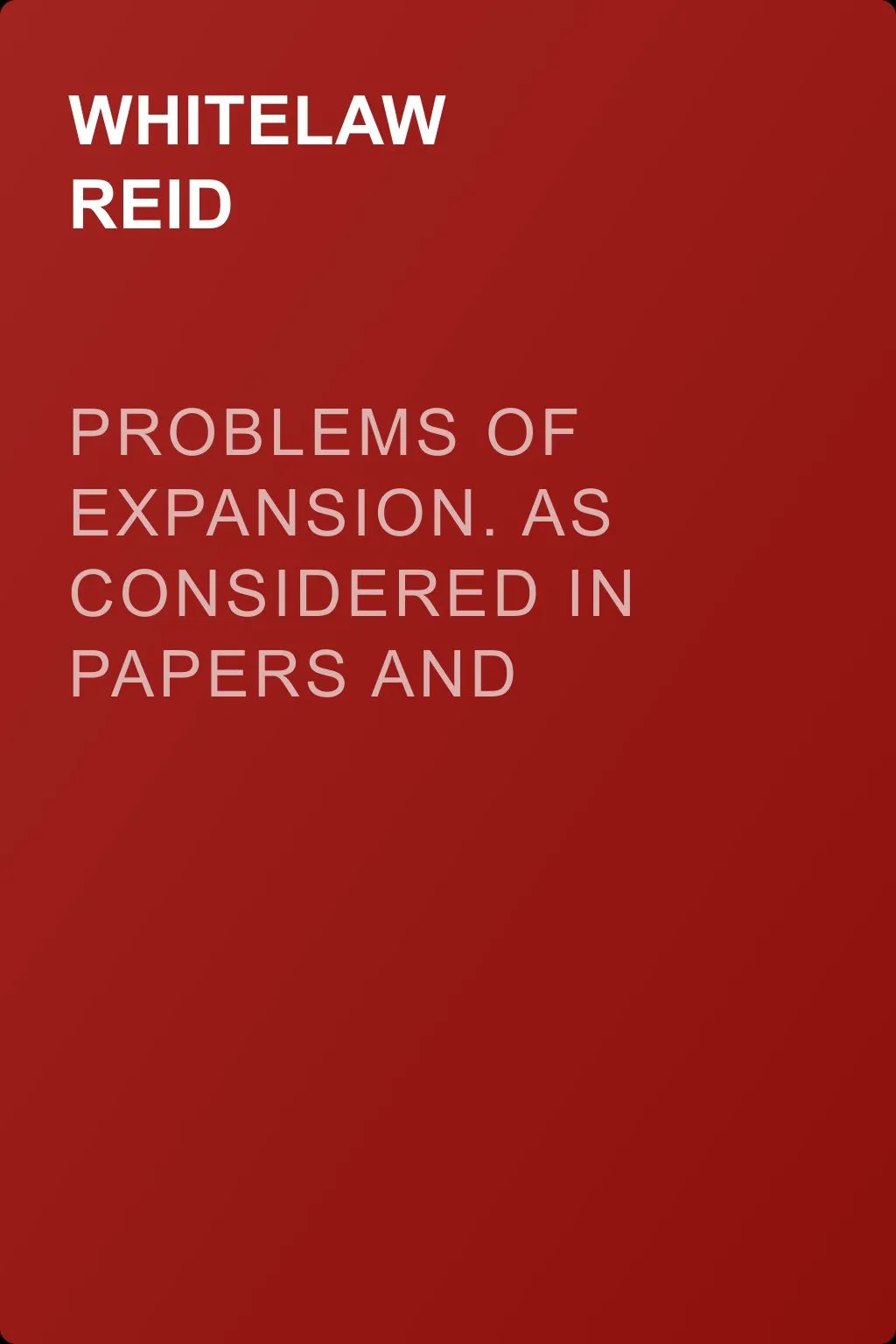
Problems of Expansion. As Considered in Papers and Addresses
Автор Whitelaw Reid0+
Удобнее читать в приложении
AI-разбор доступен после входа
Суть книги, пересказ, главный конфликт, ключевые идеи, вывод, кому полезна, главные темы, персонажи и цитаты можно получить после входа в BookRa.
auto_awesomeПолучить AI-разборО книге
Дата написания1970-01-01
Язык книгиen
Возрастное ограничение0+
Читать онлайн
Страница 2 из 52Most people now realize from what a mistake Congress was kept by the firm attitude of the President in opposing a recognition of the so-called Cuban Republic of Cubitas. It is now generally understood that virtually there was no Cuban Republic, or any Cuban government save that of wandering bands of guerrilla insurgents, probably less numerous and influential than had been represented. There seems reason to believe that however bad Spanish government may have been, the rule of these people, where they had the power, was as bad; and still greater reason to apprehend that if they had full power, their sense of past wrongs and their unrestrained tropical thirst for vengeance might lead to something worse. Is it for that pitiful result that a civilized and Christian people is giving up its sons and pouring out blood and treasure in Cuba?
In commanding the war, Congress pledged us to continue our action until the pacification of the island should be secured. When that happy time has arrived, if it shall then be found that the Cuban insurgents and their late enemies are able to unite in maintaining a settled and peaceable government in Cuba, distinctly free from the faults which now lead the United States to destroy the old one, we shall have discharged our responsibility, and will be at liberty to end our interference. But if not, the responsibility of the United States continues. It is morally bound to secure to Cuba such a government, even if forced by circumstances to furnish it itself.
At this point, however, we are checked by a reminder of the further action of Congress, "asserting its determination, when the pacification of Cuba has been accomplished, to leave the government and control of the island to its people."
Now, the secondary provisions of any great measure must be construed in the light of its main purpose; and where they conflict, we are led to presume that they would not have been adopted but for ignorance of the actual conditions. Is it not evident that such was the case here? We now know how far Congress was misled as to the organization and power of the alleged Cuban government, the strength of the revolt, and the character of the war the insurgents were waging. We have seen how little dependence could be placed upon the lavish promises of support from great armies of insurgents in the war we have undertaken; and we are beginning to realize the difference between our idea of a humane and civilized "pacification" and that apparently entertained up to this time by the insurgents. It is certainly true that when the war began neither Congress nor the people of the United States cherished an intention to hold Cuba permanently, or had any further thought than to pacify it and turn it over to its own people. But they must pacify it before they turn it over; and, from present indications, to do that thoroughly may be the work of years. Even then they are still responsible to the world for the establishment of a better government than the one they destroy. If the last state of that island should be worse than the first, the fault and the crime must be solely that of the United States. We were not actually forced to involve ourselves; we might have passed by on the other side. When, instead, we insisted on interfering, we made ourselves responsible for improving the situation; and, no matter what Congress "disclaimed," or what intention it "asserted," we cannot leave Cuba till that is done without national dishonor and blood-guiltiness.
The situation is curiously like that of England in Egypt. She intervened too, under far less provocation, it must be admitted, and for a cause rather more commercial than humanitarian. But when some thought that her work was ended and that it was time for her to go, Lord Granville, on behalf of Mr. Gladstone's government, addressed the other great European Powers in a note on the outcome of which Congress might have reflected with profit before framing its resolutions. "Although for the present," he said, "a British force remains in Egypt for the preservation of public tranquillity, Her Majesty's government are desirous of withdrawing it as soon as the state of the country and the organization of proper means for the maintenance of the Khedive's authority will admit of it. In the meantime the position in which Her Majesty's government are placed towards His Highness imposes upon them the duty of giving advice, with the object of securing that the order of things to be established shall be of a satisfactory character and possess the elements of stability and progress." As time went on this declaration did not seem quite explicit enough; and accordingly, just a year later, Lord Granville instructed the present Lord Cromer, then Sir Evelyn Baring, that it should be made clear to the Egyptian ministers and governors of provinces that "the responsibility which for the time rests on England obliges Her Majesty's government to insist on the adoption of the policy which they recommend, and that it will be necessary that those ministers and governors who do not follow this course should cease to hold their offices."
That was in 1884—a year after the defeat of Arabi, and the "pacification." It is now fourteen years later. The English are still there, and the Egyptian ministers and governors now understand quite well that they must cease to hold their offices if they do not adopt the policy recommended by the British diplomatic agent. If it should be found that we cannot with honor and self-respect begin to abandon our self-imposed task of Cuban "pacification" with any greater speed, the impetuous congressmen, as they read over their own inconsiderate resolutions fourteen years hence, can hide their blushes behind a copy of Lord Granville's letter. They may explain, if they like, with the classical excuse of Benedick, "When I said I would die a bachelor, I did not think I should live till I were married." Or if this seems too frivolous for their serious plight, let them recall the position of Mr. Jefferson, who originally declared that the purchase of foreign territory would make waste paper of the Constitution, and subsequently appealed to Congress for the money to pay for his purchase of Louisiana. When he held such an acquisition unconstitutional, he had not thought he would live to want Louisiana.
As to Cuba, it may be fairly concluded that only these points are actually clear: (1) We had made ourselves in a sense responsible for Spain's rule in that island by our consistent declaration, through three quarters of a century, that no other European nation should replace her—Daniel Webster, as Secretary of State, even seeking to guard her hold as against Great Britain. (2) We are now at war because we say Spanish rule is intolerable; and we cannot withdraw our hand till it is replaced by a rule for which we are willing to be responsible. (3) We are also pledged to remain till the pacification is complete.
Вам также может понравиться
{"page":{"canonicalUrl":"https://bookra.app/books/4NY5UBGg","pageTitle":"Problems of Expansion. As Considered in Papers and Addresses (Whitelaw Reid) — полный текст, краткое содержание, анализ и герои","metaDescription":"Полный текст книги «Problems of Expansion. As Considered in Papers and Addresses». А также краткое содержание, главные мысли, конфликт, темы, персонажи, цитаты и ответы на вопросы.","headingTitle":"«Problems of Expansion. As Considered in Papers and Addresses». Читать бесплатно онлайн","headingSubtitle":"Whitelaw Reid","structuredData":[{"@context":"https://schema.org","@type":"BreadcrumbList","@id":"https://bookra.app/books/4NY5UBGg#breadcrumb","itemListElement":[{"@type":"ListItem","position":1,"name":"BookRa","item":"https://bookra.app/"},{"@type":"ListItem","position":2,"name":"зарубежная классика","item":"https://bookra.app/genre/5214"},{"@type":"ListItem","position":3,"name":"Problems of Expansion. As Considered in Papers and Addresses","item":"https://bookra.app/books/4NY5UBGg"}]},{"@context":"https://schema.org","@type":"WebPage","@id":"https://bookra.app/books/4NY5UBGg","url":"https://bookra.app/books/4NY5UBGg","name":"«Problems of Expansion. As Considered in Papers and Addresses». Читать бесплатно онлайн","description":"Полный текст книги «Problems of Expansion. As Considered in Papers and Addresses». А также краткое содержание, главные мысли, конфликт, темы, персонажи, цитаты и ответы на вопросы.","breadcrumb":{"@id":"https://bookra.app/books/4NY5UBGg#breadcrumb"},"mainEntity":{"@id":"https://bookra.app/books/4NY5UBGg#work"},"primaryImageOfPage":{"@type":"ImageObject","url":"https://storage.yandexcloud.net/bookra-catalog-pd-public/content/cc77704e-3a87-11e9-aa86-0cc47a5453d6/thumbs/1200.webp"}},{"@context":"https://schema.org","@type":"Book","@id":"https://bookra.app/books/4NY5UBGg#work","name":"Problems of Expansion. As Considered in Papers and Addresses","url":"https://bookra.app/books/4NY5UBGg","description":"Полный текст книги «Problems of Expansion. As Considered in Papers and Addresses». А также краткое содержание, главные мысли, конфликт, темы, персонажи, цитаты и ответы на вопросы.","image":"https://storage.yandexcloud.net/bookra-catalog-pd-public/content/cc77704e-3a87-11e9-aa86-0cc47a5453d6/thumbs/1200.webp","inLanguage":"en","genre":["зарубежная классика","зарубежная старинная литература"],"sameAs":["https://litres.ru/book/whitelaw-reid/problems-of-expansion-as-considered-in-papers-and-addresses-41260892/"],"author":[{"@type":"Person","@id":"https://bookra.app/author/5a07dcc9-3a85-11e9-aa5d-0cc47a5f137d#person","name":"Whitelaw Reid","url":"https://bookra.app/author/5a07dcc9-3a85-11e9-aa5d-0cc47a5f137d"}],"about":[{"@type":"Thing","name":"зарубежная классика"},{"@type":"Thing","name":"зарубежная старинная литература"},{"@type":"Thing","name":"чтение онлайн"},{"@type":"Thing","name":"саммари"},{"@type":"Thing","name":"AI-разбор"},{"@type":"Thing","name":"персонажи"},{"@type":"Thing","name":"цитаты"}],"workExample":{"@type":"Book","@id":"https://bookra.app/books/4NY5UBGg#edition","url":"https://bookra.app/books/4NY5UBGg","bookFormat":"https://schema.org/EBook","inLanguage":"en","sameAs":["https://litres.ru/book/whitelaw-reid/problems-of-expansion-as-considered-in-papers-and-addresses-41260892/"],"isAccessibleForFree":true,"potentialAction":{"@type":"ReadAction","name":"Читать бесплатно онлайн «Problems of Expansion. As Considered in Papers and Addresses»","target":{"@type":"EntryPoint","urlTemplate":"https://bookra.app/books/4NY5UBGg","actionPlatform":["https://schema.org/DesktopWebPlatform"]},"expectsAcceptanceOf":{"@type":"Offer","category":"nologinrequired"}}}}],"book":{"idCatalog":765604,"shortId":"4NY5UBGg","title":"Problems of Expansion. As Considered in Papers and Addresses","coverUrl":"https://storage.yandexcloud.net/bookra-catalog-pd-public/content/cc77704e-3a87-11e9-aa86-0cc47a5453d6/thumbs/1200.webp","annotationText":"","catalogType":"PUBLIC_DOMAIN","catalogTypeLabel":"Общественное достояние","authorLine":"Whitelaw Reid","authors":[{"id":"5a07dcc9-3a85-11e9-aa5d-0cc47a5f137d","displayName":"Whitelaw Reid","protectedUrl":"/author/5a07dcc9-3a85-11e9-aa5d-0cc47a5f137d","wikipediaUrl":null,"wikidataUrl":null}],"genres":[{"id":5214,"title":"зарубежная классика","token":null,"publicUrl":"https://bookra.app/genre/5214"},{"id":5215,"title":"зарубежная старинная литература","token":null,"publicUrl":"https://bookra.app/genre/5215"}],"keywords":[],"facts":[{"key":"dateWritten","label":"Дата написания","value":"1970-01-01"},{"key":"bookLanguage","label":"Язык книги","value":"en"},{"key":"adult","label":"Возрастное ограничение","value":"0+"}],"seoSections":[],"authorSummary":null,"hasArtifacts":false,"canReadInApp":true,"readUrl":"https://web.bookra.app/?startapp=r_765604","artifactsUrl":"https://web.bookra.app/?startapp=b_765604","readCtaLabel":"Читать бесплатно","artifactsCtaLabel":"AI-разбор","appReadLinks":{"tg":"https://t.me/bookra_lib_bot/BookRa?startapp=r_765604","vk":"https://vk.com/app54470698#startapp=r_765604","max":"https://max.ru/id7751370047_bot?startapp=r_765604","web":"https://web.bookra.app/?startapp=r_765604"},"appAnalysisLinks":{"tg":"https://t.me/bookra_lib_bot/BookRa?startapp=b_765604","vk":"https://vk.com/app54470698#startapp=b_765604","max":"https://max.ru/id7751370047_bot?startapp=b_765604","web":"https://web.bookra.app/?startapp=b_765604"},"guestReaderUrl":"/books/4NY5UBGg?page=2#reader-content","authorCtaLabel":"Все книги автора","authorProtectedUrl":"/author/5a07dcc9-3a85-11e9-aa5d-0cc47a5f137d","readersCount":0,"adultLabel":"0+","yearLabel":null,"datePublished":null,"publisherLabel":null,"isbn":null,"oclc":null,"lccn":null,"partnerUrl":null,"accessNote":"Полный текст книги и AI-разбор откроются на защищенных страницах BookRa после входа."},"reader":{"page":2,"totalPages":52,"hasPrev":true,"hasNext":true,"prevPageUrl":"/books/4NY5UBGg#reader-content","nextPageUrl":"/books/4NY5UBGg?page=3#reader-content","progressLabel":"Страница 2 из 52","sections":[{"id":"content0:19","kind":"paragraph","text":"Most people now realize from what a mistake Congress was kept by the firm attitude of the President in opposing a recognition of the so-called Cuban Republic of Cubitas. It is now generally understood that virtually there was no Cuban Republic, or any Cuban government save that of wandering bands of guerrilla insurgents, probably less numerous and influential than had been represented. There seems reason to believe that however bad Spanish government may have been, the rule of these people, where they had the power, was as bad; and still greater reason to apprehend that if they had full power, their sense of past wrongs and their unrestrained tropical thirst for vengeance might lead to something worse. Is it for that pitiful result that a civilized and Christian people is giving up its sons and pouring out blood and treasure in Cuba?"},{"id":"content0:20","kind":"paragraph","text":"In commanding the war, Congress pledged us to continue our action until the pacification of the island should be secured. When that happy time has arrived, if it shall then be found that the Cuban insurgents and their late enemies are able to unite in maintaining a settled and peaceable government in Cuba, distinctly free from the faults which now lead the United States to destroy the old one, we shall have discharged our responsibility, and will be at liberty to end our interference. But if not, the responsibility of the United States continues. It is morally bound to secure to Cuba such a government, even if forced by circumstances to furnish it itself."},{"id":"content0:21","kind":"paragraph","text":"The Pledge of Congress."},{"id":"content0:22","kind":"paragraph","text":"At this point, however, we are checked by a reminder of the further action of Congress, \"asserting its determination, when the pacification of Cuba has been accomplished, to leave the government and control of the island to its people.\""},{"id":"content0:23","kind":"paragraph","text":"Now, the secondary provisions of any great measure must be construed in the light of its main purpose; and where they conflict, we are led to presume that they would not have been adopted but for ignorance of the actual conditions. Is it not evident that such was the case here? We now know how far Congress was misled as to the organization and power of the alleged Cuban government, the strength of the revolt, and the character of the war the insurgents were waging. We have seen how little dependence could be placed upon the lavish promises of support from great armies of insurgents in the war we have undertaken; and we are beginning to realize the difference between our idea of a humane and civilized \"pacification\" and that apparently entertained up to this time by the insurgents. It is certainly true that when the war began neither Congress nor the people of the United States cherished an intention to hold Cuba permanently, or had any further thought than to pacify it and turn it over to its own people. But they must pacify it before they turn it over; and, from present indications, to do that thoroughly may be the work of years. Even then they are still responsible to the world for the establishment of a better government than the one they destroy. If the last state of that island should be worse than the first, the fault and the crime must be solely that of the United States. We were not actually forced to involve ourselves; we might have passed by on the other side. When, instead, we insisted on interfering, we made ourselves responsible for improving the situation; and, no matter what Congress \"disclaimed,\" or what intention it \"asserted,\" we cannot leave Cuba till that is done without national dishonor and blood-guiltiness."},{"id":"content0:24","kind":"paragraph","text":"Egypt and Cuba."},{"id":"content0:25","kind":"paragraph","text":"The situation is curiously like that of England in Egypt. She intervened too, under far less provocation, it must be admitted, and for a cause rather more commercial than humanitarian. But when some thought that her work was ended and that it was time for her to go, Lord Granville, on behalf of Mr. Gladstone's government, addressed the other great European Powers in a note on the outcome of which Congress might have reflected with profit before framing its resolutions. \"Although for the present,\" he said, \"a British force remains in Egypt for the preservation of public tranquillity, Her Majesty's government are desirous of withdrawing it as soon as the state of the country and the organization of proper means for the maintenance of the Khedive's authority will admit of it. In the meantime the position in which Her Majesty's government are placed towards His Highness imposes upon them the duty of giving advice, with the object of securing that the order of things to be established shall be of a satisfactory character and possess the elements of stability and progress.\" As time went on this declaration did not seem quite explicit enough; and accordingly, just a year later, Lord Granville instructed the present Lord Cromer, then Sir Evelyn Baring, that it should be made clear to the Egyptian ministers and governors of provinces that \"the responsibility which for the time rests on England obliges Her Majesty's government to insist on the adoption of the policy which they recommend, and that it will be necessary that those ministers and governors who do not follow this course should cease to hold their offices.\""},{"id":"content0:26","kind":"paragraph","text":"That was in 1884—a year after the defeat of Arabi, and the \"pacification.\" It is now fourteen years later. The English are still there, and the Egyptian ministers and governors now understand quite well that they must cease to hold their offices if they do not adopt the policy recommended by the British diplomatic agent. If it should be found that we cannot with honor and self-respect begin to abandon our self-imposed task of Cuban \"pacification\" with any greater speed, the impetuous congressmen, as they read over their own inconsiderate resolutions fourteen years hence, can hide their blushes behind a copy of Lord Granville's letter. They may explain, if they like, with the classical excuse of Benedick, \"When I said I would die a bachelor, I did not think I should live till I were married.\" Or if this seems too frivolous for their serious plight, let them recall the position of Mr. Jefferson, who originally declared that the purchase of foreign territory would make waste paper of the Constitution, and subsequently appealed to Congress for the money to pay for his purchase of Louisiana. When he held such an acquisition unconstitutional, he had not thought he would live to want Louisiana."},{"id":"content0:27","kind":"paragraph","text":"As to Cuba, it may be fairly concluded that only these points are actually clear: (1) We had made ourselves in a sense responsible for Spain's rule in that island by our consistent declaration, through three quarters of a century, that no other European nation should replace her—Daniel Webster, as Secretary of State, even seeking to guard her hold as against Great Britain. (2) We are now at war because we say Spanish rule is intolerable; and we cannot withdraw our hand till it is replaced by a rule for which we are willing to be responsible. (3) We are also pledged to remain till the pacification is complete."}],"toc":[{"id":"content0:0:1","label":"Whitelaw Reid Problems of Expansion / As Considered in Papers and Addresses","page":1,"pageUrl":"/books/4NY5UBGg#reader-content"},{"id":"content0:1:1","label":"PREFATORY NOTE","page":1,"pageUrl":"/books/4NY5UBGg#reader-content"},{"id":"content0:10:1","label":"I THE TERRITORY WITH WHICH WE ARE THREATENED","page":1,"pageUrl":"/books/4NY5UBGg#reader-content"},{"id":"content0:12:1","label":"THE TERRITORY WITH WHICH WE ARE THREATENED","page":1,"pageUrl":"/books/4NY5UBGg#reader-content"},{"id":"content1:0:5","label":"II WAS IT TOO GOOD A TREATY?","page":5,"pageUrl":"/books/4NY5UBGg?page=5#reader-content"},{"id":"content1:13:6","label":"WAS IT TOO GOOD A TREATY?","page":6,"pageUrl":"/books/4NY5UBGg?page=6#reader-content"},{"id":"content2:0:7","label":"III PURPORT OF THE TREATY","page":7,"pageUrl":"/books/4NY5UBGg?page=7#reader-content"},{"id":"content2:2:7","label":"PURPORT OF THE TREATY","page":7,"pageUrl":"/books/4NY5UBGg?page=7#reader-content"},{"id":"content3:0:10","label":"IV THE DUTIES OF PEACE","page":10,"pageUrl":"/books/4NY5UBGg?page=10#reader-content"},{"id":"content3:2:10","label":"THE DUTIES OF PEACE","page":10,"pageUrl":"/books/4NY5UBGg?page=10#reader-content"},{"id":"content4:0:11","label":"V THE OPEN DOOR","page":11,"pageUrl":"/books/4NY5UBGg?page=11#reader-content"},{"id":"content4:2:12","label":"THE OPEN DOOR","page":12,"pageUrl":"/books/4NY5UBGg?page=12#reader-content"},{"id":"content4:11:12","label":"VI SOME CONSEQUENCES OF THE TREATY OF PARIS","page":12,"pageUrl":"/books/4NY5UBGg?page=12#reader-content"},{"id":"content4:13:12","label":"SOME CONSEQUENCES OF THE TREATY OF PARIS","page":12,"pageUrl":"/books/4NY5UBGg?page=12#reader-content"},{"id":"content5:0:19","label":"VII OUR NEW DUTIES","page":19,"pageUrl":"/books/4NY5UBGg?page=19#reader-content"},{"id":"content5:2:19","label":"OUR NEW DUTIES","page":19,"pageUrl":"/books/4NY5UBGg?page=19#reader-content"},{"id":"content6:0:28","label":"VIII LATER ASPECTS OF OUR NEW DUTIES","page":28,"pageUrl":"/books/4NY5UBGg?page=28#reader-content"},{"id":"content6:2:28","label":"LATER ASPECTS OF OUR NEW DUTIES","page":28,"pageUrl":"/books/4NY5UBGg?page=28#reader-content"},{"id":"content7:0:34","label":"IX A CONTINENTAL UNION","page":34,"pageUrl":"/books/4NY5UBGg?page=34#reader-content"},{"id":"content7:2:34","label":"A CONTINENTAL UNION","page":34,"pageUrl":"/books/4NY5UBGg?page=34#reader-content"},{"id":"content8:0:38","label":"X OUR NEW INTERESTS","page":38,"pageUrl":"/books/4NY5UBGg?page=38#reader-content"},{"id":"content8:2:38","label":"OUR NEW INTERESTS","page":38,"pageUrl":"/books/4NY5UBGg?page=38#reader-content"},{"id":"content9:0:44","label":"XI \"UNOFFICIAL INSTRUCTIONS\"","page":44,"pageUrl":"/books/4NY5UBGg?page=44#reader-content"},{"id":"content9:2:44","label":"\"UNOFFICIAL INSTRUCTIONS\"","page":44,"pageUrl":"/books/4NY5UBGg?page=44#reader-content"},{"id":"content10:0:46","label":"APPENDICES","page":46,"pageUrl":"/books/4NY5UBGg?page=46#reader-content"},{"id":"content10:6:46","label":"1 POWER TO ACQUIRE AND GOVERN TERRITORY","page":46,"pageUrl":"/books/4NY5UBGg?page=46#reader-content"},{"id":"content10:32:47","label":"2 THE TARIFF IN UNITED STATES TERRITORY","page":47,"pageUrl":"/books/4NY5UBGg?page=47#reader-content"},{"id":"content11:0:48","label":"3 THE RESOLUTIONS OF CONGRESS AS TO CUBA","page":48,"pageUrl":"/books/4NY5UBGg?page=48#reader-content"},{"id":"content11:7:48","label":"4 THE PROTOCOL OF WASHINGTON","page":48,"pageUrl":"/books/4NY5UBGg?page=48#reader-content"},{"id":"content11:24:48","label":"5 THE PEACE OF PARIS","page":48,"pageUrl":"/books/4NY5UBGg?page=48#reader-content"},{"id":"contentnotes0:0:51","label":"1","page":51,"pageUrl":"/books/4NY5UBGg?page=51#reader-content"},{"id":"contentnotes0:3:51","label":"2","page":51,"pageUrl":"/books/4NY5UBGg?page=51#reader-content"},{"id":"contentnotes0:6:51","label":"3","page":51,"pageUrl":"/books/4NY5UBGg?page=51#reader-content"},{"id":"contentnotes0:10:51","label":"4","page":51,"pageUrl":"/books/4NY5UBGg?page=51#reader-content"},{"id":"contentnotes0:13:51","label":"5","page":51,"pageUrl":"/books/4NY5UBGg?page=51#reader-content"},{"id":"contentnotes0:16:51","label":"6","page":51,"pageUrl":"/books/4NY5UBGg?page=51#reader-content"},{"id":"contentnotes0:22:52","label":"7","page":52,"pageUrl":"/books/4NY5UBGg?page=52#reader-content"},{"id":"contentnotes0:25:52","label":"8","page":52,"pageUrl":"/books/4NY5UBGg?page=52#reader-content"},{"id":"contentnotes0:28:52","label":"9","page":52,"pageUrl":"/books/4NY5UBGg?page=52#reader-content"},{"id":"contentnotes0:31:52","label":"10","page":52,"pageUrl":"/books/4NY5UBGg?page=52#reader-content"},{"id":"contentnotes0:34:52","label":"11","page":52,"pageUrl":"/books/4NY5UBGg?page=52#reader-content"},{"id":"contentnotes0:37:52","label":"12","page":52,"pageUrl":"/books/4NY5UBGg?page=52#reader-content"},{"id":"contentnotes0:45:52","label":"13","page":52,"pageUrl":"/books/4NY5UBGg?page=52#reader-content"},{"id":"contentnotes0:48:52","label":"14","page":52,"pageUrl":"/books/4NY5UBGg?page=52#reader-content"},{"id":"contentnotes0:51:52","label":"15","page":52,"pageUrl":"/books/4NY5UBGg?page=52#reader-content"},{"id":"contentnotes0:54:52","label":"16","page":52,"pageUrl":"/books/4NY5UBGg?page=52#reader-content"},{"id":"contentnotes0:57:52","label":"17","page":52,"pageUrl":"/books/4NY5UBGg?page=52#reader-content"}]},"similarBooks":[{"idCatalog":787516,"shortId":"038AHbna","title":"Человек-зверь","authorLine":"Эмиль Золя, В. Ранцова","primaryAuthorId":"82d512ee-2a82-102a-9ae1-2dfe723fe7c7","coverUrl":"https://storage.yandexcloud.net/bookra-catalog-pd-public/content/46378965-70f6-41f4-9510-013fea11211d/thumbs/400.webp","publicUrl":"https://bookra.app/books/038AHbna"},{"idCatalog":7183,"shortId":"4SSnge7p","title":"Фараон","authorLine":"Болеслав Прус, Е. Н. Троповский","primaryAuthorId":"dcbe6513-2a81-102a-9ae1-2dfe723fe7c7","coverUrl":"https://storage.yandexcloud.net/bookra-catalog-litres-public/content/32aeea09-f542-4c48-ba6c-1464e0288595/thumbs/400.webp","publicUrl":"https://bookra.app/books/4SSnge7p"},{"idCatalog":521096,"shortId":"39RurXks","title":"Хагакурэ, или Сокрытое в листве","authorLine":"Цунэтомо Ямамото, Сергей И. Логачев","primaryAuthorId":"292e10ef-2a83-102a-9ae1-2dfe723fe7c7","coverUrl":"https://storage.yandexcloud.net/bookra-catalog-litres-public/content/d2c8ca1b-24e9-11ee-8496-0cc47af30fe4/thumbs/400.webp","publicUrl":"https://bookra.app/books/39RurXks"},{"idCatalog":790354,"shortId":"08oOsnCu","title":"Сон в летнюю ночь","authorLine":"Уильям Шекспир, Николай Михайлович Сатин","primaryAuthorId":"c577ea96-2a81-102a-9ae1-2dfe723fe7c7","coverUrl":"https://storage.yandexcloud.net/bookra-catalog-pd-public/content/9cb6e365-8043-11e7-af8e-0cc47a1952f2/thumbs/400.webp","publicUrl":"https://bookra.app/books/08oOsnCu"},{"idCatalog":788220,"shortId":"0Tjejja2","title":"Нана","authorLine":"Эмиль Золя, Т. Иринова","primaryAuthorId":"82d512ee-2a82-102a-9ae1-2dfe723fe7c7","coverUrl":"https://storage.yandexcloud.net/bookra-catalog-pd-public/content/5a387752-aafd-4f3d-bb91-627dfd767da4/thumbs/400.webp","publicUrl":"https://bookra.app/books/0Tjejja2"},{"idCatalog":577406,"shortId":"0q0GFNSG","title":"Золотой осел","authorLine":"Луций Апулей, Михаил Алексеевич Кузмин","primaryAuthorId":"673278e9-2a98-102a-9ac3-800cba805322","coverUrl":"https://storage.yandexcloud.net/bookra-catalog-litres-public/content/c0602770-11db-11ef-8496-0cc47af30fe4/thumbs/400.webp","publicUrl":"https://bookra.app/books/0q0GFNSG"},{"idCatalog":763844,"shortId":"0k1CVPMc","title":"Ромео и Джульетта","authorLine":"Уильям Шекспир, Дмитрий Лаврентьевич Михаловский","primaryAuthorId":"c577ea96-2a81-102a-9ae1-2dfe723fe7c7","coverUrl":"https://storage.yandexcloud.net/bookra-catalog-pd-public/content/8c3c1916-803a-11e7-8179-0cc47a520474/thumbs/400.webp","publicUrl":"https://bookra.app/books/0k1CVPMc"},{"idCatalog":766049,"shortId":"4TrGYIUx","title":"Гамлет, принц Датский","authorLine":"Уильям Шекспир, Петр Петрович Гнедич","primaryAuthorId":"c577ea96-2a81-102a-9ae1-2dfe723fe7c7","coverUrl":"https://storage.yandexcloud.net/bookra-catalog-pd-public/content/e925d796-803b-11e7-af8e-0cc47a1952f2/thumbs/400.webp","publicUrl":"https://bookra.app/books/4TrGYIUx"},{"idCatalog":46756,"shortId":"1wKz5vUM","title":"Монахиня","authorLine":"Дени Дидро, Дебора Григорьевна Лившиц","primaryAuthorId":"b1401df8-2a93-102a-9ac3-800cba805322","coverUrl":"https://storage.yandexcloud.net/bookra-catalog-litres-public/content/37ba23fd-6a81-102c-a19b-edc40df1930e/thumbs/400.webp","publicUrl":"https://bookra.app/books/1wKz5vUM"},{"idCatalog":788440,"shortId":"0L94UZhC","title":"Доктор Паскаль","authorLine":"Эмиль Золя, Константин Григорьевич Локс","primaryAuthorId":"82d512ee-2a82-102a-9ae1-2dfe723fe7c7","coverUrl":"https://storage.yandexcloud.net/bookra-catalog-pd-public/content/61f13980-8201-4459-bcd1-e04d976a5570/thumbs/400.webp","publicUrl":"https://bookra.app/books/0L94UZhC"},{"idCatalog":11697,"shortId":"2MoUDOAh","title":"Сон в красном тереме. Том 1","authorLine":"Лев Николаевич Меньшиков, Владимир Андреевич Панасюк, Цао Сюэцинь","primaryAuthorId":"4e036549-1455-11e8-a22f-0cc47a5454c6","coverUrl":"https://storage.yandexcloud.net/bookra-catalog-litres-public/content/c9377cb2-c07d-4c18-a638-1db65e2e0cf2/thumbs/400.webp","publicUrl":"https://bookra.app/books/2MoUDOAh"},{"idCatalog":792368,"shortId":"4ft6F5H0","title":"Саламбо","authorLine":"Гюстав Флобер, Николай Максимович Минский","primaryAuthorId":"526ac12b-2a82-102a-9ae1-2dfe723fe7c7","coverUrl":"https://storage.yandexcloud.net/bookra-catalog-pd-public/content/d8927887-c0aa-11e0-9959-47117d41cf4b/thumbs/400.webp","publicUrl":"https://bookra.app/books/4ft6F5H0"}],"similarBooksPagination":{"page":1,"pageSize":12,"totalItems":2333,"totalPages":195,"hasPrev":false,"hasNext":true}},"notFound":false}