Читать бесплатно онлайн
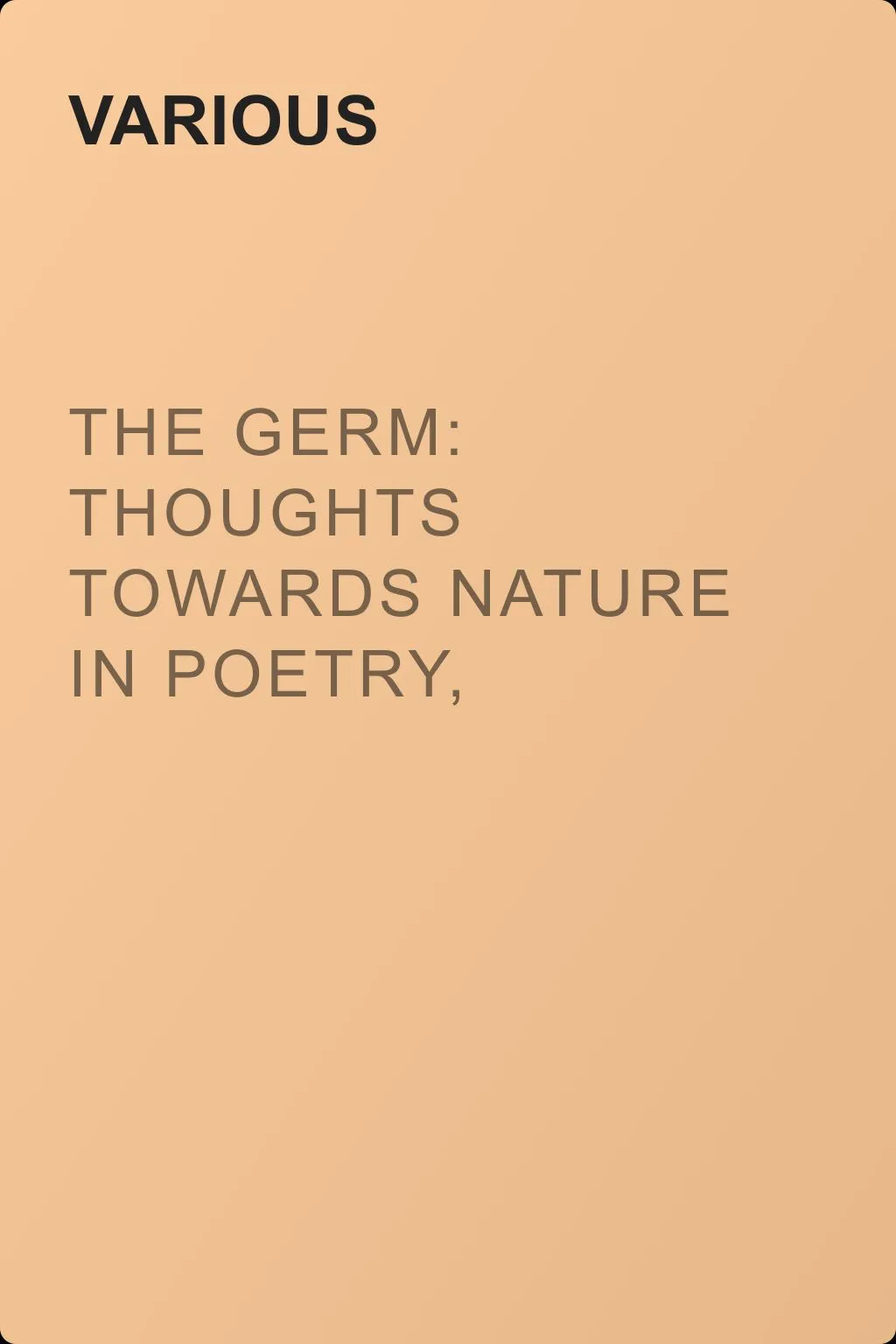
The Germ: Thoughts towards Nature in Poetry, Literature and Art
Автор Various0+
Удобнее читать в приложении
AI-разбор доступен после входа
Суть книги, пересказ, главный конфликт, ключевые идеи, вывод, кому полезна, главные темы, персонажи и цитаты можно получить после входа в BookRa.
auto_awesomeПолучить AI-разборО книге
Дата написания1970-01-01
Язык книгиen
Возрастное ограничение0+
Читать онлайн
Страница 1 из 71Various The Germ: Thoughts towards Nature in Poetry, Literature and Art
INTRODUCTION
Of late years it has been my fate or my whim to write a good deal about the early days of the Præraphaelite movement, the members of the Præraphaelite Brotherhood, and especially my brother Dante Gabriel Rossetti, and my sister Christina Georgina Rossetti. I am now invited to write something further on the subject, with immediate reference to the Præraphaelite magazine “The Germ,” republished in this volume. I know of no particular reason why I should not do this, for certain it is that few people living know, or ever knew, so much as I do about “The Germ,”; and if some press-critics who regarded previous writings of mine as superfluous or ill-judged should entertain a like opinion now, in equal or increased measure, I willingly leave them to say so, while I pursue my own course none the less.
“The Germ” is here my direct theme, not the Præraphaelite Brotherhood; but it seems requisite to say in the first instance something about the Brotherhood—its members, allies, and ideas—so as to exhibit a raison d'être for the magazine. In doing this I must necessarily repeat some things which I have set forth before, and which, from the writings of others as well as myself, are well enough known to many. I can vary my form of expression, but cannot introduce much novelty into my statements of fact.
In 1848 the British School of Painting was in anything but a vital or a lively condition. One very great and incomparable genius, Turner, belonged to it. He was old and past his executive prime. There were some other highly able men—Etty and David Scott, then both very near their death; Maclise, Dyce, Cope, Mulready, Linnell, Poole, William Henry Hunt, Landseer, Leslie, Watts, Cox, J.F. Lewis, and some others. There were also some distinctly clever men, such as Ward, Frith, and Egg. Paton, Gilbert, Ford Madox Brown, Mark Anthony, had given sufficient indication of their powers, but were all in an early stage. On the whole the school had sunk very far below what it had been in the days of Hogarth, Reynolds, Gainsborough, and Blake, and its ordinary average had come to be something for which commonplace is a laudatory term, and imbecility a not excessive one.
There were in the late summer of 1848, in the Schools of the Royal Academy or barely emergent from them, four young men to whom this condition of the art seemed offensive, contemptible, and even scandalous. Their names were William Holman-Hunt, John Everett Millais, and Dante Gabriel Rossetti, painters, and Thomas Woolner, sculptor. Their ages varied from twenty-two to nineteen—Woolner being the eldest, and Millais the youngest. Being little more than lads, these young men were naturally not very deep in either the theory or the practice of art: but they had open eyes and minds, and could discern that some things were good and other bad—that some things they liked, and others they hated. They hated the lack of ideas in art, and the lack of character; the silliness and vacuity which belong to the one, the flimsiness and make-believe which result from the other. They hated those forms of execution which are merely smooth and prettyish, and those which, pretending to mastery, are nothing better than slovenly and slapdash, or what the P.R.B.'s called “sloshy.” Still more did they hate the notion that each artist should not obey his own individual impulse, act upon his own perception and study of Nature, and scrutinize and work at his objective material with assiduity before he could attempt to display and interpret it; but that, instead of all this, he should try to be “like somebody else,” imitating some extant style and manner, and applying the cut-and-dry rules enunciated by A from the practice of B or C. They determined to do the exact contrary. The temper of these striplings, after some years of the current academic training, was the temper of rebels: they meant revolt, and produced revolution. It would be a mistake to suppose, because the called themselves Præraphaelites, that they seriously disliked the works produced by Raphael; but they disliked the works produced by Raphael's uninspired satellites, and were resolved to find out, by personal study and practice, what their own several faculties and adaptabilities might be, without being bound by rules and big-wiggeries founded upon the performance of Raphael or of any one. They were to have no master except their own powers of mind and hand, and their own first-hand study of Nature. Their minds were to furnish them with subjects for works of art, and with the general scheme of treatment; Nature was to be their one or their paramount storehouse of materials for objects to be represented; the study of her was to be deep, and the representation (at any rate in the earlier stages of self-discipline and work) in the highest degree exact; executive methods were to be learned partly from precept and example, but most essentially from practice and experiment. As their minds were very different in range and direction, their products also, from the first, differed greatly; and these soon ceased to have any link of resemblance.
The Præraphaelite Brothers entertained a deep respect and a sincere affection for the works of some of the artists who had preceded Raphael; and they thought that they should more or less be following the lead of those artists if they themselves were to develop their own individuality, disregarding school-rules. This was really the sum and substance of their “Præraphaelitism.” It may freely be allowed that, as they were very young, and fired by certain ideas impressive to their own spirits, they unduly ignored some other ideas and theories which have none the less a deal to say for themselves. They contemned some things and some practitioners of art not at all contemptible, and, in speech still more than in thought, they at times wilfully heaped up the scorn. You cannot have a youthful rebel with a faculty who is also a model head-boy in a school.
The P.R.B. was completed by the accession of three members to the four already mentioned. These were James Collinson, a domestic painter; Frederic George Stephens, an Academy-student of painting; and myself, a Government-clerk. These again, when the P.R.B. was formed towards September 1848, were all young, aged respectively about twenty-three, twenty-one, and nineteen.
Вам также может понравиться
{"page":{"canonicalUrl":"https://bookra.app/books/4R9lTCDr","pageTitle":"The Germ: Thoughts towards Nature in Poetry, Literature and Art (Various) — полный текст, краткое содержание, анализ и герои","metaDescription":"Полный текст книги «The Germ: Thoughts towards Nature in Poetry, Literature and Art». А также краткое содержание, главные мысли, конфликт, темы, персонажи, цитаты и ответы на вопросы.","headingTitle":"«The Germ: Thoughts towards Nature in Poetry, Literature and Art». Читать бесплатно онлайн","headingSubtitle":"Various, William Michael Rossetti","structuredData":[{"@context":"https://schema.org","@type":"BreadcrumbList","@id":"https://bookra.app/books/4R9lTCDr#breadcrumb","itemListElement":[{"@type":"ListItem","position":1,"name":"BookRa","item":"https://bookra.app/"},{"@type":"ListItem","position":2,"name":"зарубежная классика","item":"https://bookra.app/genre/5214"},{"@type":"ListItem","position":3,"name":"The Germ: Thoughts towards Nature in Poetry, Literature and Art","item":"https://bookra.app/books/4R9lTCDr"}]},{"@context":"https://schema.org","@type":"WebPage","@id":"https://bookra.app/books/4R9lTCDr","url":"https://bookra.app/books/4R9lTCDr","name":"«The Germ: Thoughts towards Nature in Poetry, Literature and Art». Читать бесплатно онлайн","description":"Полный текст книги «The Germ: Thoughts towards Nature in Poetry, Literature and Art». А также краткое содержание, главные мысли, конфликт, темы, персонажи, цитаты и ответы на вопросы.","breadcrumb":{"@id":"https://bookra.app/books/4R9lTCDr#breadcrumb"},"mainEntity":{"@id":"https://bookra.app/books/4R9lTCDr#work"},"primaryImageOfPage":{"@type":"ImageObject","url":"https://storage.yandexcloud.net/bookra-catalog-pd-public/content/c043b5de-871a-11e8-bef6-0cc47a5f3f85/thumbs/1200.webp"}},{"@context":"https://schema.org","@type":"Book","@id":"https://bookra.app/books/4R9lTCDr#work","name":"The Germ: Thoughts towards Nature in Poetry, Literature and Art","url":"https://bookra.app/books/4R9lTCDr","description":"Полный текст книги «The Germ: Thoughts towards Nature in Poetry, Literature and Art». А также краткое содержание, главные мысли, конфликт, темы, персонажи, цитаты и ответы на вопросы.","image":"https://storage.yandexcloud.net/bookra-catalog-pd-public/content/c043b5de-871a-11e8-bef6-0cc47a5f3f85/thumbs/1200.webp","inLanguage":"en","genre":["зарубежная классика","зарубежная старинная литература"],"sameAs":["https://litres.ru/book/various-10848091/the-germ-thoughts-towards-nature-in-poetry-literature-and-35503435/"],"author":[{"@type":"Person","@id":"https://bookra.app/author/6bc78809-ff55-11e6-9c73-0cc47a1952f2#person","name":"Various","url":"https://bookra.app/author/6bc78809-ff55-11e6-9c73-0cc47a1952f2"}],"about":[{"@type":"Thing","name":"зарубежная классика"},{"@type":"Thing","name":"зарубежная старинная литература"},{"@type":"Thing","name":"чтение онлайн"},{"@type":"Thing","name":"саммари"},{"@type":"Thing","name":"AI-разбор"},{"@type":"Thing","name":"персонажи"},{"@type":"Thing","name":"цитаты"}],"workExample":{"@type":"Book","@id":"https://bookra.app/books/4R9lTCDr#edition","url":"https://bookra.app/books/4R9lTCDr","bookFormat":"https://schema.org/EBook","inLanguage":"en","sameAs":["https://litres.ru/book/various-10848091/the-germ-thoughts-towards-nature-in-poetry-literature-and-35503435/"],"isAccessibleForFree":true,"potentialAction":{"@type":"ReadAction","name":"Читать бесплатно онлайн «The Germ: Thoughts towards Nature in Poetry, Literature and Art»","target":{"@type":"EntryPoint","urlTemplate":"https://bookra.app/books/4R9lTCDr","actionPlatform":["https://schema.org/DesktopWebPlatform"]},"expectsAcceptanceOf":{"@type":"Offer","category":"nologinrequired"}}}}],"book":{"idCatalog":764897,"shortId":"4R9lTCDr","title":"The Germ: Thoughts towards Nature in Poetry, Literature and Art","coverUrl":"https://storage.yandexcloud.net/bookra-catalog-pd-public/content/c043b5de-871a-11e8-bef6-0cc47a5f3f85/thumbs/1200.webp","annotationText":"","catalogType":"PUBLIC_DOMAIN","catalogTypeLabel":"Общественное достояние","authorLine":"Various, William Michael Rossetti","authors":[{"id":"6bc78809-ff55-11e6-9c73-0cc47a1952f2","displayName":"Various","protectedUrl":"/author/6bc78809-ff55-11e6-9c73-0cc47a1952f2","wikipediaUrl":null,"wikidataUrl":null},{"id":"8e4b84d1-ea98-11e0-9959-47117d41cf4b","displayName":"William Michael Rossetti","protectedUrl":"/author/8e4b84d1-ea98-11e0-9959-47117d41cf4b","wikipediaUrl":null,"wikidataUrl":null}],"genres":[{"id":5214,"title":"зарубежная классика","token":null,"publicUrl":"https://bookra.app/genre/5214"},{"id":5215,"title":"зарубежная старинная литература","token":null,"publicUrl":"https://bookra.app/genre/5215"}],"keywords":[],"facts":[{"key":"dateWritten","label":"Дата написания","value":"1970-01-01"},{"key":"bookLanguage","label":"Язык книги","value":"en"},{"key":"adult","label":"Возрастное ограничение","value":"0+"}],"seoSections":[],"authorSummary":null,"hasArtifacts":false,"canReadInApp":true,"readUrl":"https://web.bookra.app/?startapp=r_764897","artifactsUrl":"https://web.bookra.app/?startapp=b_764897","readCtaLabel":"Читать бесплатно","artifactsCtaLabel":"AI-разбор","appReadLinks":{"tg":"https://t.me/bookra_lib_bot/BookRa?startapp=r_764897","vk":"https://vk.com/app54470698#startapp=r_764897","max":"https://max.ru/id7751370047_bot?startapp=r_764897","web":"https://web.bookra.app/?startapp=r_764897"},"appAnalysisLinks":{"tg":"https://t.me/bookra_lib_bot/BookRa?startapp=b_764897","vk":"https://vk.com/app54470698#startapp=b_764897","max":"https://max.ru/id7751370047_bot?startapp=b_764897","web":"https://web.bookra.app/?startapp=b_764897"},"guestReaderUrl":"/books/4R9lTCDr#reader-content","authorCtaLabel":"Все книги автора","authorProtectedUrl":"/author/6bc78809-ff55-11e6-9c73-0cc47a1952f2","readersCount":0,"adultLabel":"0+","yearLabel":null,"datePublished":null,"publisherLabel":null,"isbn":null,"oclc":null,"lccn":null,"partnerUrl":null,"accessNote":"Полный текст книги и AI-разбор откроются на защищенных страницах BookRa после входа."},"reader":{"page":1,"totalPages":71,"hasPrev":false,"hasNext":true,"prevPageUrl":null,"nextPageUrl":"/books/4R9lTCDr?page=2#reader-content","progressLabel":"Страница 1 из 71","sections":[{"id":"content0:0","kind":"heading","text":"Various The Germ: Thoughts towards Nature in Poetry, Literature and Art"},{"id":"content0:1","kind":"heading","text":"INTRODUCTION"},{"id":"content0:2","kind":"paragraph","text":"Of late years it has been my fate or my whim to write a good deal about the early days of the Præraphaelite movement, the members of the Præraphaelite Brotherhood, and especially my brother Dante Gabriel Rossetti, and my sister Christina Georgina Rossetti. I am now invited to write something further on the subject, with immediate reference to the Præraphaelite magazine “The Germ,” republished in this volume. I know of no particular reason why I should not do this, for certain it is that few people living know, or ever knew, so much as I do about “The Germ,”; and if some press-critics who regarded previous writings of mine as superfluous or ill-judged should entertain a like opinion now, in equal or increased measure, I willingly leave them to say so, while I pursue my own course none the less."},{"id":"content0:3","kind":"paragraph","text":"“The Germ” is here my direct theme, not the Præraphaelite Brotherhood; but it seems requisite to say in the first instance something about the Brotherhood—its members, allies, and ideas—so as to exhibit a raison d'être for the magazine. In doing this I must necessarily repeat some things which I have set forth before, and which, from the writings of others as well as myself, are well enough known to many. I can vary my form of expression, but cannot introduce much novelty into my statements of fact."},{"id":"content0:4","kind":"paragraph","text":"In 1848 the British School of Painting was in anything but a vital or a lively condition. One very great and incomparable genius, Turner, belonged to it. He was old and past his executive prime. There were some other highly able men—Etty and David Scott, then both very near their death; Maclise, Dyce, Cope, Mulready, Linnell, Poole, William Henry Hunt, Landseer, Leslie, Watts, Cox, J.F. Lewis, and some others. There were also some distinctly clever men, such as Ward, Frith, and Egg. Paton, Gilbert, Ford Madox Brown, Mark Anthony, had given sufficient indication of their powers, but were all in an early stage. On the whole the school had sunk very far below what it had been in the days of Hogarth, Reynolds, Gainsborough, and Blake, and its ordinary average had come to be something for which commonplace is a laudatory term, and imbecility a not excessive one."},{"id":"content0:5","kind":"paragraph","text":"There were in the late summer of 1848, in the Schools of the Royal Academy or barely emergent from them, four young men to whom this condition of the art seemed offensive, contemptible, and even scandalous. Their names were William Holman-Hunt, John Everett Millais, and Dante Gabriel Rossetti, painters, and Thomas Woolner, sculptor. Their ages varied from twenty-two to nineteen—Woolner being the eldest, and Millais the youngest. Being little more than lads, these young men were naturally not very deep in either the theory or the practice of art: but they had open eyes and minds, and could discern that some things were good and other bad—that some things they liked, and others they hated. They hated the lack of ideas in art, and the lack of character; the silliness and vacuity which belong to the one, the flimsiness and make-believe which result from the other. They hated those forms of execution which are merely smooth and prettyish, and those which, pretending to mastery, are nothing better than slovenly and slapdash, or what the P.R.B.'s called “sloshy.” Still more did they hate the notion that each artist should not obey his own individual impulse, act upon his own perception and study of Nature, and scrutinize and work at his objective material with assiduity before he could attempt to display and interpret it; but that, instead of all this, he should try to be “like somebody else,” imitating some extant style and manner, and applying the cut-and-dry rules enunciated by A from the practice of B or C. They determined to do the exact contrary. The temper of these striplings, after some years of the current academic training, was the temper of rebels: they meant revolt, and produced revolution. It would be a mistake to suppose, because the called themselves Præraphaelites, that they seriously disliked the works produced by Raphael; but they disliked the works produced by Raphael's uninspired satellites, and were resolved to find out, by personal study and practice, what their own several faculties and adaptabilities might be, without being bound by rules and big-wiggeries founded upon the performance of Raphael or of any one. They were to have no master except their own powers of mind and hand, and their own first-hand study of Nature. Their minds were to furnish them with subjects for works of art, and with the general scheme of treatment; Nature was to be their one or their paramount storehouse of materials for objects to be represented; the study of her was to be deep, and the representation (at any rate in the earlier stages of self-discipline and work) in the highest degree exact; executive methods were to be learned partly from precept and example, but most essentially from practice and experiment. As their minds were very different in range and direction, their products also, from the first, differed greatly; and these soon ceased to have any link of resemblance."},{"id":"content0:6","kind":"paragraph","text":"The Præraphaelite Brothers entertained a deep respect and a sincere affection for the works of some of the artists who had preceded Raphael; and they thought that they should more or less be following the lead of those artists if they themselves were to develop their own individuality, disregarding school-rules. This was really the sum and substance of their “Præraphaelitism.” It may freely be allowed that, as they were very young, and fired by certain ideas impressive to their own spirits, they unduly ignored some other ideas and theories which have none the less a deal to say for themselves. They contemned some things and some practitioners of art not at all contemptible, and, in speech still more than in thought, they at times wilfully heaped up the scorn. You cannot have a youthful rebel with a faculty who is also a model head-boy in a school."},{"id":"content0:7","kind":"paragraph","text":"The P.R.B. was completed by the accession of three members to the four already mentioned. These were James Collinson, a domestic painter; Frederic George Stephens, an Academy-student of painting; and myself, a Government-clerk. These again, when the P.R.B. was formed towards September 1848, were all young, aged respectively about twenty-three, twenty-one, and nineteen."}],"toc":[{"id":"content0:0:1","label":"Various The Germ: Thoughts towards Nature in Poetry, Literature and Art","page":1,"pageUrl":"/books/4R9lTCDr#reader-content"},{"id":"content0:1:1","label":"INTRODUCTION","page":1,"pageUrl":"/books/4R9lTCDr#reader-content"},{"id":"content1:0:10","label":"“The Germ”","page":10,"pageUrl":"/books/4R9lTCDr?page=10#reader-content"},{"id":"content1:5:10","label":"Opinions of the press","page":10,"pageUrl":"/books/4R9lTCDr?page=10#reader-content"},{"id":"content1:14:11","label":"The Germ: Thoughts towards Nature In Poetry, Literature, and Art. No. 1. January, 1850","page":11,"pageUrl":"/books/4R9lTCDr?page=11#reader-content"},{"id":"content1:15:11","label":"With an Etching by W. HOLMAN HUNT","page":11,"pageUrl":"/books/4R9lTCDr?page=11#reader-content"},{"id":"content1:17:11","label":"My Beautiful Lady","page":11,"pageUrl":"/books/4R9lTCDr?page=11#reader-content"},{"id":"content2:0:12","label":"Of My Lady In Death","page":12,"pageUrl":"/books/4R9lTCDr?page=12#reader-content"},{"id":"content2:2:13","label":"The Love of Beauty","page":13,"pageUrl":"/books/4R9lTCDr?page=13#reader-content"},{"id":"content2:4:13","label":"The Subject in Art","page":13,"pageUrl":"/books/4R9lTCDr?page=13#reader-content"},{"id":"content2:5:13","label":"(No. 1.)","page":13,"pageUrl":"/books/4R9lTCDr?page=13#reader-content"},{"id":"content3:0:16","label":"The Seasons","page":16,"pageUrl":"/books/4R9lTCDr?page=16#reader-content"},{"id":"content3:2:16","label":"Dream Land","page":16,"pageUrl":"/books/4R9lTCDr?page=16#reader-content"},{"id":"content3:4:16","label":"Songs of One Household","page":16,"pageUrl":"/books/4R9lTCDr?page=16#reader-content"},{"id":"content3:5:16","label":"No. 1","page":16,"pageUrl":"/books/4R9lTCDr?page=16#reader-content"},{"id":"content3:6:16","label":"My Sister's Sleep","page":16,"pageUrl":"/books/4R9lTCDr?page=16#reader-content"},{"id":"content3:8:16","label":"Hand and Soul","page":16,"pageUrl":"/books/4R9lTCDr?page=16#reader-content"},{"id":"content4:0:21","label":"Reviews","page":21,"pageUrl":"/books/4R9lTCDr?page=21#reader-content"},{"id":"content4:1:21","label":"The Bothie of Toper-na-fuosich: a Long-vacation Pastoral. By Arthur Hugh Clough. Oxford: Macpherson. London: Chapman an…","page":21,"pageUrl":"/books/4R9lTCDr?page=21#reader-content"},{"id":"content5:0:25","label":"Her First Season","page":25,"pageUrl":"/books/4R9lTCDr?page=25#reader-content"},{"id":"content5:2:26","label":"A Sketch From Nature","page":26,"pageUrl":"/books/4R9lTCDr?page=26#reader-content"},{"id":"content5:5:26","label":"An End","page":26,"pageUrl":"/books/4R9lTCDr?page=26#reader-content"},{"id":"content5:11:26","label":"The Germ: Thoughts towards Nature In Poetry, Literature, and Art. No. 2. February, 1850","page":26,"pageUrl":"/books/4R9lTCDr?page=26#reader-content"},{"id":"content5:12:26","label":"With an Etching by JAMES COLLINSON","page":26,"pageUrl":"/books/4R9lTCDr?page=26#reader-content"},{"id":"content5:14:26","label":"The Child Jesus","page":26,"pageUrl":"/books/4R9lTCDr?page=26#reader-content"},{"id":"content5:17:26","label":"I. The Agony in the Garden","page":26,"pageUrl":"/books/4R9lTCDr?page=26#reader-content"},{"id":"content6:0:27","label":"II. The Scourging","page":27,"pageUrl":"/books/4R9lTCDr?page=27#reader-content"},{"id":"content6:2:27","label":"III. The Crowning with Thorns","page":27,"pageUrl":"/books/4R9lTCDr?page=27#reader-content"},{"id":"content6:4:27","label":"IV. Jesus Carrying his Cross","page":27,"pageUrl":"/books/4R9lTCDr?page=27#reader-content"},{"id":"content6:6:27","label":"V. The Crucifixion","page":27,"pageUrl":"/books/4R9lTCDr?page=27#reader-content"},{"id":"content7:0:28","label":"A Pause of Thought","page":28,"pageUrl":"/books/4R9lTCDr?page=28#reader-content"},{"id":"content7:2:28","label":"The Purpose and Tendency of Early Italian Art","page":28,"pageUrl":"/books/4R9lTCDr?page=28#reader-content"},{"id":"content8:0:31","label":"Song","page":31,"pageUrl":"/books/4R9lTCDr?page=31#reader-content"},{"id":"content8:2:31","label":"Morning Sleep","page":31,"pageUrl":"/books/4R9lTCDr?page=31#reader-content"},{"id":"content8:4:32","label":"Sonnet","page":32,"pageUrl":"/books/4R9lTCDr?page=32#reader-content"},{"id":"content8:6:32","label":"Stars and Moon","page":32,"pageUrl":"/books/4R9lTCDr?page=32#reader-content"},{"id":"content8:8:32","label":"On the Mechanism of a Historical Picture","page":32,"pageUrl":"/books/4R9lTCDr?page=32#reader-content"},{"id":"content8:9:32","label":"Part I. The Design","page":32,"pageUrl":"/books/4R9lTCDr?page=32#reader-content"},{"id":"content9:0:33","label":"A Testimony","page":33,"pageUrl":"/books/4R9lTCDr?page=33#reader-content"},{"id":"content9:2:34","label":"O When and Where","page":34,"pageUrl":"/books/4R9lTCDr?page=34#reader-content"},{"id":"content9:4:34","label":"Fancies at Leisure","page":34,"pageUrl":"/books/4R9lTCDr?page=34#reader-content"},{"id":"content9:5:34","label":"I. Noon Rest","page":34,"pageUrl":"/books/4R9lTCDr?page=34#reader-content"},{"id":"content9:7:34","label":"II. A Quiet Place","page":34,"pageUrl":"/books/4R9lTCDr?page=34#reader-content"},{"id":"content9:9:34","label":"III. A Fall of Rain","page":34,"pageUrl":"/books/4R9lTCDr?page=34#reader-content"},{"id":"content9:11:34","label":"IV. Sheer Waste","page":34,"pageUrl":"/books/4R9lTCDr?page=34#reader-content"},{"id":"content9:13:35","label":"The Light beyond","page":35,"pageUrl":"/books/4R9lTCDr?page=35#reader-content"},{"id":"content9:14:35","label":"I","page":35,"pageUrl":"/books/4R9lTCDr?page=35#reader-content"},{"id":"content10:0:35","label":"II","page":35,"pageUrl":"/books/4R9lTCDr?page=35#reader-content"},{"id":"content10:2:35","label":"III","page":35,"pageUrl":"/books/4R9lTCDr?page=35#reader-content"},{"id":"content10:4:35","label":"The Blessed Damozel","page":35,"pageUrl":"/books/4R9lTCDr?page=35#reader-content"},{"id":"content10:6:36","label":"Reviews","page":36,"pageUrl":"/books/4R9lTCDr?page=36#reader-content"},{"id":"content11:0:40","label":"Art and Poetry: Being Thoughts towards Nature Conducted principally by Artists. No. 3. March, 1850","page":40,"pageUrl":"/books/4R9lTCDr?page=40#reader-content"},{"id":"content11:1:40","label":"With an Etching by F. Madox Brown","page":40,"pageUrl":"/books/4R9lTCDr?page=40#reader-content"},{"id":"content11:3:40","label":"Cordelia","page":40,"pageUrl":"/books/4R9lTCDr?page=40#reader-content"},{"id":"content11:5:40","label":"Macbeth9","page":40,"pageUrl":"/books/4R9lTCDr?page=40#reader-content"},{"id":"content12:0:45","label":"Repining","page":45,"pageUrl":"/books/4R9lTCDr?page=45#reader-content"},{"id":"content13:0:46","label":"Sweet Death","page":46,"pageUrl":"/books/4R9lTCDr?page=46#reader-content"},{"id":"content13:2:46","label":"The Subject in Art No. II","page":46,"pageUrl":"/books/4R9lTCDr?page=46#reader-content"},{"id":"content14:0:49","label":"The Carillon. (Antwerp and Bruges)","page":49,"pageUrl":"/books/4R9lTCDr?page=49#reader-content"},{"id":"content14:4:49","label":"Emblems","page":49,"pageUrl":"/books/4R9lTCDr?page=49#reader-content"},{"id":"content14:6:49","label":"Sonnet: Early Aspirations","page":49,"pageUrl":"/books/4R9lTCDr?page=49#reader-content"},{"id":"content14:8:49","label":"From the Cliffs: Noon","page":49,"pageUrl":"/books/4R9lTCDr?page=49#reader-content"},{"id":"content14:10:49","label":"Fancies at Leisure","page":49,"pageUrl":"/books/4R9lTCDr?page=49#reader-content"},{"id":"content14:11:49","label":"I. In Spring","page":49,"pageUrl":"/books/4R9lTCDr?page=49#reader-content"},{"id":"content14:13:50","label":"II. In Summer","page":50,"pageUrl":"/books/4R9lTCDr?page=50#reader-content"},{"id":"content14:15:50","label":"III. The Breadth of Noon","page":50,"pageUrl":"/books/4R9lTCDr?page=50#reader-content"},{"id":"content14:17:50","label":"IV. Sea-Freshness","page":50,"pageUrl":"/books/4R9lTCDr?page=50#reader-content"},{"id":"content14:19:50","label":"V. The Fire Smouldering","page":50,"pageUrl":"/books/4R9lTCDr?page=50#reader-content"},{"id":"content14:21:50","label":"Papers of “The M.S. Society”12","page":50,"pageUrl":"/books/4R9lTCDr?page=50#reader-content"},{"id":"content14:22:50","label":"No. I. An Incident in the Siege of Troy, seen from a modern Observatory","page":50,"pageUrl":"/books/4R9lTCDr?page=50#reader-content"},{"id":"content15:0:51","label":"No. II. Swift's Dunces","page":51,"pageUrl":"/books/4R9lTCDr?page=51#reader-content"},{"id":"content15:6:51","label":"No. III. Mental Scales","page":51,"pageUrl":"/books/4R9lTCDr?page=51#reader-content"},{"id":"content15:11:51","label":"Reviews","page":51,"pageUrl":"/books/4R9lTCDr?page=51#reader-content"},{"id":"content16:0:53","label":"Art and Poetry, Being Thoughts towards Nature","page":53,"pageUrl":"/books/4R9lTCDr?page=53#reader-content"},{"id":"content16:1:53","label":"Conducted principally by Artists","page":53,"pageUrl":"/books/4R9lTCDr?page=53#reader-content"},{"id":"content16:5:54","label":"Art and Poetry: Being Thoughts towards Nature Conducted principally by Artists. No. 4. May, 1850","page":54,"pageUrl":"/books/4R9lTCDr?page=54#reader-content"},{"id":"content16:6:54","label":"With an Etching by W.H. Deverell","page":54,"pageUrl":"/books/4R9lTCDr?page=54#reader-content"},{"id":"content16:8:54","label":"Viola and Olivia","page":54,"pageUrl":"/books/4R9lTCDr?page=54#reader-content"},{"id":"content16:10:54","label":"A Dialogue on Art","page":54,"pageUrl":"/books/4R9lTCDr?page=54#reader-content"},{"id":"content16:18:55","label":"Dialogue I., in the House of Kalon","page":55,"pageUrl":"/books/4R9lTCDr?page=55#reader-content"},{"id":"content17:0:63","label":"On a Whit-sunday morn in the month of May","page":63,"pageUrl":"/books/4R9lTCDr?page=63#reader-content"},{"id":"content17:2:63","label":"Modern Giants","page":63,"pageUrl":"/books/4R9lTCDr?page=63#reader-content"},{"id":"content18:0:65","label":"To the Castle Ramparts","page":65,"pageUrl":"/books/4R9lTCDr?page=65#reader-content"},{"id":"content18:2:66","label":"Pax Vobis","page":66,"pageUrl":"/books/4R9lTCDr?page=66#reader-content"},{"id":"content18:5:66","label":"A Modern Idyl","page":66,"pageUrl":"/books/4R9lTCDr?page=66#reader-content"},{"id":"content19:0:66","label":"“Jesus Wept”","page":66,"pageUrl":"/books/4R9lTCDr?page=66#reader-content"},{"id":"content19:2:67","label":"Sonnets for Pictures","page":67,"pageUrl":"/books/4R9lTCDr?page=67#reader-content"},{"id":"content19:3:67","label":"1. For a Virgin and Child, by Hans Memmelinck; in the Academy of Bruges","page":67,"pageUrl":"/books/4R9lTCDr?page=67#reader-content"},{"id":"content19:5:67","label":"2. A Marriage of St. Katharine, by the same; in the Hospital of St. John at Bruges","page":67,"pageUrl":"/books/4R9lTCDr?page=67#reader-content"},{"id":"content19:7:67","label":"3. A Dance of Nymphs, by Andrea Mantegna; in the Louvre","page":67,"pageUrl":"/books/4R9lTCDr?page=67#reader-content"},{"id":"content19:10:67","label":"4. A Venetian Pastoral, by Giorgione; in the Louvre","page":67,"pageUrl":"/books/4R9lTCDr?page=67#reader-content"},{"id":"content19:13:67","label":"5. “Angelica rescued from the Sea-monster,” by Ingres; in the Luxembourg","page":67,"pageUrl":"/books/4R9lTCDr?page=67#reader-content"},{"id":"content19:15:67","label":"6. The same","page":67,"pageUrl":"/books/4R9lTCDr?page=67#reader-content"},{"id":"content19:17:67","label":"Papers of “The M. S. Society”","page":67,"pageUrl":"/books/4R9lTCDr?page=67#reader-content"},{"id":"content19:18:67","label":"No. IV. Smoke","page":67,"pageUrl":"/books/4R9lTCDr?page=67#reader-content"},{"id":"content20:0:68","label":"No. V. Rain","page":68,"pageUrl":"/books/4R9lTCDr?page=68#reader-content"},{"id":"content20:2:68","label":"Reviews","page":68,"pageUrl":"/books/4R9lTCDr?page=68#reader-content"},{"id":"content20:3:68","label":"Christmas Eve and Easter Day: by Robert Browning.—Chapman and Hall. 1850","page":68,"pageUrl":"/books/4R9lTCDr?page=68#reader-content"},{"id":"content21:0:70","label":"The Evil under the Sun","page":70,"pageUrl":"/books/4R9lTCDr?page=70#reader-content"},{"id":"content21:3:70","label":"Art and Poetry, Being Thoughts towards Nature","page":70,"pageUrl":"/books/4R9lTCDr?page=70#reader-content"},{"id":"content21:4:70","label":"Conducted principally by Artists","page":70,"pageUrl":"/books/4R9lTCDr?page=70#reader-content"},{"id":"contentnotes0:0:70","label":"1","page":70,"pageUrl":"/books/4R9lTCDr?page=70#reader-content"},{"id":"contentnotes0:3:70","label":"2","page":70,"pageUrl":"/books/4R9lTCDr?page=70#reader-content"},{"id":"contentnotes0:6:70","label":"3","page":70,"pageUrl":"/books/4R9lTCDr?page=70#reader-content"},{"id":"contentnotes0:9:70","label":"4","page":70,"pageUrl":"/books/4R9lTCDr?page=70#reader-content"},{"id":"contentnotes0:12:70","label":"5","page":70,"pageUrl":"/books/4R9lTCDr?page=70#reader-content"},{"id":"contentnotes0:15:70","label":"6","page":70,"pageUrl":"/books/4R9lTCDr?page=70#reader-content"},{"id":"contentnotes0:18:70","label":"7","page":70,"pageUrl":"/books/4R9lTCDr?page=70#reader-content"},{"id":"contentnotes0:21:71","label":"8","page":71,"pageUrl":"/books/4R9lTCDr?page=71#reader-content"},{"id":"contentnotes0:24:71","label":"9","page":71,"pageUrl":"/books/4R9lTCDr?page=71#reader-content"},{"id":"contentnotes0:27:71","label":"10","page":71,"pageUrl":"/books/4R9lTCDr?page=71#reader-content"},{"id":"contentnotes0:30:71","label":"11","page":71,"pageUrl":"/books/4R9lTCDr?page=71#reader-content"},{"id":"contentnotes0:33:71","label":"12","page":71,"pageUrl":"/books/4R9lTCDr?page=71#reader-content"},{"id":"contentnotes0:36:71","label":"13","page":71,"pageUrl":"/books/4R9lTCDr?page=71#reader-content"},{"id":"contentnotes0:39:71","label":"14","page":71,"pageUrl":"/books/4R9lTCDr?page=71#reader-content"}]},"similarBooks":[{"idCatalog":787516,"shortId":"038AHbna","title":"Человек-зверь","authorLine":"Эмиль Золя, В. Ранцова","primaryAuthorId":"82d512ee-2a82-102a-9ae1-2dfe723fe7c7","coverUrl":"https://storage.yandexcloud.net/bookra-catalog-pd-public/content/46378965-70f6-41f4-9510-013fea11211d/thumbs/400.webp","publicUrl":"https://bookra.app/books/038AHbna"},{"idCatalog":7183,"shortId":"4SSnge7p","title":"Фараон","authorLine":"Болеслав Прус, Е. Н. Троповский","primaryAuthorId":"dcbe6513-2a81-102a-9ae1-2dfe723fe7c7","coverUrl":"https://storage.yandexcloud.net/bookra-catalog-litres-public/content/32aeea09-f542-4c48-ba6c-1464e0288595/thumbs/400.webp","publicUrl":"https://bookra.app/books/4SSnge7p"},{"idCatalog":521096,"shortId":"39RurXks","title":"Хагакурэ, или Сокрытое в листве","authorLine":"Цунэтомо Ямамото, Сергей И. Логачев","primaryAuthorId":"292e10ef-2a83-102a-9ae1-2dfe723fe7c7","coverUrl":"https://storage.yandexcloud.net/bookra-catalog-litres-public/content/d2c8ca1b-24e9-11ee-8496-0cc47af30fe4/thumbs/400.webp","publicUrl":"https://bookra.app/books/39RurXks"},{"idCatalog":790354,"shortId":"08oOsnCu","title":"Сон в летнюю ночь","authorLine":"Уильям Шекспир, Николай Михайлович Сатин","primaryAuthorId":"c577ea96-2a81-102a-9ae1-2dfe723fe7c7","coverUrl":"https://storage.yandexcloud.net/bookra-catalog-pd-public/content/9cb6e365-8043-11e7-af8e-0cc47a1952f2/thumbs/400.webp","publicUrl":"https://bookra.app/books/08oOsnCu"},{"idCatalog":788220,"shortId":"0Tjejja2","title":"Нана","authorLine":"Эмиль Золя, Т. Иринова","primaryAuthorId":"82d512ee-2a82-102a-9ae1-2dfe723fe7c7","coverUrl":"https://storage.yandexcloud.net/bookra-catalog-pd-public/content/5a387752-aafd-4f3d-bb91-627dfd767da4/thumbs/400.webp","publicUrl":"https://bookra.app/books/0Tjejja2"},{"idCatalog":577406,"shortId":"0q0GFNSG","title":"Золотой осел","authorLine":"Луций Апулей, Михаил Алексеевич Кузмин","primaryAuthorId":"673278e9-2a98-102a-9ac3-800cba805322","coverUrl":"https://storage.yandexcloud.net/bookra-catalog-litres-public/content/c0602770-11db-11ef-8496-0cc47af30fe4/thumbs/400.webp","publicUrl":"https://bookra.app/books/0q0GFNSG"},{"idCatalog":763844,"shortId":"0k1CVPMc","title":"Ромео и Джульетта","authorLine":"Уильям Шекспир, Дмитрий Лаврентьевич Михаловский","primaryAuthorId":"c577ea96-2a81-102a-9ae1-2dfe723fe7c7","coverUrl":"https://storage.yandexcloud.net/bookra-catalog-pd-public/content/8c3c1916-803a-11e7-8179-0cc47a520474/thumbs/400.webp","publicUrl":"https://bookra.app/books/0k1CVPMc"},{"idCatalog":766049,"shortId":"4TrGYIUx","title":"Гамлет, принц Датский","authorLine":"Уильям Шекспир, Петр Петрович Гнедич","primaryAuthorId":"c577ea96-2a81-102a-9ae1-2dfe723fe7c7","coverUrl":"https://storage.yandexcloud.net/bookra-catalog-pd-public/content/e925d796-803b-11e7-af8e-0cc47a1952f2/thumbs/400.webp","publicUrl":"https://bookra.app/books/4TrGYIUx"},{"idCatalog":46756,"shortId":"1wKz5vUM","title":"Монахиня","authorLine":"Дени Дидро, Дебора Григорьевна Лившиц","primaryAuthorId":"b1401df8-2a93-102a-9ac3-800cba805322","coverUrl":"https://storage.yandexcloud.net/bookra-catalog-litres-public/content/37ba23fd-6a81-102c-a19b-edc40df1930e/thumbs/400.webp","publicUrl":"https://bookra.app/books/1wKz5vUM"},{"idCatalog":788440,"shortId":"0L94UZhC","title":"Доктор Паскаль","authorLine":"Эмиль Золя, Константин Григорьевич Локс","primaryAuthorId":"82d512ee-2a82-102a-9ae1-2dfe723fe7c7","coverUrl":"https://storage.yandexcloud.net/bookra-catalog-pd-public/content/61f13980-8201-4459-bcd1-e04d976a5570/thumbs/400.webp","publicUrl":"https://bookra.app/books/0L94UZhC"},{"idCatalog":11697,"shortId":"2MoUDOAh","title":"Сон в красном тереме. Том 1","authorLine":"Лев Николаевич Меньшиков, Владимир Андреевич Панасюк, Цао Сюэцинь","primaryAuthorId":"4e036549-1455-11e8-a22f-0cc47a5454c6","coverUrl":"https://storage.yandexcloud.net/bookra-catalog-litres-public/content/c9377cb2-c07d-4c18-a638-1db65e2e0cf2/thumbs/400.webp","publicUrl":"https://bookra.app/books/2MoUDOAh"},{"idCatalog":792368,"shortId":"4ft6F5H0","title":"Саламбо","authorLine":"Гюстав Флобер, Николай Максимович Минский","primaryAuthorId":"526ac12b-2a82-102a-9ae1-2dfe723fe7c7","coverUrl":"https://storage.yandexcloud.net/bookra-catalog-pd-public/content/d8927887-c0aa-11e0-9959-47117d41cf4b/thumbs/400.webp","publicUrl":"https://bookra.app/books/4ft6F5H0"}],"similarBooksPagination":{"page":1,"pageSize":12,"totalItems":2333,"totalPages":195,"hasPrev":false,"hasNext":true}},"notFound":false}